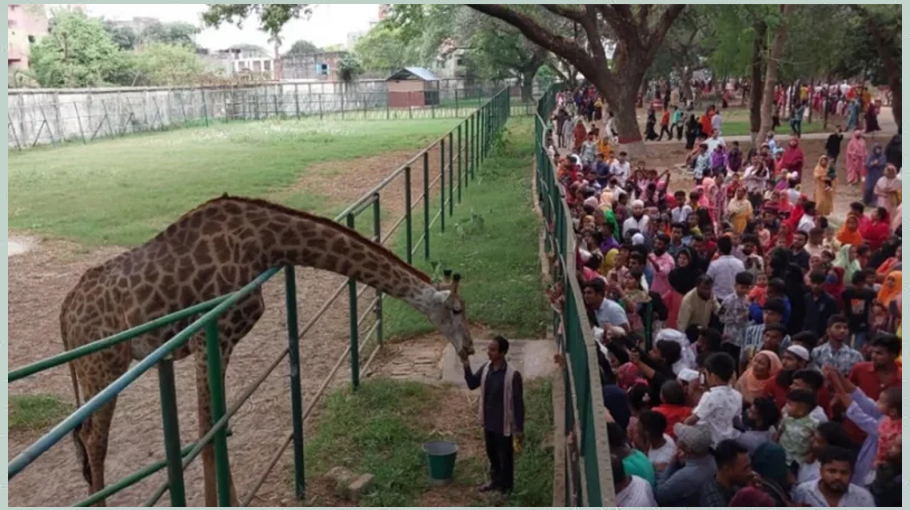
The Bangladesh National Zoo at Mirpur in Dhaka city and other zoos in the country have been running under the supervision of the Ministry of Fisheries and Livestock but without any law.
However, all the government-run zoos in the country, including the national zoo, will run under a new law titled ‘Zoo Act, 2023’. The initiative of enactment of the law has been taken in order to smoothly run the zoos and ensure facilities for the captive animals there.
The Zoo Bill, 2023 was passed in the Parliament on Wednesday (October 25, 2023). Fisheries and Livestock Minister SM Rezaul Karim moved the Bill in the House and it was passed by voice votes with Speaker Dr Shirin Sharmin Chaudhury in the chair.
The Zoo Bill, 2023 was passed in the Parliament aiming to make provisions for animal collection, rearing, welfare, treatment, breeding, conservation, control and zoo development, management, infrastructural facilities and other ancillary matters in government-run zoos.
The ‘Zoo Act, 2023’ has 28 sections. The law has been framed giving importance to fully follow the ‘Wildlife (Preservation and Security) Act, 2012’ or the regulations made under it in the case of wildlife collection in the zoos.
Director of Bangladesh National Zoo Dr Mohammad Rafiqul Islam Talukder said that although the zoos in the country have been operating under executive order for a long time, the zoos will now come under the new law. The ‘Zoo Act, 2023’ will play a vital role in the management of all zoos in the country, including the Bangladesh National Zoo in Dhaka, in a more beautiful and dynamic manner, he added.
As per the ‘Zoo Act, 2023’, any visitors of the zoo will face fines or imprisonment if they irritate and hurt any animals.
Tk. 2000 administrative compensation would be collected from such visitors for exasperating animals while two months of imprisonment and Tk. 5,000 will be imposed for injuring them or giving food without prior permission.
All the government zoos in the country will be run under it. Earlier, the Bangladesh National Zoo is managed through an advisory committee.
According to the law, if a visitor enters into the zoo without an entry fee, he will be charged an equivalent amount of the entry fee. Tk. 2000 compensation can be collected from that person considering the level.
As per the law, it will be an offence for any visitor to hurt or injure any zoo animal in any way, or to disobey the instructions of the curator or to give food without permission. For this, imprisonment for two months or a fine of Tk5000 or both will be given.
These crimes can be tried through mobile court.
The Bill allows the painless death of an animal in a zoo due to age-related physical disability or infectious diseases to save the life of another animal or to prevent the unbearable sufferings of an animal in the interest of public health.
According to the Bill, under no circumstances can an animal of the same species of the same sex be kept in a zoo without a specific reason.
No animal shall be separated or kept singly from animals kept in groups for natural reasons except under the direction of the Veterinary Officer.
Considering the nature of the animal, it should be confined or kept free in cages with minimal natural environment or facilities.
The infrastructure of animal cages should be made considering the natural behaviour of the animals, the safety of the people involved in raising the animals concerned and the visitors.
The government may designate one or more zoos to preserve any endangered species.
According to the Bill, the information obtained from regular examination of each animal according to the applicability to determine the extent or level of diseases-germs or parasites which are transmissible from animal to animal or to humans in the body of animals in zoos must be stored separately for each animal in the manner prescribed by the rules.
It said that no foreign species of wild animals can be bought, bartered, gifted or otherwise collected in any zoo without the approval of the government.