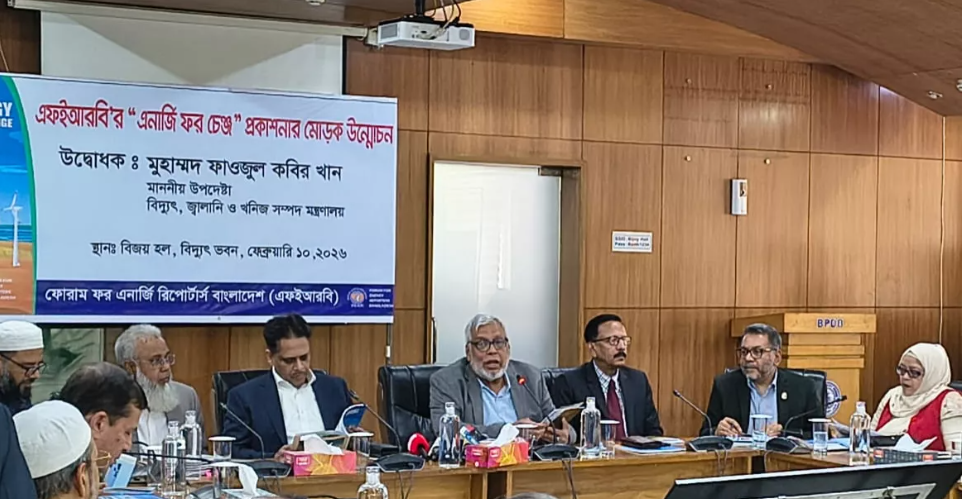
Clearing massive outstanding dues owed to foreign energy suppliers has been the biggest achievement of the interim government in the energy sector, Power, Energy and Mineral Resources Adviser Muhammad Fouzul Kabir Khan said on Tuesday, marking his last working day in office.
Speaking at a press conference at Bidyut Bhaban reviewing the interim government’s performance in the power and energy sector, the adviser said the sector had been burdened with huge liabilities when the government took office.
“The biggest challenge was settling the dues. Within days of taking charge, I was told that LNG imports would not be possible unless payments were cleared. Late payment fees were also crippling the energy sector. Considering everything, we decided that settling the dues would be our top priority,” he said.
According to the Energy and Mineral Resources Division, Petrobangla’s outstanding dues to various international oil and gas companies had stood at Tk 9,106 crore following the fall of the Awami League government on August 5, 2024. Between then and April 2025, Petrobangla paid energy bills worth Tk 35,700 crore, bringing its outstanding liabilities down to zero.
The adviser said cost optimisation was another major focus of the interim government alongside debt repayment. Through lower premiums in both spot and long-term LNG purchases, around Tk 1,500 crore was saved in the first six months, he said.
Petrobangla has signed new Master Sales and Purchase Agreements (MSPAs) with 24 companies, enabling LNG imports at reduced premiums. While the average premium stood at USD 1.28 per unit between July 2023 and August 2024, it has now dropped to 38 cents.
“Although we have little control over international gas index prices, significant savings were achieved through lower purchase premiums,” Fouzul said, adding that unnecessary expenditure in gas exploration drilling was also curtailed.
He said the government repealed the Speedy Supply of Power and Energy (Special Provision) Act, 2010, and conducted drilling under the Public Procurement Act and Rules (PPR), ensuring transparency and competitive pricing.
According to official estimates, significant cost savings were made in drilling five gas exploration wells in Bhola under BAPEX. Earlier projected costs of Tk 1,555 crore were reduced to Tk 907 crore.
However, Fouzul acknowledged that gas discovery from the drilled wells fell short of expectations. “The amount of gas discovered is insufficient compared to the depletion rate. Exploration is a time-consuming process. Even feasibility tests take more than six months, and the interim government did not have enough time to complete many initiatives.”
The adviser also said no major investment could be secured in the energy sector due to uncertainty over the government’s tenure. “Potential investors repeatedly asked about the government’s term. As we could not provide a clear answer, it was not possible to finalise major investment deals.”
No decisions were taken on coal-based energy projects, leaving those to the elected government, he added.
Fouzul also said document-related complexities of offshore bidding processes initiated during the previous government had been resolved.
Outlining recommendations for the next government, he stressed the importance of offshore bidding for oil and gas exploration in maritime areas, along with plans to establish land-based LNG terminals and a fourth Floating Storage and Regasification Unit (FSRU).
To address the country’s gas crisis, the energy division has recommended drilling 100 wells by 2028, which could add an additional 900 million cubic feet per day (mmcfd) of gas to the national grid.
On his final working day, the adviser said he would leave behind a written guideline for the next minister in charge. “I did not receive any roadmap when I took office. But the next person should know where to start and which direction to move in.”
Senior officials of power and energy-related agencies, ministry officials, and public and private sector stakeholders were present at the press conference.