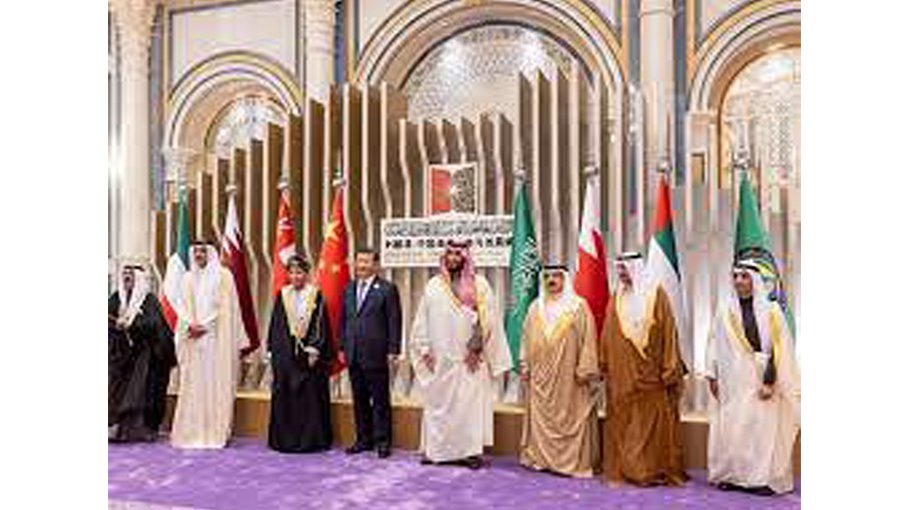
Chinese President Xi Jinping on Friday touted close security and energy ties with Gulf nations during summit meetings in Saudi Arabia that have highlighted tensions with Washington.
On the third and final day of his visit, Xi attended summits of the six-member Gulf Cooperation Council and a broader China-Arab leaders' meeting.
This is only Xi's third journey outside China since the coronavirus pandemic began. The discussions came one day after bilateral sit-downs with Saudi royals yielded a joint statement stressing "the importance of stability" in oil markets -- a point of friction with the United States. Washington has urged the Saudis to raise production.
"China will continue to firmly support the GCC countries in maintaining their own security... and build a collective security framework for the Gulf," Xi said at the start of the China-GCC summit.
"China will continue to import large quantities of crude oil from GCC countries on an ongoing basis," he said, also vowing to expand other areas of energy cooperation including liquefied natural gas imports.
Oil from Saudi Arabia alone accounted for 17 percent of China's imports last year, and last month Qatar announced a 27-year natural gas deal with China.
Earlier on Friday, a joint Chinese-Saudi statement spoke of "focusing on emissions rather than sources" in tackling climate change, the approach championed by the resource-rich Gulf monarchies.
Forty-six bilateral agreements and memorandums of understanding were announced on everything from housing to Chinese language teaching. Both sides are seeking economic and strategic benefits by deepening cooperation. However, few details were released despite a Saudi state media report on Thursday that about $30 billion in deals would be signed during Xi's visit. Riyadh and Beijing stressed "deepening relations within the framework of the comprehensive strategic partnership between the two countries, and reaching new and promising horizons", the statement said.
Xi's visit comes during tensions between Saudi Arabia and the United States, its long-time partner and security guarantor, over oil production, human rights issues and regional security.
It follows US President Joe Biden's trip to Jeddah in July, before midterm elections, when he failed to persuade the Saudis to pump more oil to calm prices.
Crown Prince Mohammed bin Salman, Saudi Arabia's 37-year-old de facto ruler, addressed both summits on Friday, promising "continuing Arab-Chinese cooperation to serve our common goals and aspirations of our peoples".
The Gulf countries, strategic partners of Washington, are bolstering ties with China as part of an eastward turn that involves diversifying their fossil fuel-reliant economies.
At the same time China, hit hard by its Covid lockdowns, is trying to revive its economy and widen its sphere of influence, notably through its Belt and Road Initiative which provides funding for infrastructure projects around the world.
Officials provided few details about the agenda for Friday's talks, but one potential area of focus was a China-GCC free trade agreement under discussion for nearly two decades.
Drawing those negotiations to a close would be "a matter of prestige for Beijing," said Robert Mogielnicki of the Arab Gulf States Institute in Washington.
"It's not as simple for the GCC states, which seem to be more invested in advancing bilateral ties and are engaged in varying degrees of regional economic competition with their neighbouring member states."
A breakthrough on the trade pact could help Saudi Arabia, the Middle East's biggest economy, diversify its economy in line with the Vision 2030 reform agenda championed by Prince Mohammed.
Beijing's foreign ministry has described Xi's trip as the "largest-scale diplomatic activity between China and the Arab world" since the People's Republic of China was founded.
The visit earned a rebuke from the White House, which warned of "the influence that China is trying to grow around the world". Washington called Beijing's objectives "not conducive to preserving the international rules-based order".