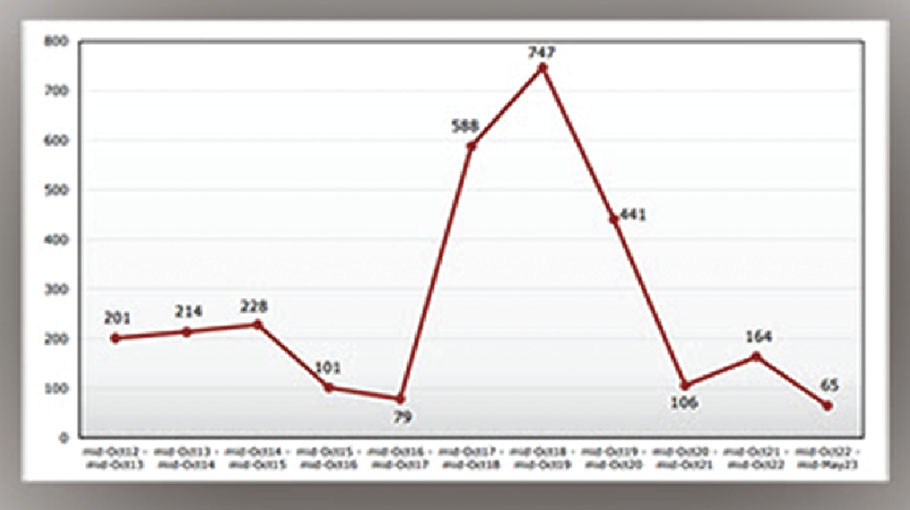
The WTO Director-General’s mid-year report on trade-related developments shows that WTO members continued to facilitate imports and generally exercise restraint in the use of trade-restrictive measures from mid-October 2022 to mid-May 2023.
However, while the number of export restrictions on food, feed and fertilizers has come down substantially, many such measures remained in place, contributing to supply uncertainty and price volatility.
Director-General Ngozi Okonjo-Iweala urged members to work together to deliver results at the 13th Ministerial Conference (MC13) that strengthen the WTO and ensure trade continues to foster growth, resilience and prosperity.
Speaking at the launch of the report, DG Okonjo-Iweala said: “The fact that WTO members have been taking more steps to facilitate imports illustrates how trade is a valuable tool for pushing back against inflationary pressures.”
Pointing to the introduction of export restrictions on food, feed and fertilizers since the start of the war in Ukraine in February 2022, DG Okonjo-Iweala noted that several such restrictions have been phased out.
While the reduction is a “welcome step” in the right direction, “it also means we still have quite a way to go,” DG Okonjo-Iweala said.
“Once again let me call on members to roll back these export restrictions, which contribute to making food prices more volatile — and therefore to making life harder for poor people around the world. Keeping food moving around the world is especially important now in light of the recent termination of the Black Sea Grain Initiative, which will make it harder for grains from that region to reach international markets. ”
The report, presented to members at a Trade Policy Review Body meeting on 27 July, arrives at a time when the global economy continues to be affected by multiple crises, including the continuing war in Ukraine, events related to climate change, high food and energy prices, inflation and the lingering ramifications of the COVID-19 pandemic.
The report indicates that the pace of implementation of new export restrictions by WTO members has increased since 2020, first in the context of the pandemic and subsequently with the war in Ukraine and the food security crisis. The WTO Secretariat's ongoing monitoring shows that as of 14 July 2023, out of the 104 export-restrictive measures on food, feed and fertilizers introduced since the start of the war in Ukraine in late February 2022, 59 are still in place, covering roughly USD 24.5 billion of trade (down from 63 in mid-May 2023).