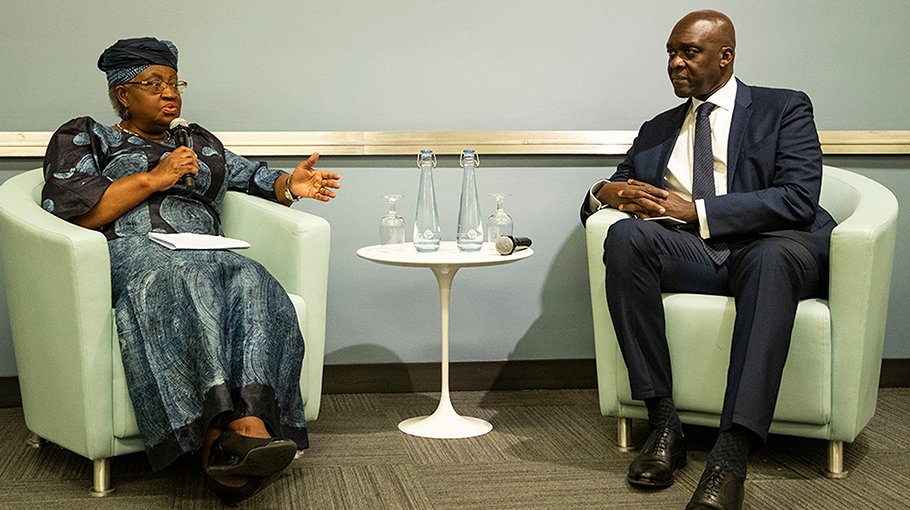
A joint publication on “Trade Finance in West Africa” was launched by Director-General Ngozi Okonjo-Iweala and International Finance Corporation (IFC) Managing Director Makhtar Diop on 12 October in Washington DC.
Using the results of a survey of banks in the four largest economies of the Economic Community of West African States (ECOWAS) — Côte d’Ivoire, Ghana, Nigeria and Senegal — the publication assesses the shortfall in trade finance in these countries. It also outlines ways of removing obstacles to credit facilities and of unleashing the trade potential of the region.
The publication is the result of a joint commitment of the two chiefs in 2021 to enhance cooperation and launch a study on barriers and opportunities to reduce the trade finance gap in West Africa.
In his opening remarks at the launch, Diop said: “Global trade finance gaps increased during the pandemic. Supply chain pressures, inflation, and the war in Ukraine have only exacerbated the problem. This study couldn't be timelier. There is enormous potential for an economic boost in West Africa by harnessing intra-Africa trade, but we will need coordinated action from governments, the private sector, and multilaterals to build the capacity of local lenders and improve access for SMEs.”
The publication finds that, despite recent growth, ECOWAS4 countries' trade is vastly constrained by limited and costly trade finance, notably high rejection rates, expensive offerings, low coverage and high costs of trade. As a result, trade finance supports on average only 25% of trade in these countries, Diop noted.
WTO DG Okonjo-Iweala, while addressing, lauded the rich information collected by the study. Underlining the critical role of trade finance in making trade happen, she noted the low coverage of trade finance in ECOWAS4 countries.
“The share of trade supported by trade finance in the region is only 25%, lower than the African average, estimated to be 40% and the global average of 60% to 80%. That is quite troubling,” she said.
She also highlighted the high rejection rate (25%) for trade finance requests in the region, with small businesses disproportionately affected. Combined with high costs, it explains why a lot of importers and exporters give up even asking for trade finance, she said.