The 2024 UN climate conference, commonly known as COP29, is being held in Baku of Azerbaijan from November 11, but any representatives from many of the world’s biggest polluters are still absent in the climate summit. The world summit will continue till November 22.
Professor Dr. Ahmad Kamruzzaman Majumder, dean of Faculty of Science at Stamford University Bangladesh and chairman of Center for Atmospheric Pollution Studies (CAPS); sent the information to The Bangladesh Post on Wednesday (November 13).
The leading environmentalist of Bangladesh and renounced expert on air pollution is now staying at the venue of COP29. He sent a writ-up to this correspondent tiled ‘Lack of Significant achievement in day three of COP29’ where the information was provided.
According to Professor Dr. Ahmad Kamruzzaman Majumder, many of the world’s biggest polluters are not sending any representatives to this year's climate summit. The COP29 meeting began but the leaders of the 13 largest carbon dioxide-emitting countries will not be there. The world's biggest polluters and powerful economies, China and the United States, are not sending any representatives. These countries are the world's four most populous countries, home to more than 42 percent of the world's population.
Of course, there may be some logical reason why the leaders of powerful countries will have to stay in Brazil next week for the G20 meeting.
In addition, the recent US elections, natural disasters and personal illnesses have also kept many leaders away.
In the past, climate summits have often featured the presence of many big names from different countries, including football stars. However, they were not seen at this year's summit. New data released at the COP29 suggests that global warming emissions from fossil fuels — coal, oil and gas — are projected to be about 8 percent higher in 2024 than in 2015, the year the Paris climate agreement was signed. But the COP says emissions will fall by 43 percent by 2030. The world’s nations agreed to phase out fossil fuels in favor of renewables at COP28 in Dubai in 2023. The decision was hailed as a breakthrough because none of the previous 27 summits had called for curbs on the primary cause of global warming. But there is no sign of moving away from burning fossil fuels.
The world’s nations pledged a year ago that 2024 would set another record for global carbon emissions, with no end in sight yet. 1.5 degrees Celsius. The world still has a chance to meet temperature targets and limit the "increasingly dramatic" climate impacts on people around the world.
Leaders from some of the world's most climate-sensitive countries have put on a powerful show. The two-day World Leaders Summit is being attended by heads of state from several small island states and more than a dozen African countries. Developing-country leaders told a session on Tuesday that the climate fund "needs trillions of dollars to address the challenges of climate change, not for war, but for the environment."
The G77 and China, a coalition of developing countries, have proposed a new target for the climate fund of $1.3 trillion and have called for a draft before negotiations on a new Joint Quantitative Goals (NCQG) on Climate Finance. Reverend Fletcher Harper of Greenfaith, a faith-based environmental activism group, responded by calling fossil fuels "literally the highway to hell for billions of people and the planet."
Sweden has pledged $20 million to the Loss and Damage Fund. British Prime Minister Keir Starmer has announced a new target of cutting emissions by 81% by 2035 compared to 1990 levels. The target is to reach 100% clean energy supply by 2030. “There is no national or economic security without climate security,” he said.
President of Azerbaijan Ilham Aliyev slammed Armenia, Western media, climate activists and critics of his country’s rich oil and gas history and trade, saying “we are victims of coordinated propaganda.”
Azerbaijan's president kicked off a two-day address to world leaders, calling their words hypocritical, saying the United States is the world's largest oil consumer.
He added that it was unfair to call Azerbaijan a petrostate because it produces less than 1 percent of the world's oil and gas. He described oil and gas as "gifts from God," like the sun, wind and minerals. Aliyev said he would push his country to move away from fossil fuels and toward green and clean energy.
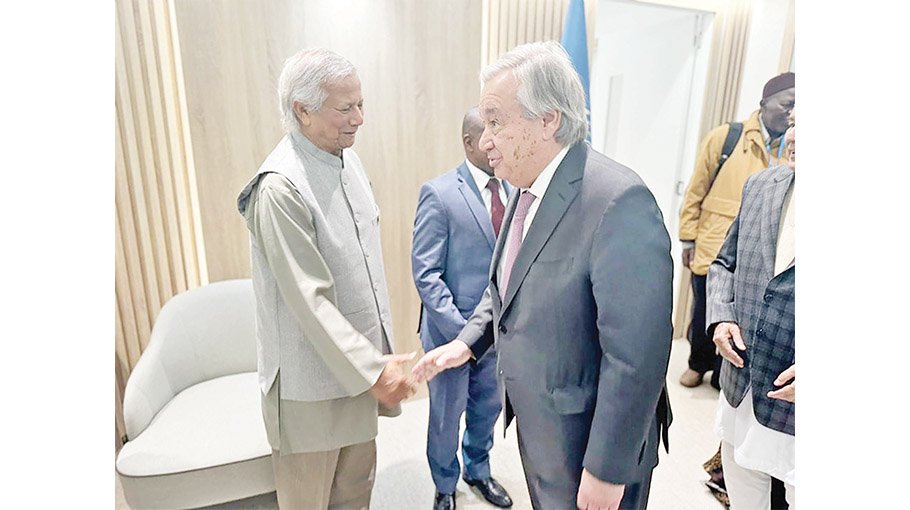
UN Secretary-General Antonio Guterres has told world leaders that this will definitely be the hottest year on record. But Guterres expressed hope, saying, “The clean energy revolution is here. No group, no business, no government can stop it.”
UN officials said that when Trump was first elected in 2016, the world had 180 gigawatts of clean energy and 700,000 electric vehicles, which has now increased to 600 gigawatts of clean energy and 14 million electric vehicles. Nations are negotiating huge sums of money, ranging from $100 billion to $1.3 trillion a year. “This money is not charity, it is an investment. Developing countries should not be sent back empty-handed from Baku,” Guterres said.
Joining the climate conference, Chief Adviser Professor Dr Muhammad Yunus said that Bangladesh has given top priority to water management to prevent floods and make the best use of water to boost the country's economic growth.
He added, "Water is our main environmental issue. We need to manage water in a way that supports nature." The Chief Advisor on Wednesday called for the creation of a South Asia grid for hydropower generated in Nepal and Bhutan.
Stating that Bangladesh, India, Nepal and Bhutan should think about creating a South Asia grid, Professor Yunus said, "Bangladesh can easily import hydropower from Nepal because it is only 40 miles away from Bangladesh. Nepal's hydropower will also be easily accessible."
He also spoke about the main topic of COP29 and Bangladesh's current position on carbon credits. He presented his dream of three zeros to the conference and said, “Each young person will grow up as a three zero person — zero net carbon emissions, zero wealth concentration, through building social businesses only, and zero unemployment by turning themselves into entrepreneurs. Each person will grow up as a three zero person, and remain a three zero person all his/her life. That will create the new civilisation.”
Spanish Prime Minister Pedro Sanchez has noted that the severe flooding that hit his country last month would have been less likely and less severe without the effects of climate change. "We must ensure that the number of natural disasters does not increase," he said. "We must now implement what we promised to do seven years ago in Paris."
The main focus of this year's discussion in the conference is climate finance, where rich countries will compensate poor countries affected by climate change, provide money to transition their economies away from fossil fuels to green and clean economies, and help with adaptation.
However, rich countries are trying to minimize the importance of COP by stalling on this important financing discussion. They are trying to avoid their responsibility to pay for fund.
Overcoming all obstacles and dangers, collecting sufficient loss and damage funds and distributing them equitably among the countries affected by climate disasters has now become a very challenging task. We must meet this challenge and ensure climate finance. In addition, only if we can reduce carbon emissions and phase out fossil fuels or stop the use of fossil fuels by targeting the Paris Agreement can we move towards the success of preventing climate change.