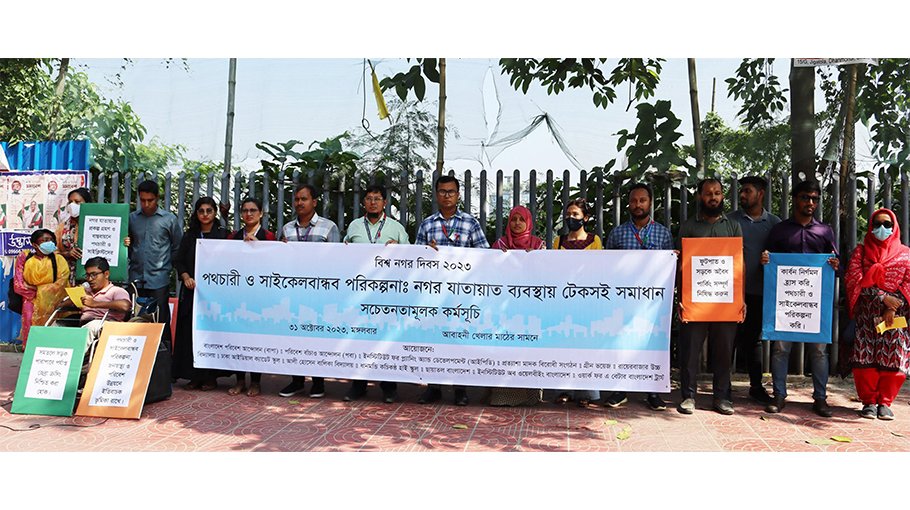
The World Cities Day-2023 was observed in Bangladesh as elsewhere in the world on Tuesday with the theme ‘Financing sustainable urban future for all’. The World Cities Day is observed annually throughout the world on October 31.
Bangladesh Paribesh Andolan (BAPA), Poribesh Bachao Andolon (Poba- Save the Environment Movement), Work for a Better Bangladesh Trust (WBB Trust) and some other organisations observed the day in Bangladesh amid various programmes.
Speakers at awareness event on the day said that 60 per cent of people in Dhaka city commute on foot, while only 5-7 per cent of people in the city own private cars. Despite that, various projects centered on private cars are being adopted and infrastructure is being built in the urban transport plan. There is no alternative to ensuring a pedestrian and cycle-friendly environment in order to build a sustainable and inclusive city and meet the commuting needs of the majority of people, they added.
BAPA, Poba, WBB Trust, Institute for Planning and Development (IPD), Green Voice, Institute of Wellbeing Bangladesh and some other organisations jointly arranged the awareness programme titled ‘Pedestrian and Cycle Friendly Planning: Sustainable Solutions in Urban Transport System’ in Dhaka city.
Director of WBB Trust Gaous Pearee chaired the event, while assistant project officer Md. Mithun moderated it. Project manager of the organisation Naima Akter, founder of Dhaka Ideal Cadet School MA Mannan Monir and others spoke on the occasion.
Speakers said that the detailed area plan lays emphasis on building an equitable and inclusive city. To implement this goal, it is necessary to adopt and implement such projects, where the majority of the people of the city will benefit. Pedestrians walk more than one crore times in the capital every day.
According to the study, the allocation for one crore pedestrians is only 0.24 percent. On the other hand, despite the fact that nearly 2 lakh people travel by bicycle, no effective steps have been observed to ensure cycle-friendly travel. Cyclists have not benefited from provision of isolated cycle lanes but lack of route network and cycle parking facilities.
The speakers also said that Dhaka city is facing continuous challenges due to lack of planned urbanization. Along with the increase in population, Dhaka has become a city of traffic congestion due to the increase in traffic demand and mechanical vehicles in the city. Along with this, the fuel cost, pollution and road accidents have increased and the negative impact on the environment and public health has increased manifold. Pedestrian- and bicycle-friendly transit systems meet commuting needs as well as daily physical activity needs and reduce fuel consumption and carbon emissions, which contribute positively to both the environment and public health. That is, building livable, sustainable, and inclusive cities requires curbing private cars as well as building pedestrian and bicycle-friendly cities.