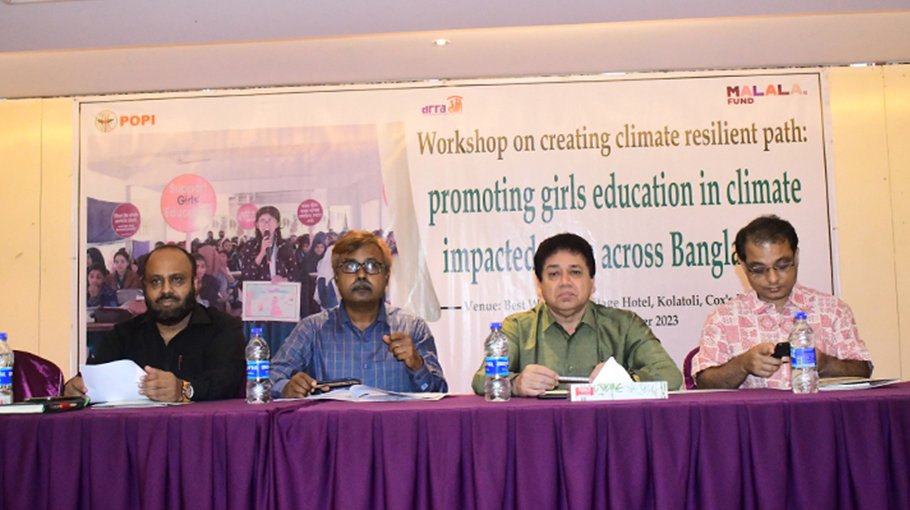
A workshop was held in the Cox’s Bazar District to promote girls& education in the climate vulnerable areas. POPI and DRRA as members of the Bangladesh Education Champion Network (ECN) jointly organized the workshop at the Best Western Heritage Hotel, Kolatoli, Cox’s Bazar on Tuesday.
The workshop served as a vital platform for stakeholders from Cox’s Bazar and neighboring districts to convene and address the challenges surrounding girls’ education in the face of a changing environment.
During the workshop’s thematic presentation, alarming statistics highlighted the growing issue of child marriage within impoverished families in Cox’s Bazar, particularly during and after disasters.
This alarming trend is exacerbated by the adverse effects on people’s livelihoods. Despite the government’s earnest endeavors to combat child marriage, the region continues to grapple with a significant child marriage rate. A 2021 survey by the Coast Foundation revealed a substantial increase in child marriage rates in Cox’s Bazar District.
Eidgaon upazila witnessed an 82 percent increase, while Ukhiya upazila experienced a 75 percent rise. Similarly, there was a 72 percent increase in Ramu, 66 percent in Teknaf, 61 percent in Moheshkhali, 54 percent in Qutubdia, and 51 percent in Cox’s Bazar Sadar. Chakaria and Pekua also saw rises of 32 percent and 26 percent, respectively.
In today’s rapidly changing world, the impact of climate change on girls’ education has become a pressing concern, particularly in countries like Bangladesh.
The workshop provided a unique opportunity for participants to explore practical approaches to empower girls in effectively addressing climate-related challenges.
Principal of Cox’s Bazar Govt. Mahila College Professor A.K. Faruque Ahmed, Cox’s Bazar Sadar Upazila Nirbahi Officer Mohammad Zakaria, Cox’s Bazar District Education Officer Md Nasir Uddin and In-Country Representative of Malala Fund Bangladesh Musharraf Tansen were present as guests while Executive Director of POPI Murshed Alam Sarker presided over the workshop.
The workshop drew active participation from individuals representing government bodies, non-governmental organizations, educational institutions, and development partners.
Through various scheduled sessions, participants engaged in the exchange of valuable knowledge and shared their firsthand experiences, ultimately proposing practical solutions to the challenges facing girls’ education in climate-affected areas. Participants unanimously expressed the need for
urgent attention and collaborative efforts to address the vulnerabilities in girls’ education brought about by climate change.
They underscored the importance of working together and implementing innovative programs to pave the way for a sustainable future.