Bangladesh has ‘truly’ seen a ‘significant difference’ in keeping women at the centre of all economic and social activities.
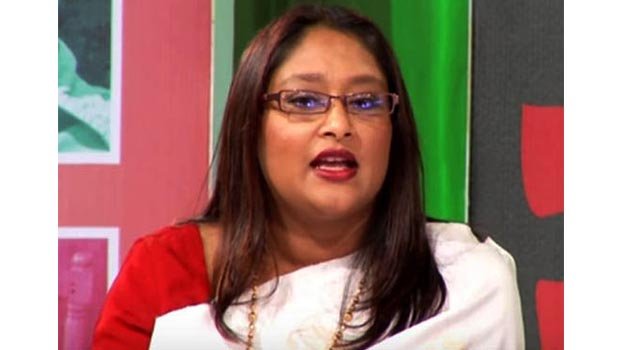
“And it is because our Prime Minister is a woman,” Saima Wazed Hossain said, speaking at an international conference as an advisor of the WHO’s director-general.
She said the system that “has been in place and the priority that has been given to girls’ education, girls’ healthcare and all of them comes in tremendous use during this crisis”.
She highlighted some policies including those related to mental health, women and child health and said the pandemic also gave opportunity to Bangladesh like many other countries to learn what in the system does not work and refine it.
Saima, daughter of the prime minister, was speaking at an international webinar on the ‘impact of the Covid-19 Pandemic on Women & Girls’ organised by the Inter Press Services (IPS) UN Bureau.
Catherine Bertini, distinguished fellow of global food and agriculture at the Chicago Council on Global Affairs, Yasmine Sherif of Education Cannot Wait (ECW), Josefina Stubbs of Enel Green Power, Italy, Susan Papp of Women Deliver, and Doaa Abdel-Motaal of the Guarini Institute of Public Affairs in Rome, Italy were her co-panelists.
The all-women panel of international thought leaders discussed and made recommendations for consideration by all sectors of society, from governments to international organisations and to civil society organizations, in order to respond to the needs of women and girls during and after this public health crisis, with examples of actions already taken and what more needs to be done.
Saima, known by her nickname Putul in Bangladesh, is a US licensed school psychologist. She is currently an advisor to the Director-General of WHO on autism and mental health, member of WHO’s Expert Advisory Panel on Mental Health, and chairperson of the National Advisory Committee on Autism and Neuro-developmental Disorders in Bangladesh, and Shuchona Foundation.
She spearheads mental health campaigns across the world as a WHO expert and is credited to bringing the neglected issue to the fore in South Asia by organising the first-ever regional conference in Dhaka in 2011.
The United Nations adopted several resolutions based on her proposals. WHO also bestowed the ‘Excellence in Public Health Award’ upon her in September 2014, noting that ‘she put autism on WHO’s map’.
Due to her steps, the Bangladesh government also put priority on the mental health issues in recent years.
Saima highlighted the community healthcare system in Bangladesh, one of the key policies of the prime minister, which is managed by women and said those have been kept active during the lockdown.
“And that was one of the first decisions that was made and again it was the woman who was making the decision.”
She said food security for women and children were the priority issues that could be ensured as the relief fund went directly to women “as easily accessible as possible using the infrastructure of our money transfer system over the phone”.
Despite school closure, education was made available by using the parliament television channel, she said, adding that everybody is not accessing this, but the fact is it is kind of a procedure which is made available.
On women’s health, she said the government is making sure that deliveries are safe. “We have been working for the last many years to make sure that deliveries happen in healthcare centers rather than home births and safely.
“We are training healthcare workers to provide that. The system is not closed (in lockdown)... Maternal care and delivery care it’s all priorities because the woman is in power and she is making the decision.”
She said Bangladesh was also “fortunate because we had a lot of safety nets already available for women.”
Saima, however, said: “Our system may not be completely perfect or may not meet all of the standards. Of course, we have challenges.”
“The problem in a crisis situation is that you cannot think from a point of view of what you can do. You have to have those priorities set first.”
She said: "During the pandemic, we knew one of the core issues is going to be food shortage and Bangladesh is agriculture-based."
“Even we had civic leaders, political leaders going to the field and they have been there not just to help farmers – this is something of priority.”
Saima said the crisis also created an opportunity for Bangladesh to learn.
"For example," she said, "for a long time we were wondering how to get medical professionals to learn through the use of technology. That has already been put in place, but has not been utilised for that purpose."
“Implementing that using the crisis as an opportunity to refine it and make it work better,” she said.