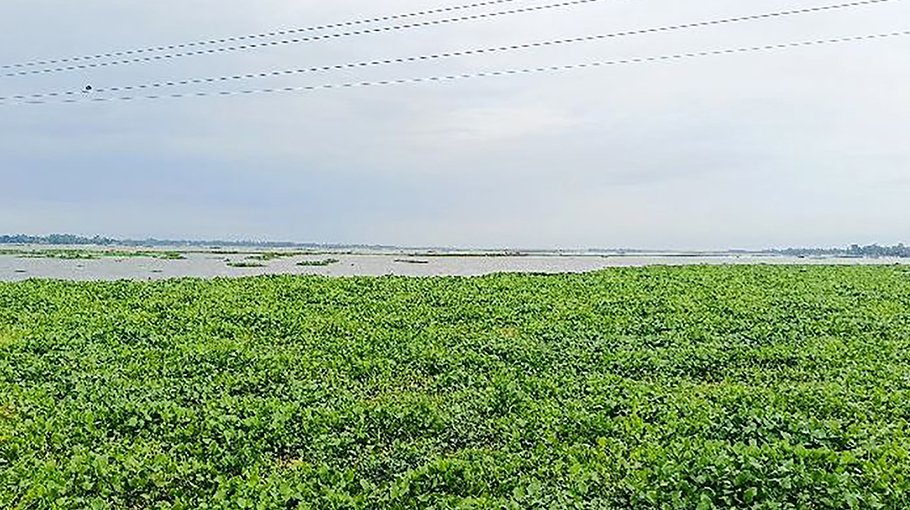
The farmers in Natore and Sirajganj district are worried about the cultivation of Rabi crops as almost 200,000 hectares of agricultural land in Chalan Beel remain submerged in water.
This year, Chalan Beel was flooded twice and the water that entered the Beel has not receded yet. If the water does not drain soon, the Rabi crop cultivation will be at risk. According to the agricultural officers the middle of the November is the full season for cultivating Rabi crop. Rye-mustard, garlic, onion, coriander, and black cumin are cultivated during this season. Potato, winter vegetables, khesari, peanut, wheat and corn are cultivated as well. If the water does not recede from the Beel within the next 15 days, the Rabi crop cultivation might be hampered.
According to the information from the Department of Agricultural Extension the largest amount of mustard is cultivated in the Sirajganj part of Chalan Beel. Mustard is cultivated on at least 50 agricultural plots within Chalan Beel, spreading across eight upazilas of the district including, Tarash, Ullapra and Shahjadpur. Last year, only mustard was cultivated in 85,170 hectares of land in the district. This is year, the target was set to cultivate mustard in 90,000 hectares of land and cultivate Rabi crop in 56,010 hectares of land in the district. Moreover, mustard was cultivated in 10,185 hectares of land in six upazilas of Natore district including Gurudaspur, Singra and Baraigram upazilas. The target was set to cultivate mustard in 14,576 hectares of land in the district this year. Along with that, Rabi crop is to be cultivated in 40,000 hectares of land.
The farmers said the fertile soil of Chalan Beel is suitable for Rabi crop cultivation. They see a bumper yield of mustard, garlic and onion every year. The farmers usually start cultivating Rabi crop at the beginning of November. However, the farmers are concerned about Rabi crop cultivation being hampered this year as the flood water that enters the Beel intermittently has not receded yet.
Farmers Azahar Ali, Farid Uddin and Alam Sarker said Atrai, Gumani, Besani, Nandakuja and Boral Rivers flow through the Chalan Beel. During the rainy season, these rivers overflows and inundate the Beel. Then again, the water goes to Jamuna River from this Beel through these rivers. However, the water in the Chalan Beel is receding slowly due to various obstruction including obstructing water flow to illegally catch fish in the river, indiscriminately excavating for pond, river encroachment and accumulation of water hyacinths. As a result, the farmers cannot start Rabi crop cultivation even though the season has already come.
The sources said Rabi crop is cultivated at least in hundred points across two districts within the Chalan Beel including Bilsha, Halti, Makorson, Ruhai, Pipla, Kaliya, Haripur, Jamtoiler Chora, Dholeshwar, Koijuri, Subarnasara, Baniyagati, Rasulpur Pagla-Chhagla, Dholeshwar Jobkhali and Soguna. However, most of these areas are still submerged in water, creating a risk for Rabi crop cultivation. Deputy Director of Natore Department of Agricultural Extension, Md Abdul Wadud and Deputy Director of Sirajganj Department of Agricultural Extension, AZM Ahsan Shahid Sarker, said although the Rabi crop cultivation season has begun, the farmers are yet to start their work as the agricultural lands are still under water. If the water does not recede within 15 to 20 days, the Rabi crop cultivation might be hindered.