The UK based Scholars Power Limited and Enduring Energy Limited of Bangladesh undertake a joint initiative to establish ‘’waste to energy recovery plant’ for disposing the solid waste in an efficient manner as well as generating low cost renewable energy in Bangladesh.
Actually, the environment especially air and water are polluting due to lack of effective solid waste disposal system, posing serious threat to lead a healthy life. Considering this, such kind of initiative is really praiseworthy to consider the protective measure of nature from pollution.
In this connection, the Rural Development and Co‐operatives, the authorities of SirajganjPourashava signed an agreement for establishing a Municipal Solid Waste (MSW) Disposal Facility by producing Solid Recovered Fuel (SRF) plant with UK based Scholars Power Limited and its associate Enduring Energy Limited of Bangladesh recently.
As per the agreement, Scholars Power Limited will establish the MSW to SRF production plant in collaboration with its associates with 100 percent own finance and no investment or subsidy from the Government of Bangladesh for the safe and eco‐friendly disposal of the MSW and recovering renewable energy from it by producing SRF.
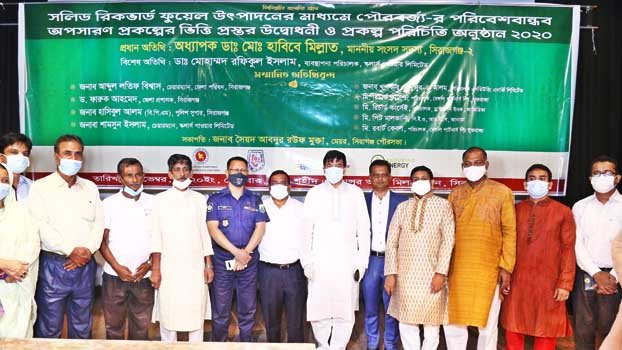
However, the ground breaking ceremony of the project along with a detailed introduction of the project to the city dwellers took place in the Shaheed M. Mansur Ali auditorium in the city recently.
Industry insiders said, safe and eco‐friendly disposal of the MSW is an expansive process. In England, the authority pays an amount of US$ 65 to US$170 equivalent amount of money to dispose of per ton MSW to the service providers, which is roughly BDT 5,500 to BDT 14,500.
In this Sirajganj MSW Disposal and SRF Production facility, Scholars Power Limited will provide this service at a free of cost which will recover its investment from the sales of the produced SRF for a twenty years period of time. Such activities would help delivering a clean and green Sirajganj.
Landfills are one of the primary sources of water, air and soil pollution as well as the breeding ground for insect and animal borne diseases. Whatever we are throwing away today as waste or garbage is coming back to us by decomposing in the ground, evaporating in the atmosphere and mixing in the ground water.
The organic fraction of the MSW produces methane at the time of decomposition which is a 30 times more damaging gas comparing to carbon dioxide for the atmosphere. It is also the primary
Breeding ground of mosquitoes and flies and source for diseases carried by those, as well as rats, cats, dogs and other animals that scavenges in the landfills. The worst of it is, when there is not sufficient space in the landfills, the authorities or the local people set fire in the MSW which release a huge number of poisonous gas including Dioxin and Furan that immediately cause long term damage to human health.
In a seminar held by World Bank on 21‐Oct‐2020 on the topic “World Bank Flagship study on Air Quality Management in the South Asia region (SAR)” where the Additional Secretary of Environment Ministry of Bangladesh, Head of Air Pollution Control of Department of Environment of Bangladesh, leading scholars and professors on the subject of the universities, representatives of World Bank and United Nations shared their new findings for the air pollution sources, it came out shockingly that now a days, MSW is contributing approximately 15% of the present air pollution in the country. This is extremely dangerous. This is sign of possibility of seeing a completely damaged future generations if actions are not taken immediately, if possible from right now.
Until now, approximately 35% to 40% of the daily generated waste is being collected by the authority due to the shortage of space in the landfill. As soon as the plant goes operational, all 100% of the daily generated waste will be collected and SRF will be produced from it. Therefore, not only the district will become clean and green, the produced SRF will also be used to substitute coal that will significantly reduce pollution made from coal usage.