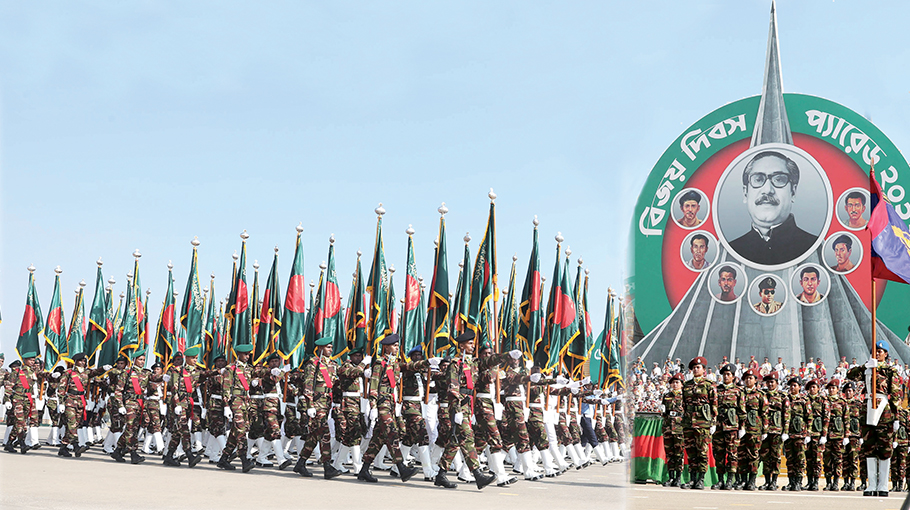
The nation celebrated its 50th anniversary of Victory Day with a vow to build a non-communal and prosperous Sonar Bangla.
In view of this Prime Minister Sheikh Hasina on Thursday administered an oath to the nation to build the country as a developed, prosperous and non-communal “Sonar Bangla” being imbued with the ideology of the Father of the Nation Bangabandhu Sheikh Mujibur Rahman.
On December 16, 1971, Bangladesh was born as an independent country under the leadership of Sheikh Mujibur Rahman at the cost of the lives of three million people and the honour of 200,000 women.
In the first phase of the Victory Day programme President M Abdul Hamid at first paid glowing tributes to the martyrs of the 1971 Liberation War by placing a wreath at the National Memorial in Savar on the outskirts of the capital early Thursday.
After the President, Prime Minister Sheikh Hasina paid rich tributes to the martyrs of the Liberation War by placing a wreath at the National Memorial.
Prime minister Sheikh Hasina also paid homage to Sheikh Mujibur Rahman on Thursday morning on the occasion.
Smartly turned out contingents drawn from the Bangladesh Army, Navy and Air Force and other security forces presented the state salutes on the occasion.
Jatiya Sangsad Speaker Dr Shirin Sharmin Chaudhury, Chief Justice Syed Mahmud Hossain and leaders of different political as well as socio-cultural organisations and mass people placed wreaths at the National Memorial.
Leaders of Awami League, members of Bir Sreshthos, wounded freedom fighters and Bir Muktijoddhas, foreign diplomats, and different political and social organisations and people from all walks of life also paid tributes to the martyrs of the Liberation War.
The celebration of Victory Day this year added a new dimension as the day was set to be celebrated coinciding with the two significant events -- birth centenary of Sheikh Mujibur Rahman and the golden jubilee of the country’s independence.
Marking the two celebrations, Father of the Nation Bangabandhu Sheikh Mujibur Rahman’s Birth Centenary Celebration National Implementation Committee outlined a three-day special programme titled ‘the Great Hero of the Great Victory’ at the South Plaza of the Jatiya Sangsad in the city from December 16 to 17.
At the second session of the programme, a discussion programme was held with Prime Minister Sheikh Hasina in the chair.
President M Abdul Hamid was present as the chief guest while his Indian counterpart President Ram Nath Kovind was present as the guest of honour at the discussion.
Besides, Prime Minister Sheikh Hasina administered an oath to the people of the country on a live broadcast programme.
As part of the victory day programmes, Bangladesh staged an extraordinary Victory Day parade with President M Abdul Hamid taking the salute while his Indian counterpart Ram Nath Kovind joined the ceremony along with Prime Minister Sheikh Hasina.
Military contingents from three foreign countries - India, Russia and Bhutan - joined the parade, the first-ever participation of foreign troops in a Victory Day ceremony since Bangladesh's independence alongside Bangladesh forces.
The contingents of the three countries took part in the march-past while their own military music bands as their officers led the troops and saluted the Bangladesh president.
President M Abdul Hamid, also the supreme commander of the armed forces, took the salute at the ceremony from a saluting dais while Kovind, as the guest of honour, witnessed the event along with Sheikh Hasina.
The parade was organised and conducted by the 9th Infantry Division of Bangladesh Army under the supervision of the Armed Forces Division with the directives of the Ministry of Liberation War Affairs.
The day was a public holiday.
On the occasion, a festive mood remained all over Bangladesh and in the mind of its people. Various socio-cultural programmes were held in the capital Dhaka and elsewhere in the country. All the embassies, missions of Bangladesh abroad also celebrated the occasion in befitting manners.
Thousands of people came out on the streets and at different places, including zoos, parks, museums and other public places. City streets were decorated with miniature national flags and colourful festoons, and the illumination of important buildings and establishments, roads and street islands at night.
National dailies brought out special supplements on the occasion while Bangladesh Postal Department released memorial postage stamps.
The state-owned and private televisions and radios broadcast special programmes highlighting the Liberation War.
Marking the day, improved diets were served to inmates of jails, hospitals, orphanages and vagrant homes across the country.