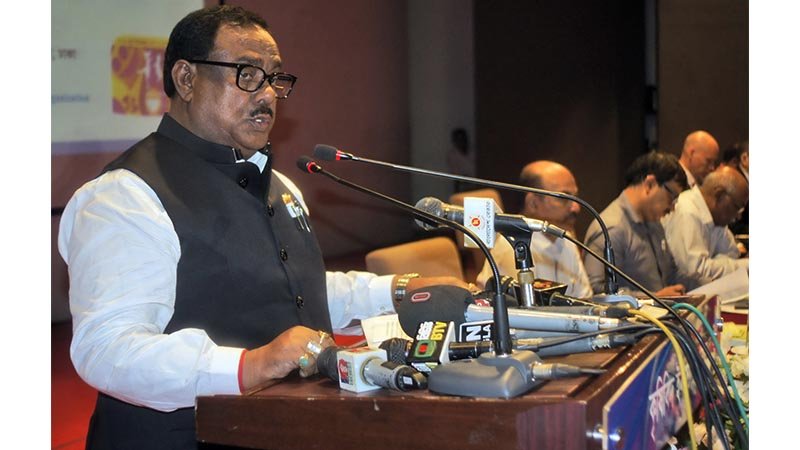
Different vested quarters at home and abroad are plotting to destabilise the country’s harmony through spreading propaganda only to disrupt the ongoing development work, speakers said on Wednesday. Food Minister Sadhan Chandra Majumder, MP, Md. Ashraf Ali Khan Khasru,MP, State Minister, Ministry of Fisheries and Livestock made the comment at Krishibid Institution Bangladesh (KIB) at its auditorium at Khamarbari in the capital.
Besides, a section of unscrupulous traders, in association with these vested quarters, is also active to make the country’s kitchen market volatile through hiking the prices of essential commodities. System abuses, such as misuse of plant and animal pharmaceuticals, migration in farming, illegal fisheries, mono-cropping, and mismanagement of plastic waste, have clearly shown adverse sequences on the food system, now being seen in terms of vast deforestation, soil quality deterioration and erosion, climate change, loss of biodiversity, water and soil contamination, desertification, flooding, and increased greenhouse gases, to name just a few. Each year, 18.7 million acres of forests in the world, mainly in the African and southeast Asian regions, is lost.
The consequences from climate change can be seen as the increase in natural hazards and their severity. The number of hazards in the Asia Pacific region during 2009-2017 was higher than those during 1992-1999 by 42%. Meanwhile, the cost of damage per disaster in 1990 to 2016 increased from 15 to 40 billion US dollars.
Dr. Visith Chavasit, director at the Institute Mahidol University in Thailand said, in 2013, Center for Disease Control, US stated that each year in the US, at least 2 million people get an antibiotic-resistant infection, and at least 23,000 people die. Due to these adverse conditions, food safety, food productivity, and environmental biodiversity are certainly being affected, which can decrease the quality, quantity, and diversity of the food entering the food value chain.
On the other end of the food system, the environment in which food is distributed and consumed, or the so-called “food environment,” is another significant component of the food system. He said, a shorter logistic chain within the food system overall has less impact on the environment and is a more efficient mechanism of food utilization. A short logistic chain utilizes less carbon for food processing, transportation, distribution, and consumption.
Per capita, people in developed countries can create food waste during retailing and consumption up to 300 kg. In 2015, the mismanagement of plastics created 140 million tons from packaging. The logistic chain can be shortened and made more fruitful if the foods are produced and consumed in the community or nearby areas.
The new Agriculture Theory of Thailand’s King Rama IX is a good example where a priority is placed on households producing a variety of foods for their own consumption, before selling the surplus to nearby communities. Regarding the guideline, a land can be divided into 4 parts for different purposes water and fish pond, staple food production, fruit trees and living and backyard animals of 30,30,30 and 10% of the area, respectively.
Ashraf Ali Khan Khasru said “balanced nutrients” should include optimum energy distribution from macro nutrients 55-75% from carbohydrates, 10-15% from protein and 15-30% from fat adequate fruits and vegetables of at least 400 gram per day. He added, limitation of certain nutrients, sodium of no more than 2000 mg/day, sugar of less than 10 % total energy intake, saturated and trans fatty acids of no more than 10 and 1% of total energy intake, respectively.
One-third of the children in this region are stunted and some are both stunted and overweight. Sadhan Chandra Majumder said, food diversity in our diet is one of the keys to health. By combining a variety of foods at the right proportion, a healthy diet can be obtained. The ideal characteristics of a healthy diet include safety, nutritional quality, diversity, and acceptability.
Professor Dr. Nazma Shaheen of the Institute of Nutrition and Food Science, University of Dhaka, Dr. Thameed Ahmed, senior director Nutrition & Clinical Service Icddr,b, and Md Hamidur Rahman, former Director General,Department of Agricultural Extension, were also present.