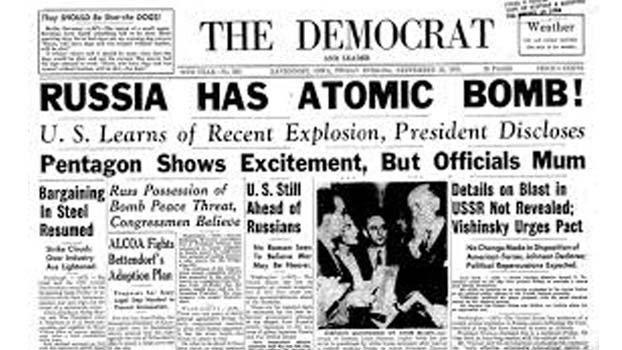
On 29 August 1949, the Soviet Union conducted its first nuclear test, code-named 'RDS-1', at the Semipalatinsk test site in modern-day Kazakhstan. The device had a yield of 22 kilotons.
Many historians consider the test the beginning of the nuclear arms race.
Known as "First Lightning" to the Russians and "Joe-1" (a cheeky reference to Joseph Stalin) to the Americans, the weapon had roughly the equivalent in yield to the atomic bomb the United States had dropped on Nagasaki four years earlier. The successful Soviet test came as a profound shock to the West. US intelligence believed that the Soviet Union was at least several years away from being able to detonate a nuclear device.
That progress had been accelerated, thanks in part to physicist Klaus Fuchs and other scientists who were members of an effective Soviet spy ring inside the US nuclear program. Fuchs, a German émigré who became a British subject before joining the Manhattan Project in 1943, had been passing British and American nuclear secrets to Moscow since the German invasion of the USSR in 1941, believing the Soviets had the right to know what their allies were up to.
The extent of Soviet penetration into their rival's nuclear program wasn't fully appreciated until January 1950, when Fuchs, under prolonged questioning by British intelligence, finally cracked. His confession to MI5 also implicated Harry Gold, a naturalized American who later admitted to acting as a Soviet courier on Fuchs' behalf. Gold would later be a key witness in the trial of Julius and Ethel Rosenberg.
The bombings of Hiroshima and Nagasaki in 1945 had prompted Joseph Stalin to order the development of nuclear weapons within five years. The young nuclear physicist Igor Kurchatov was charged with leading this project.
It was no coincidence that the RDS-1-device bore a close resemblance to the U.S. ‘Fat Man’ bomb dropped on Nagasaki, as Soviet espionage had managed to obtain details about the US Manhattan Project and the ‘Trinity’ test on 16 July 1945. The Soviet device was therefore also a plutonium-based implosion device.
Within a few years, the Cold War nuclear arms race was at full steam. In 1951, the United States exploded the first thermonuclear device in the ‘George’ test, to be followed two more years later by the Soviet Union with the RDS-6 test. Until the end of the Cold War, the United States would conduct 1,032 nuclear tests, the Soviet Union 715.
The Soviet Union conducted 456 of its tests at the Semipalatinsk test site, with severe consequences for the local population, including high cancer rates, genetic defects and deformations in babies. Read more on the effects of Soviet nuclear testing.
After its independence from the Soviet Union, Kazakhstan closed the test site on 29 August 1991, exactly 42 years after RDS-1. On the initiative of Kazakhstan, the United Nations proclaimed 29 August as the International Day against Nuclear Tests in 2009. —CTBTO