AP, Bremen
The two men risked their lives together nearly a decade ago trying to eliminate the Taliban, dodging bullets and forever bonding in a way that can only be forged in war.
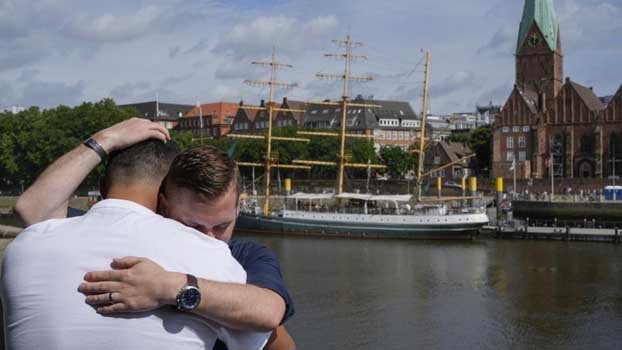
Now the American soldier and his Afghan translator were together again in Germany shopping for a suit. Abdulhaq Sodais’s future hinges on an asylum hearing in a German court after he was denied a US visa, and US Army Veteran Spencer Sullivan was there to help him prepare.
Together, they watched videos from Sodais’ hometown: The crackle of gunfire, dead bodies being carted off as black smoke billowed. Once US troops withdrew, the fragile government built over years by people like Sodais and Sullivan collapsed in just days.
“I couldn’t stop crying,” Sodais said. “My father said the Taliban were knocking on every single door in Herat looking for guys who worked for the coalition forces.”
Sullivan already lost another translator, Sayed Masoud, who was killed by the Taliban while waiting for a US visa. It’s a scar Sullivan carries deeply, the realization that the US government is capable of the one thing he never believed: betrayal.
Sullivan was determined not to let Sodais, who used smugglers to get to Europe, suffer the same fate.
So he flew from California to Germany to help Sodais pick out something to wear for his Sept. 6 asylum hearing. In a world of hurt and uncertainty, buying a suit was the one thing Sullivan could control. It offered a small hope of making a difference.
A professional appearance just might convince a judge to help keep Sodais safe and uphold the sacred vow that America was unable to keep.
“I made a promise to him just as America made a promise to him to protect him and save his life,” Sullivan said. “I mean how can you turn your back on that promise? I don’t think the answer is more complicated than that. I think it’s actually very simple.”
Sullivan is among scores of US combat veterans working on their own to rescue the Afghans who served alongside them.
Their efforts started long before this month’s chaotic rush to evacuate Afghans after the Taliban’s swift takeover of Afghanistan as US forces withdraw from America’s forever war.
Thousands of Afghans who aided US troops have spent years stuck in a backlogged and beleaguered US Special Immigrant Visa program, while frantic messages of the Taliban hunting them down have been pinging the phones of the American soldiers they helped on the battlefield.
The program was meant to award Afghans for their support by giving them and their families a pathway to the United States. But it has fallen far short, with Congress failing to approve enough visas each year, while the former Trump administration added new security requirements and bureaucratic hurdles that turned the average wait time from a few months into nearly three years.
Others have been denied over what immigration attorneys say were minor or unjust discrepancies in their performance records. Many now fear that the time they were marked as late to work, unfairly or accidentally even, may cost them their escape, and possibly their life.
Sodais and Masoud stood out among the dozen interpreters who worked with the platoon Sullivan led in Afghanistan from 2012 to 2013.
Both interpreters went with his platoon on dozens of missions into villages controlled by the Taliban, taking on fire while unarmed.
In 2013, Masoud applied for a special immigrant visa after receiving death threats for his work. His application included a letter of recommendation from Sullivan who described him as “punctual and professional, an exemplary linguist and trustworthy friend.”
“Granting him a special immigration visa is the least that can be done in order to express America’s gratitude for his services,” Sullivan wrote.
Two years later, Masoud’s application was denied. The US embassy said he had not worked for the US government or its military. In fact, Masoud was hired by a US firm that had a contract with the Department of Defense to provide linguistic services to troops in Afghanistan.
Masoud appealed and Sullivan wrote another letter to the Chief of Mission at the US Embassy, Kabul, providing more details of his work, but he got no response.
Sullivan reached out to other veterans to see what he could do. He learned he could pay $20,000 to get Masoud smuggled out, but he didn’t want to support a criminal network. Instead, he hoped the US government would come through on its end.
Meanwhile, Masoud’s texts to Sullivan became more sporadic as the threats escalated, forcing him to move from house to house.