International Desk
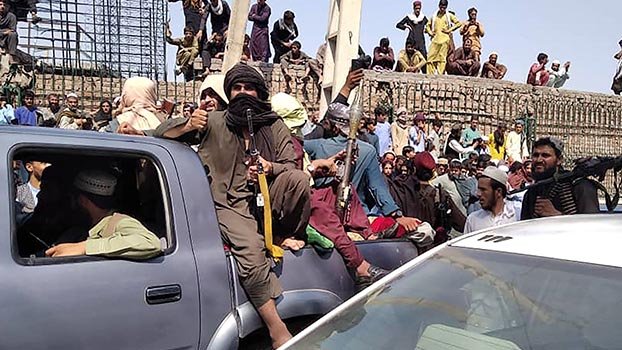
The unrest and sporadic clashes between Talibans and protesters in Afghanistan continue.
The concern grew further as firing was heard in Jalalabad as flag-waving protesters defy the Taliban on Wednesday.
At least three people were killed and more than a dozen injured after Taliban militants opened fire during protests against the group in the Afghan city of Jalalabad, two witnesses and a former police official told Reuters.
Taliban leaders are expected in Kabul after they arrived in Kandahar from exile on Tuesday. The leader of the Taliban-linked Haqqani Network meets former President Hamid Karzai.
On the other hand The UK parliament holds an emergency debate on Afghanistan. Meanwhile, the White House says the Taliban have promised civilians can travel safely to Kabul airport.
Reports say Afghans have been beaten by Taliban guards on their way there. Militants are out in force manning checkpoints across the city, according to BBC.
According to other news agencies, the US withdrawal from Afghanistan and the Taliban’s return to power is a victory for al Qaeda. But just how much of a win is it? This question is at the heart of the Biden administration’s decision to withdraw from the country.
Defending his choice despite the chaos and horror descending on Afghanistan as the government collapsed, President Joe Biden declared on Monday, “Our only vital national interest in Afghanistan remains today what it has always been: preventing a terrorist attack on [the] American homeland.”
Republicans are taking Biden to task on this very point. Representative Michael McCaul, a Republican from Texas and the ranking member of the House Foreign Affairs Committee, warned, “We are going to go back to a pre-9/11 state—a breeding ground for terrorism.” General Mark Milley, chairman of the Joint Chiefs of Staff, cautioned that al Qaeda and the Islamic State (also known as ISIS) could quickly rebuild their networks in Afghanistan.
The Taliban leadership has signaled that the group will not employ the same brutal rule it did two decades ago. But Taliban fighters in Jalalabad fired into a crowd and beat protesters during an outpouring of public anger at their rule.
Even as the Taliban took their first steps to create a functioning government, they faced the first street protests on Wednesday against their takeover of Afghanistan.
The public display of dissent in the northeastern city of Jalalabad was met by an overwhelming use of force. Taliban soldiers fired into the crowd and beat protesters and journalists.
The Taliban had taken control of Afghanistan without much of a fight. Despite the risks, hundreds of protesters marched through the main shopping street, whistling, shouting and bearing large flags of the Afghan republic.
The outpouring of public anger came as the Taliban prepared to offer details on shape of their government, naming ministers and filing key positions.
“We don’t want Afghanistan to be a battlefield anymore,” Zabihullah Mujahid, the Taliban’s longtime chief spokesman, said in a news conference on Tuesday.
“From today onward, war is over.”
There were noticeably fewer women on the streets. At homes and businesses, a knock on the door could stir fear.
It remains to be seen whether the pragmatic needs of a nation of 38 million will continue to temper the ideological fanaticism that defined the group’s rule from 1996 to 2001. But the country the Taliban now control is vastly changed from two decades ago.
The progress of women- from the millions of girls in school and women in critical roles in civil society- is the most visible example.
The protests offered early signs that many Afghans will not simply accept Taliban rule.
The arrival of the Taliban mullahs- a reference to group’s religious leaders- also set off widespread fear.
Now, even though the airport is under the control of the US military and evacuation flights have been stepped up, tens of thousands are still struggling to escape Taliban rule.
The Taliban’s top leaders have spent years on the run, in hiding, in jail and dodging American drones. They are now emerging from obscurity after a 20-year battle, but little is known about them or how they plan to govern.
As they take charge of Afghanistan’s government and a nation of 38 million people, the Taliban’s leaders have tried to signal that they are more worldly and tolerant than their predecessors in the 1990s, willing to work with women and urging people to get back to their jobs without fear of reprisals, the New York Times adds.