Tanvir Islam, Moulvibazar
Majority of the Manipuri population of Bangladesh lives in Moulvibazar and adjacent areas of Sylhet division. Adampur and Madhabpur are their main residence. Manipuri Community is famous for their culture and traditions.
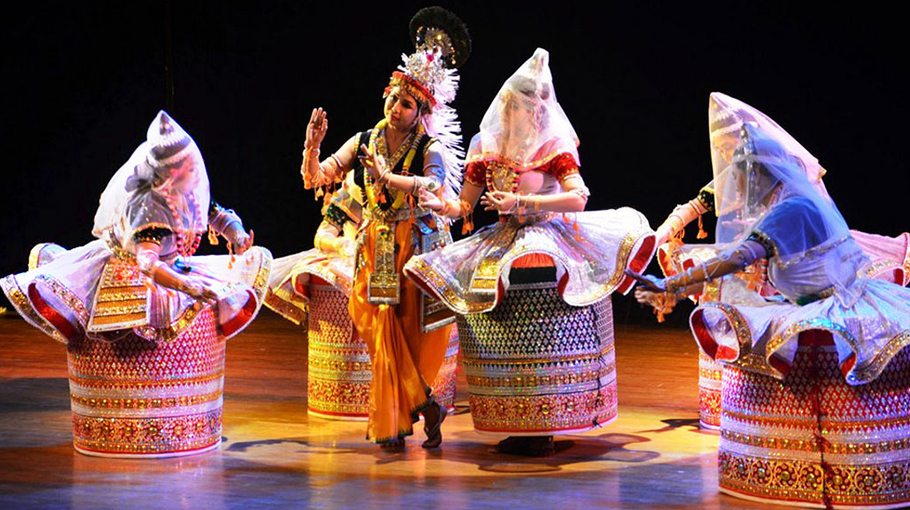
Dance and music seem to be inextricably linked with the life of Manipuri people. Among these, Manipuri dance is the richest in Manipuri culture. Manipuri dance is called Lashya. Softness and modesty are the hallmarks of Manipur dance. There are also frames for Manipuri dance. These are mainly divided into two parts. Folk or folk dance and classical dance. Folk dances include Laiharaoba, Khamba-Thoibi, Maibi-Jagoi, Leisham Jagoi, etc. Rasa dance, on the other hand, includes classical dances such as Gostha Leela, Udukhol, Mridanga, etc.
Sanatan Hamom, (Munipuri writer and poet) said, “We ourselves are trying our best to nurture this culture in various ways. If we get the sympathy and kindness of concern authority towards us then we can go further.”
The Manipuri people are a small and distinctive people of India and Bangladesh. They originally settled in the Indian state of Manipur, but when the Burmese army invaded the Indian state of Manipur in the early nineteenth century, some ethnic groups from there settled in Sylhet. They are called Manipuri because they came to Bangladesh from the Indian state of Manipur. Although they are known as Manipuri, they have three different nationalities. Maitai Manipuri, Bishnupriya and Pangan Manipuri.
H Tanubabu Singh Director of Chauba Memorial Manipuri Intellectual, Poparty Museum said that when the Burmese War of Liberation took place in 1819, the Manipuris were defeated by the Burmese and settled in nearby Sylhet, Kasar, Assam and Tripura. Manipuris have been living in Bangladesh for almost two hundred years. According to the 1991 census, the number of Manipuris in Bangladesh is about 25,000. At one time Manipuris lived in Durgapur of Mymensingh, Khasba of Cumilla and in Tejgaon Manipuri Para of Dhaka. Currently they living in the largest Sylhet, Sunamganj, Moulvibazar, Habiganj district.
Manipuris of Bangladesh are dependent on agriculture. They cultivate in traditional way. They are also very hardworking like other ethnic groups. Manipuri women work equal with men. Weaving is the tradition of almost all ethnic groups of Bangladesh. Manipuris are quite famous in this tradition. Manipuri girls have a deep connection with weaving machine and wheel. Each of their houses has a wheel. Their handlooms saree, sheets and towel bags are popular.
Manipuri woman Nehar Singha said that the cost of making a cloth is Tk 300-400 and the profit is Tk 400-500. The cost of making a towel is Tk 200 and the profit is also Tk 200. It costs Tk 250 to make a bag. I sell it for Tk 500. A whole day is needed to make a cloth.
Besides, in religious judgment, all Manipuris now believe in the traditional religion of Chaitanya. However, before the adoption of traditional religion in the eighteenth century, Manipuris practiced Apokpa. Later, although the inherent beauty of the traditional Vaishnava religion won the hearts of the Manipuris, they did not completely abandon their earlier beliefs. As a result, a new trend has been created by the synthesis of these two beliefs. On the one hand, Manipuris solemnly perform various ceremonies of traditional religion, such as Rath Yatra, Raspurnima, Dul Yatra, etc and also perform their earlier ceremonies like Laiharaoba, Sajibu Chairaoba.
They also worship the deities of Sanamahi, Pakangba and Leimaren. There are also many Manipuris who simultaneously practice the former faith and Islam. They are called Meitei Pangon or Manipuri Muslims. Religions and rituals play an important role in the daily life of Manipuris. At special junctures of life, such as birth, death, marriage, etc., they perform various religious ceremonies and rituals.