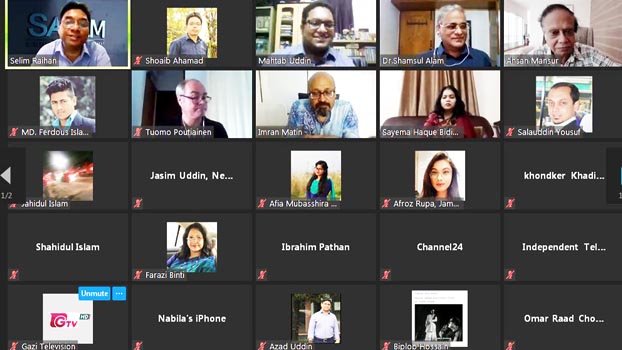
Speakers at a webinar on Saturday observed that the issues of unemployment, livelihood, and supporting the recovery of the economy are the major challenges, the country faces at the moment.
They said the issues of mismatch of skill demand and skill supply, quality of education, low level of participation and quality of jobs of females, automation, 4th Industrial Revolution, job destruction, decent job, workers safety, and informality are to be addressed with due priority.
The remarks were made in the sixth episode of SANEM Shongzog, titled “COVID-19 and the Challenges of Labour Market in Bangladesh”, held on Saturday.
Mahtab Uddin, Research Economist of SANEM, and Lecturer, Department of Economics, University of Dhaka. moderated the session while Dr. Sayema Haque Bidisha, Research Director of SANEM, and Professor, Department of Economics, University of Dhaka presented the keynote paper at the Shongzog.
Professor Shamsul Alam, Member (Senior Secretary), General Economics Division, Bangladesh Planning Commission, Tuomo Poutiainen, Country Director of ILO Bangladesh attended the session the special guest.
As the distinguished panelists were present Dr. Ahsan H. Mansur, Executive Director, Policy Research Institute, Dr. Selim Raihan, Executive Director of SANEM and Professor, Department of Economics, University of Dhaka and Dr. Imran Matin, Executive Director, BIGD. Around 60 researchers, economists, academicians, development practitioners, journalists, and students joined the Shongzog.
Dr. Ahsan H. Mansur pointed out that deficiency of data is a major challenge to research on labour market of Bangladesh.
He said that currently, the country is facing three challenges: containment of the COVID-19 disease itself, issues of unemployment and livelihood, and supporting the recovery of the economy. As the economy has opened up, there has been a slow upward movement; however, it seems a sub-optimal point will be reached in this way.
Explaining the necessity of a focused recovery strategy, Dr. Mansur said that attracting the investments deflecting from China should be a part of Bangladesh's recovery and post-recovery strategy.
In his welcome remarks, Mahtab Uddin explained the context of the webinar and highlighted the current dynamics revolving of the labour market in Bangladesh. He presented a brief assessment of the situation prevailing in the foreign labour market, the manufacturing sector, and the urban informal sector.
In his introductory remarks, Professor Shamsul Alam shed light on the policies undertaken by the government and discussed the issues related to employment generation in Bangladesh.
He remarked that the 7th Five Year Plan did not generate employment as expected.
In the keynote presentation by Dr. Sayema Haque Bidisha presented a detailed assessment of the current situation. She discussed the demand crisis at local and global level along with the resulting loss in income and employment.
She explained the pre-COVID 19 challenges in labour market of Bangladesh and highlighted issues of mismatch of skill demand and skill supply, quality of education, low level of participation and quality of jobs of females, automation, 4th Industrial Revolution, job destruction, decent job, workers safety, and informality.
Dr. Selim Raihan, Executive Director of SANEM recommended that the government should form a Labour and Employment Commission which will assess the current unprecedented situation and suggest necessary measures. The BBS should be entrusted to collect data and information on the current situation
He suggested to Introduce new social safety net programmes targeting the labour market. In this context, the employment guarantee scheme for the next six months for vulnerable people can be seriously considered. The modalities can be sorted out.
In the speech of the Special Guest, Tuomo Poutiainen put emphasis on public employment programs. He also said that stimulus should not only be for business and liquidity but also should have a focus on jobs and employment.