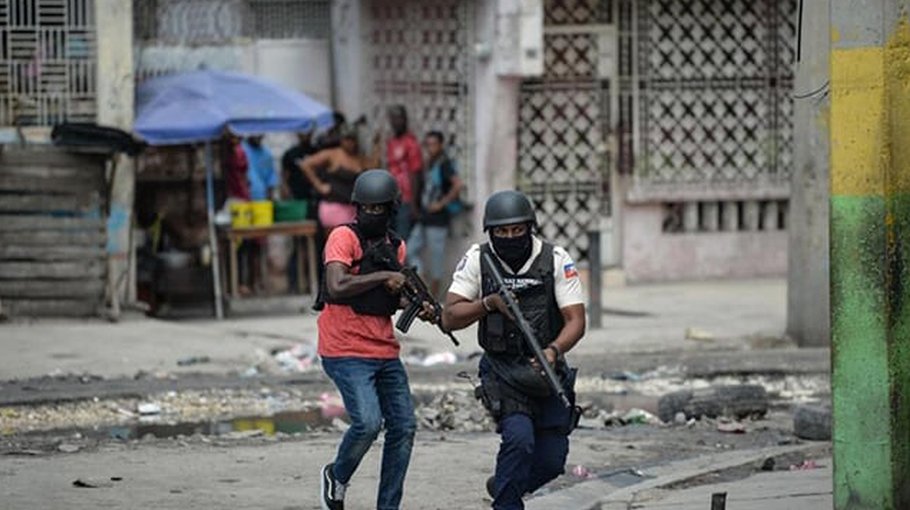
UN representatives on Thursday repeated their plea for an intervention force to stabilize Haiti, highlighting the growing number of extrajudicial killings of suspected gang members as a sign of the crisis-wracked nation's insecurity.
Haiti, the Western Hemisphere's poorest nation, has seen compounding humanitarian, political and security crises, with gangs controlling most of the capital and terrorizing the population with frequent kidnappings, rape and murder.
For months, UN chief Antonio Guterres and Haiti's Prime Minister Ariel Henry have called for an international force to help quell the mounting violence, but there has been little action as no country has stepped up to lead the operation.
Without a sufficient security apparatus to combat the rampant gangs, Haitians in the capital Port-au-Prince have begun taking matters into their own hands, UN Haiti envoy Maria Isabel Salvador told the Security Council on Thursday. The UN office in Haiti, known as BINUH, "has documented the killing of at least 264 alleged gang members by vigilante groups," she said, noting the trend as adding "another layer of complexity" to the country's security situation.
In one of the first gruesome episodes in April, a group of civilians seized several gang members from police custody, beat them to death and burned their bodies in the street.
A few weeks later, Haiti's Minister for External Cooperation Ricard Pierre
warned of a high risk of "civil war" without foreign intervention.
Guterres, who visited Port-au-Prince over the weekend before attending the
CARICOM summit of Caribbean nations, where Haiti was a key topic, repeated
his plea for an international force on Thursday, describing the Haitian
population as "trapped in a living nightmare."
"We are not calling for a military or political mission of the United
Nations," he told reporters at UN headquarters in New York.
"We are calling for a robust security force deployed by Member States to work
hand-in-hand with the Haitian National Police to defeat and dismantle the
gangs and restore security across the country."
When asked if the force would need to be composed of around 1,000 to 2,000
people, Guterres said it would need to be "robust" with a "meaningful number
of officers."
"So I believe that those numbers do not reflect any exaggeration," he said.
No elections have been held in Haiti since 2016, and Henry, appointed prime
minister just days before the assassination of president Jovenel Moise in
July 2021, faces questions about his legitimacy.
Guterres admitted however that "there can be no lasting and inclusive
political solutions without a drastic improvement of the security situation."
- No US offer to lead -
While some countries support the idea of an international force, none has
volunteered to lead such an operation into Haiti, where numerous prior
foreign interventions ended in failure.
US Secretary of State Antony Blinken, a day after meeting with Haiti's prime
minister on the sidelines of the CARICOM summit, said Thursday that the
United States was working to find a country willing to take on the "leading-
nation role."
"We're in very active conversations with countries in the region and beyond
about such a force and we're in active conversations, of course, at the
United Nations about what it might do to give a force the proper imprimatur
from the international community," Blinken told reporters in Guyana, his
second stop on a regional tour.
Haitian Foreign Minister Jean Victor Geneus told the Security Council that
Haiti "stands by its renewed request for robust international assistance to
support the police's efforts," while also being "flexible and open to all the
options" the council may consider.
China, a veto-holding permanent member of the body, has long advocated for a
broad arms embargo to Haiti, a call its UN ambassador Jun Zhang repeated
Thursday.
"If large numbers of weapons were to continue to flow unabated into the hands
of Haitian gangs, it would be futile for the international community to try
to give more support to the Haitian police," he added.
Jamaican Prime Minister Andrew Holness, addressing the Security Council via
video as CARICOM's point person on Haiti, argued that expressions of
solidarity were "meaningless without urgent action" to help Haiti "finally
achieve the peace, stability and prosperity that they deserve."
In addition to the violence, some 5.2 million people -- almost half of
Haiti's population -- are in need of humanitarian assistance, including
nearly three million children.