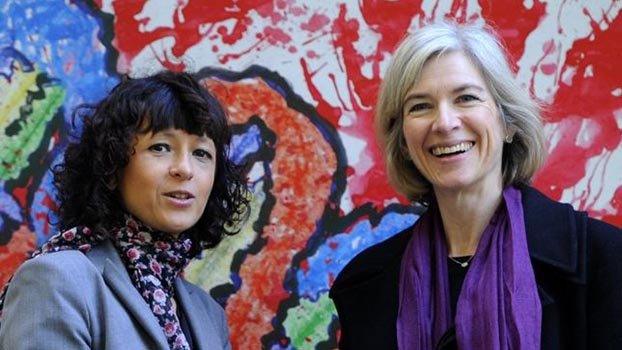
Two scientists have been awarded the 2020 Nobel Prize in Chemistry for developing the tools to edit DNA, reports BBC.
Emmanuelle Charpentier and Jennifer Doudna are the first two women to share the prize, awarded for their work on the technology of genome editing.
Their discovery, known as Crispr-Cas9 genetic scissors, is a way of making specific and precise changes to the DNA contained in living cells.
They will share the prize money of 10 million krona (£861,200; $1,110,400).
The technology has been transformative for basic science research and it could also potentially be used to treat, or even cure, inherited illnesses.
Commenting on her win, Prof Emmanuelle Charpentier, from the Max Planck Unit for the Science of Pathogens in Berlin, said she was emotional on learning about the award.
"When it happens, you're very surprised, and you think it's not real. But obviously it's real," she said.
On being one of the first two women to share the prize, Prof Charpentier said: "I wish that this will provide a positive message specifically for young girls who would like to follow the path of science...and to show them that women in science can also have an impact with the research they are performing."
She continued: "This is not just for women, but we see a clear lack of interest in following a scientific path, which is very worrying."
Commenting on the discovery, biological chemist Pernilla Wittung-Stafshede, said: "The ability to cut DNA where you want has revolutionised the life sciences."
During Prof Charpentier's studies of the bacterium Streptococcus pyogenes, she discovered a previously unknown molecule called tracrRNA. Her work showed that tracrRNA is part of the organism's system of immune defence.
This system, known as CRISPR-Cas, disarms viruses by cleaving their DNA - like genetic scissors.
In 2011, the same year she published this work, Charpentier began a collaboration with Prof Doudna, from the University of California, Berkeley.
The two had been introduced by a colleague of Doudna's at a cafe in Puerto Rico, where the scientists were attending a conference.
The following day, during a walk through streets of the island's capital San Juan, Charpentier proposed the idea of working together on the problem.
Together, they worked to recreate the bacterium's genetic scissors in a test tube. They also worked on simplifying the scissors' molecular components so they were easier to use.
In their natural form, the bacterial scissors recognise DNA from viruses. But Charpentier and Doudna showed that they could be reprogrammed to cut any DNA molecule at a predetermined site, publishing their findings in a landmark paper in 2012. Cutting the DNA allowed the code of life to be rewritten.
Chemist Claes Gustafsson added: "We can edit any genome, we can ask all kinds of questions," adding that it was already being harnessed to treat genetic disorders.
Since the two scientists discovered the Crispr-Cas9 genetic scissors in 2012, their use has exploded. The tool has contributed to many important discoveries in basic research and, in medicine, clinical trials of new cancer therapies are underway.
The technology also holds the promise of being able to treat or even cure inherited diseases. For example, the technology is currently being investigated for its potential to treat sickle cell anaemia, a blood disorder that affects millions of people worldwide.
But without regulation, some fear the techniques could equally be used to create "designer babies", opening up an ethical minefield. If genome-edited children were to grow up and have children, any alterations to their genomes could be passed down through the generations.
Last year, Chinese scientist He Jiankui was jailed for three years after creating the world's first gene-edited human babies. He was convicted of violating a government ban by carrying out his own experiments on human embryos, to try to give them protection against HIV.
It had been thought a Nobel for this revolutionary science would not be awarded for many years because the technique is also the subject of a long-running patent battle in the US.
The dispute involves Charpentier and Doudna's group at the University of California, Berkeley, and a team at MIT and Harvard's Broad Institute in Cambridge, Massachusetts.
The disagreement centres on the use of the Crispr technique in eukaryotic cells - those cells that bundle their DNA in a nucleus. It is in such cells, which are found in higher animals, that the most profitable future applications will exist.
The competing institutions claim their scientists made the crucial, most relevant advances.
Swedish industrialist and chemist Alfred Nobel founded the prizes in his will, written in 1895 - a year before his death.