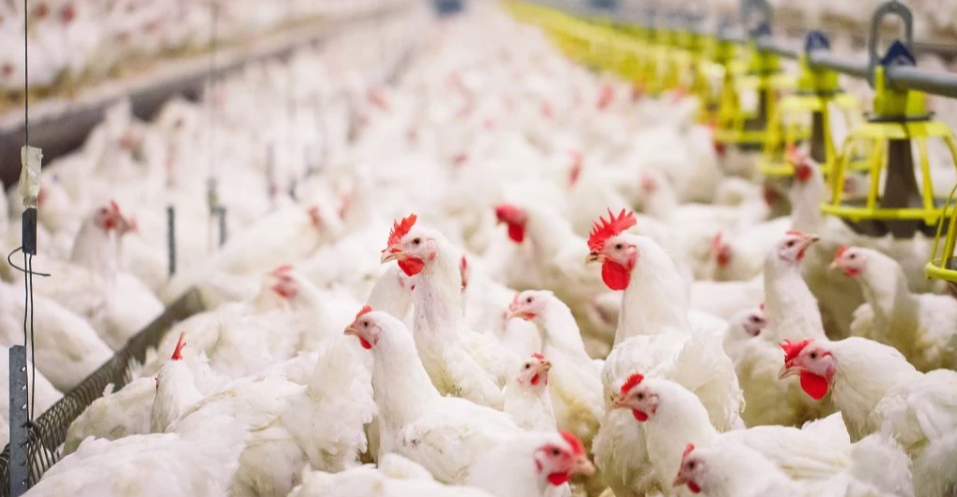
Bangladesh’s growing poultry industry, worth approximately Tk 50,000 crore, is facing an existential crisis due to skyrocketing production costs and heavy taxation.
The recent price hike of chicken and poultry products affected the market. The sector experts and analysts warn that without immediate government intervention to reduce production costs in the upcoming budget, the sector could collapse, leading to a severe protein deficiency for the next generation.
Over the last five years, production costs in the poultry sector have nearly doubled, with the most significant hike occurring this year. According to data from the Bangladesh Bureau of Statistics and industry organizations, using 2021 as a base of 100 percent, production costs rose to 115 percent in 2022, 145 percent in 2023, and 170 percent in 2024, and are projected to reach 190 percent in 2025. Consequently, the industry’s growth rate has declined from 5.2 percent in 2022 to an estimated 3.2 percent in 2025.
Industry leaders cited the recent hike in corporate tax—from 15 percent to 27.5 percent—along with increased import duties and Advance Income Tax (AIT) as primary drivers of the crisis.
AIT was raised from 1 percent to 5 percent. Turnover tax increased from 0.6 percent to 1 percent.
Currently, feed accounts for 75 percent to 80 percent of a farmer's total expenditure, yet a 5 percent advance tax remains on the import of feed ingredients.
Dr. Ripon Kumar Mondal, Professor of the Department of Agricultural Economics at Sher-e-Bangla Agricultural University, said, "If you want to save the poultry industry, you must first reduce the price of food. Because 75 to 80 percent of the total cost of farming is spent on buying food. To provide food to farmers at a low price, you must reduce the cost of food production.”
Since food production materials are dependent on imports, policymakers must look to reduce income tax and customs duties. In the current situation, it is important to reduce it to the lowest level, he said.
In addition, Prof. Mondol suggested creating entrepreneurs in domestic food production and providing various benefits, including duty exemptions on the import of their equipment. "This is the only way out of the current situation. If this is not resolved, this source of easily available animal protein may face a deep crisis," he said.
Bangladesh currently imposes the highest corporate tax on the poultry sector among its neighbours.
In Pakistan, small and medium feed mills pay only 7.5 percent to 15 percent tax based on turnover. In Thailand, feed industries receive 100 percent tax exemption for five to eight years.
Meanwhile in Malaysia, sales tax on raw materials has been withdrawn, with new industries receiving 100 percent tax exemption for up to 10 years. In India, there is no advance income tax on general imports, and TCS on agricultural machinery was fully removed in 2026.
Impact on Marginal Farmers
Farmers report that while it costs Tk 10.50 to Tk 11 to produce a single egg, they are often forced to sell at wholesale prices of Tk 7.50 to Tk 8.50. Similarly, the production cost of broiler chicken stands at Tk 150–160 per kg, while wholesale prices hover around Tk 155–165, leaving almost no profit margin.
Mosharaf Hossain Chowdhury, President of the Bangladesh Poultry Industries Association (BPIA), warned that if marginal farmers are wiped out, the industry will fall under the absolute control of large corporate companies.
"Consumers will then be forced to buy eggs and meat at prices dictated by those corporations," he stated.
As a suggestion, Dr. Md. Elias Hossain, Professor of the Department of Poultry Science at Bangladesh Agricultural University, said that all types of taxes and duties have been increased in the poultry sector in the current fiscal year, the impact of which is already being seen.
He has urged the government to reduce corporate tax to 10 percent and turnover tax to 0.2 percent, lower AIT to 1 percent, simplify the refund process, and provide electricity subsidies for farms and prioritize farmers for the government's 'Krishak Card'.
Eliminate tax and VAT on the sale of poultry products, he also said.
“With 60 to 70 lakh people directly or indirectly employed in the sector—many of them young entrepreneurs—the collapse of this industry would lead to massive unemployment and a significant blow to the rural economy,” said Professor Elias Hossain.