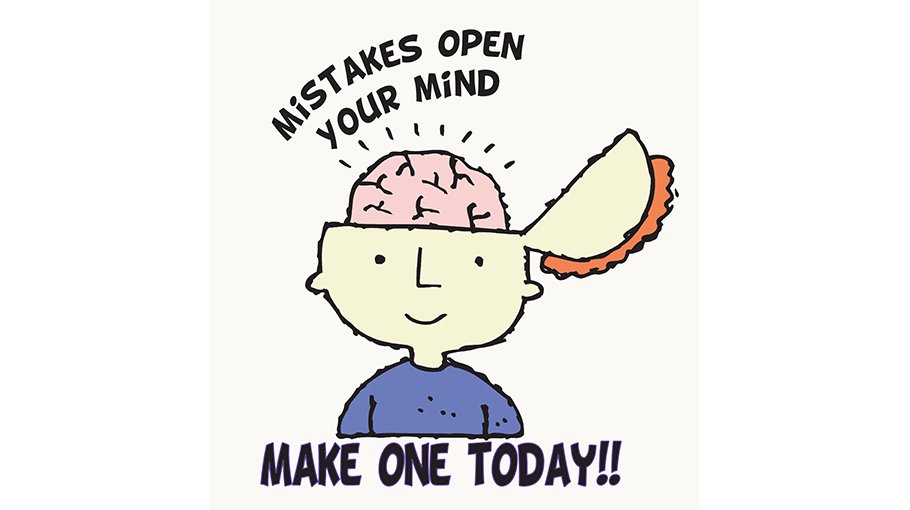
It’s widely acceptable for students and even adults to say, “I’m not good at math.” Far more acceptable than saying, “I’m not good at reading.” I’ve spent countless hours wondering why that is. What I’ve come to is that somewhere along their educational journey, the math naysayers were not celebrated when they made mistakes in the math classroom.
Making a mistake in front of others is nerve-racking for anyone, especially a student in front of their peers. But it doesn’t have to be! Not if mistake making is celebrated. We must create brave spaces where students trust that they will not be put down when they take intellectual risks and make mistakes.
We have all been conditioned to believe that getting the right answer to a math problem means that you’re “good at math.” Students who get the right answer are celebrated. We know through research that our brain grows more when we make mistakes than when we simply get a problem correct. Convincing students of this will take time and a fundamental mindset shift.
Students need a growth mindset to see the good in mistakes. Teachers can design lessons that support the belief that mistakes are beautiful and need to be celebrated. The strategy most prominent in my math teacher’s classrooms is the use of error analysis.
Using error analysis in the math classroom requires students to work backward. Rather than solving a math problem, students are given a solved problem that contains errors. Students examine the problem, identify any errors made in solving it, justify their reasoning, and solve the problem correctly. These problems often contain conceptual errors and/or computational errors.
3 WAYS TO USE ERROR ANALYSIS
1. Error analysis is a great way to generate student discussion. After giving students a traditional math problem, it’s difficult to have a pair or group discussion immediately because students often need to solve the problem on their own first; I know I do. The discussions that follow tend to center around the steps they used to find their solution.
With error analysis, a pair or group of students can be given a solved problem and immediately begin having a discussion about what they’ve noticed. They are able to talk about the types of mistakes they identified and why the person solving the problem may have made that mistake. These types of discussions in math truly allow students to understand how problems are solved, and they promote strategic thinking.
2. The place mat strategy is a wonderful vehicle for error analysis. The place mat strategy, often utilized in humanities classes, calls for groups of four students to respond to a given prompt independently. They take turns sharing their responses. The group synthesizes their individual contributions into a final group response that is composed of all members’ initial responses.
Adapting this strategy for math, the prompt is replaced with a completely solved math problem containing a series of computational and/or conceptual errors. Students analyze the problem and identify as many mistakes as they can find. Each member of the group shares their findings and reasons why they believe an error was made. The group synthesizes their findings and then uses those findings to correctly solve the problem.
3. Error analysis works well as a formative assessment. One challenge of error analysis is the time it takes for teachers to create erroneously solved problems. This is where using error analysis as a peer assessment strategy comes in. You can utilize the work completed by your students as your problem set for error analysis.
You give the class a problem to solve independently, and then pairs swap papers and conduct an error analysis of their peers’ response. Sometimes they will find errors and be able to provide feedback on the mistakes found, but sometimes the problem will be completely correct. In this case, they can articulate how they proved that their peers’ answer was correct.