Business Desk
Textile Innovation Exchange (TIE) and The Institution of Textile Engineers and Technologists (ITET), Bangladesh, have signed an In-Collaboration Agreement to establish the TIE–ITET Innovation & Research Cell, creating a structured platform to connect textile professionals, industry, researchers and innovators.
The cell also aims at accelerating practical innovation, and bring those innovations to Textile Innovation Expo 2026, scheduled for November 12–14, 2026 at International Convention City Bashundhara (ICCB), Dhaka.
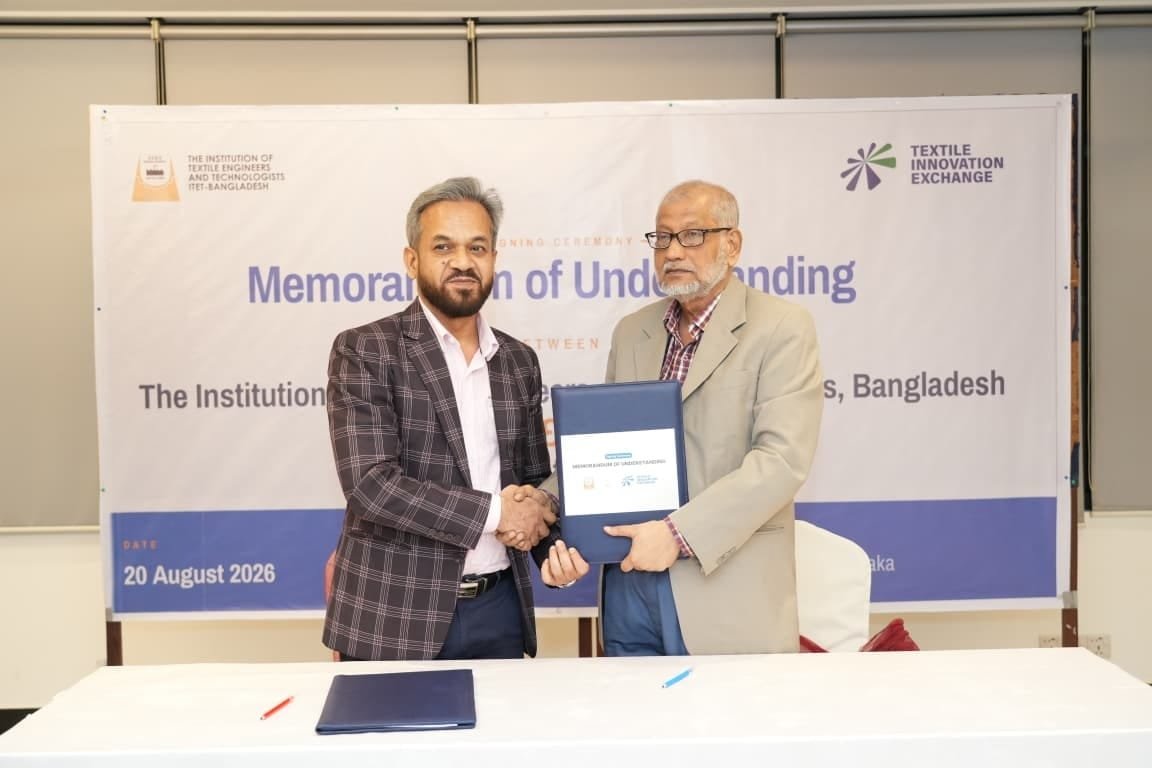
The collaboration was announced at an MoU signing ceremony at Dhaka Regency Hotel on August 20.
Under the agreement, ITET will be recognized as an “In-Collaboration” partner of TIE and will support the Expo by mobilizing textile engineers and technologists, factories, industry leaders, policymakers, public institutions, exhibitors, sponsors and other relevant stakeholders.
The agreement was signed on behalf of Textile Innovation Exchange by Engr. Ehsanul Karim Kaiser, Chairman, TIE, and on behalf of ITETby Engr. Md. Enayet Hossain, President, ITET.
The Expo is already generating strong momentum across the industry, with Pacific RSF Associates Ltd. and a growing list of leading local and international companies confirming participation to showcase their latest innovations, technologies and solutions.
Unlike conventional trade expos, Textile Innovation Expo 2026 is being positioned as a leading innovation platform, where live demonstrations, applied technologies, factory-ready solutions and sustainability-driven innovations take center stage.
The Expo will feature four concurrent innovation zones -Dyeing & Printing Innovation Expo, Textile Materials Innovation Expo, Garments Automation & Innovation Expo, and Green & SusTech Expo- bringing together a wide spectrum of technologies, materials, automation systems and sustainable solutions under one roof.
With increasing participation from solution providers, machinery innovators, chemical and material companies, automation leaders and sustainability-focused organizations, the Expo is expected to become one of the largest and most dynamic textile innovation gatherings in the region.
At the signing ceremony, Engr. ASM Hafizur Rahman Nixon, Secretary General, ITET, and Engr. Sumayel Muhammad Mallik, Senior Vice President, ITET,Prof. Dr. Engr. A N M Ahmed Ullah, Head of the Department of Textile Engineering, Southeast University, Nafis-Ud-Doula, Director, BGMEA & Director, Impress-Newtex Composite Textiles Ltd. shared their perspectives on the growing importance of innovation for the competitiveness and future of Bangladesh’s textile and apparel industry.
ASM Tareq Amin, Member Secretary, TIE, presented the overall activities, mission and vision of Textile Innovation Exchange and outlined the future activities planned under the TIE–ITET collaboration.
He highlighted how the partnership can connect industry professionals and institutions with practical innovation, applied research, capability development and the Textile Innovation Expo.
ATM Mahbubul Alam Milton, Executive Director of Masco Group and Member of the Steering Board, TIE, emphasized that innovation has become essential for the survival and competitiveness of the textile industry.
He also stressed that innovation should not be confused with invention. While research and invention may demand extensive resources, innovation can begin with a mindset of continuously identifying problems and improving existing processes.
For TIE, the collaboration is intended to give the Expo deeper access to Bangladesh’s professional textile engineering community and strengthen participation from factories, technical experts and institutions.
TIE’s stated mission is to connect the textile ecosystem so factories can systematically implement, measure and scale innovation.
Engr. Ehsanul Karim Kaiser, Chairman, Textile Innovation Exchange, said “Innovation cannot be something we do once and then stop; it is a continuous process. We have to understand the necessity and keep innovating accordingly.”
He expressed confidence that the TIE–ITET partnership would translate professional knowledge and industry experience into activities that create tangible value for Bangladesh’s textile sector.
For ITET, the partnership creates a structured channel for its members to participate in the Expo as professionals, technical contributors and industry stakeholders.
The agreement also provides ITET members with access, subject to program rules and capacity, to TIE-supported training, masterclasses, research opportunities, expert networks, peer learning, conferences and Expo participation.
Engr. Md. Enayet Hossain, President, ITET, said the agreement reflects the organization’s commitment to moving beyond institutional discussion and delivering visible activities for textile engineers and the wider industry.
The two organizations have established the TIE–ITET Innovation & Research Cell as the coordination mechanism for the partnership. Two focal points from each organization will be nominated, with the Cell meeting at least quarterly and major programs and decisions being taken through mutual agreement.
From Textile Innovation Exchange (TIE), Safat-Ul-Azam and Faysal Ahmmad have been nominated to represent the organisation.
From ITET, the nominated representatives are Engr. Chandra Shekhar Das, Press & Publication Secretary, Engr. Md. Abdullah Al Mamun, Assistant Press & Publication Secretary , Engr. Md. Faisal Hossain, Education & Literature Affairs Secretary and
Engr. Tasbidul Islam Dipu, Assistant Education & Literature Affairs Secretary.
Beyond the Expo, the collaboration covers an international research conference, need-based masterclasses and technical training, a peer-reviewed international journal, policy research and advocacy, and joint mobilization of applied research and innovation activities.
With Textile Innovation Expo 2026 now positioned as a central activity of the TIE–ITET collaboration, the November event is expected to serve as a practical meeting point for Bangladesh’s textile and apparel factories, engineers, technology and material suppliers, researchers, policymakers and other industry stakeholders.