Romeo Anjelo
It is said that what we see affects our mind and soul, and what affects our mind and soul also affect our thought. While viewing the spectacular patterns of the kaleidoscope, several shifting shades, patterns are seen.
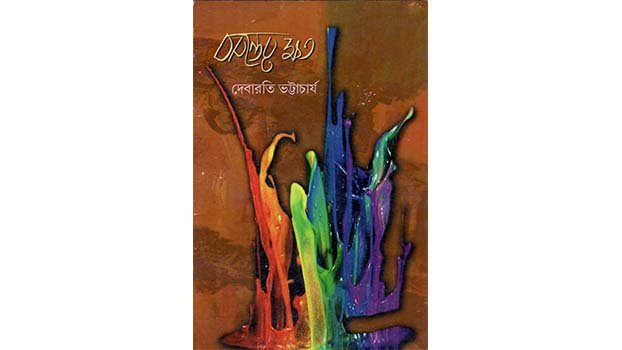
What happens when we purview our emotions acts quite like that. The anthology of Debarati Bhattacharya, ‘Boshonter Khoto’ (The Summer Stings) gives us a quite glimpse of our emotions which alike kaleidoscope shifts accordingly to situations, times, incidents and even persons. And even our memories which causes to shift towards nostalgia.
The poet Debarati Bhattyacharya wrote most the poem on her experience but on some few poem she appeared to be the lone spectator. The anthology is composed with short abstract poems, which gives the reader to unleash their deducting power on the poetry. Many poems had the touch of pessimistic feeling, but few poems had romantic verses. It consisted with the poems of being dejected, hopeful, passionate, bereavement, even waiting for eternity. Like the anthology itself becomes the kaleidoscope of emotions.
If read through the imagery rather than literally, the poem vivifies. The poems gives us wings to fly in our inner world which it be known. The romantic poet John Keats wanted to stay in that world, which still echoes in the poem ‘Ode to Nightingale’. Which we see when the poet Debarati wanted to know what lies inside, from an extract of the headlined poem ‘Boshonter Khoto’ reveals her inquisitive mind. She wrote:
‘Majhrate tara chinte bar hoechhi
Ondhokar. Nikosh ondhokar
Paye futchhe ki jeno
Kush? Chorkanta?
Na; Takiye dekhi taray taray bhore gechhe
Shoshshokhet alpoth
Du’paye rokto jhorchhe, bornil rokto
Boshonter Khoto’
(To know the stars I came out at midnight,
Darkness. Absolute darkness
What is it prickling at my foot
Grass? Or bush thorns?
No; Stars are all around
All through the meadows
Fast asleep and sound
My feet are bleeding with blood, colorful blood
From the summer stings)
On another poem named ‘Shuvomohorot’ (The New Beginning), she wrote:
‘Chinton dhele shajai tomay
Obochetonay snan sharo
Jhore jay holud pata……
Chiroshobuj tumi.
Choiti hawar dol legechhe
Srijon-shongher moncho utshob tai
Roj shuvomohorot’
(All the time I re-arrange you
Unconsciously you bathe
Getting off those dry and yellow leaves
Now you are evergreen.
The new spring air revives
The spring carnival
So the new beginning starts again)
This poem reminds about Percy Bysshe Shelley’s poem ‘Ode to West Wind’. Alike the west wind which draws away the dry, dead leaves it might seem ominous but along the leaves the wind also draws the seeds for the future. ‘The New Beginning’ also gives that sensuousness for the hope of the spring.
But the an extract from poem ‘Burning Musk’ says differently:
‘Phire takay Kostorimrigo
….Pichhudaka mana
Shara gay agun mekhe
Rate pure chhai’
(The Musk Deer looks back
……looking back is forbidden
Willingly taking the fire
Burns to ashes all night.)
The subtle expression of deliberate suffering, the emotion of constant torment sets this poem apart. It is like the testimony of a stoic person who bears the pain of the truth willingly all through the life. But, what if a person burning with passion it could be seen from this extract;
‘Khoykhotir ashonka
Mastul bhenge decker opor nabik megh
Deck lagowa jhulonto baranday hawar shaishai
Jhonjhon shobde bhenge jachchhe nirjone tule rakha
Shobtuku tondra.
Shamudric jhor. Prochondo gotibeg
Bhumoddhoshagore nongor felechhe premik nabik.’
(There is an imminent fear for lose
The sailor cloud breaks the mast off the deck
Gale causing the hanging porch swing to and fro
The shooing whistle of the gale snatches away
All the stored clumsiness.
Stormy sea. Turbulent waves
The sailor lover anchored in the Mediterranean sea.)
The storm itself being an innuendo for the passionate encounter between the lovers. Reading it, seemed that perhaps the poet herself narrating the incident. Yet the rage of the storm continues like lover running blindfolded without seeing what lies ahead. Splendid writing on this part, since the poet vivified the blind rage of passion.
Alike these poems the poet sets the anthology with different emotion pattern. On which we see the color of our emotions varies on different times, situations and persons.
Romeo Anjelo is a student of Notre Dame University Bangladesh