What is motivation? Why it is important for workplaces and what are the differences it create?
Motivation can be referred to a process or some factors that drive, energize, and direct toward attaining a goal. The world is changing very quickly. Companies are trying their level best to keep up with the changes and keep the company balanced and stable. There are changes every now and then in the work policy with the flow of time. So this is where motivation comes in the picture.
There are so many theories,
experiments conducted related to motivation.
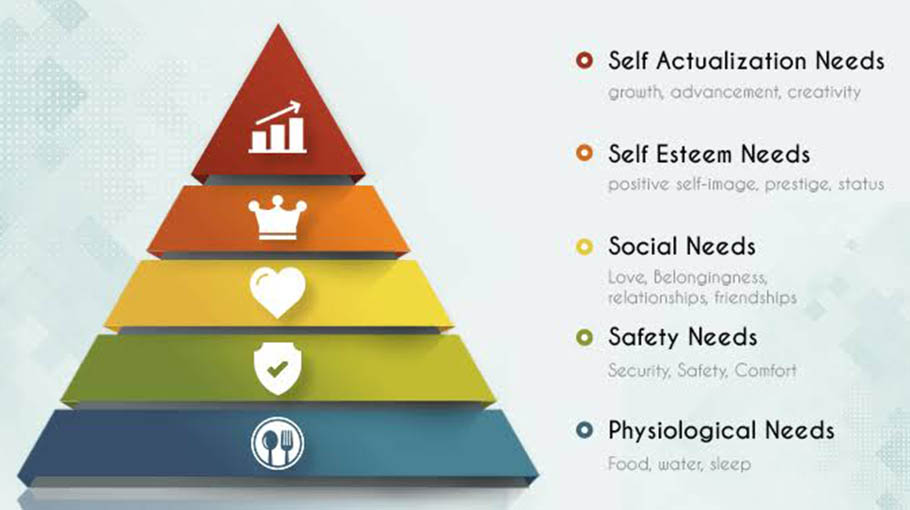
Let’s start with what Abraham Maslow, a psychologist has to say about it. In Maslow’s model, he identified five basic needs that explain the internal motivation process: physiological, safety, social, esteem, and self-actualization needs. A pyramid can represent the model with basic needs at the bottom and the higher level needs at the top.
The basic needs are primary drives. These are the physiological needs - water, food, sleep. The next step is the safety needs - the need for a safe and secure environment. After these two levels love and belongingness comes. People feel the need to obtain and give affection. The model gets sophisticated step by step. The next step is esteem. It is a need to develop a sense of self worth. The last and final step is the self-actualization. It is a state where self fulfillment is felt. A person who reaches self-actualization has come close to using his or her full sets of skills.
It is a tough task for the companies to
ensure that their employees are motivated
enough to meet the organisations’ goals
On to the next theory, Douglas McGregor, a professor of management who introduced a theory of managerial style, referred to as Theory X and Theory Y. Theory X is an assumption that employees dislike work, responsibility, and accountability and must be closely directed and controlled to be motivated to perform. On the other hand, theory Y is a managerial assumption that employees want to be challenged, like to display creativity, and can be highly motivated to perform well if given some freedom to direct or manage their own behavior. Many companies now-a-days are following Theory Y. It is a democratic way. Employees want to satisfy their social esteem and others want to feel important. Theory X, on the other hand, is an autocratic way of leading a company which produces anxiety and frustration.
If we talk about another one, Fredrick Herzberg is a social psychologist and consultant, who proposed a work motivation model in 1950s. It is still very popular among business managers. Work motivation model is an explanation of motivation that defines hygiene factors, and how
they affect job satisfaction & dissatisfaction.
One sector of factors are the hygiene factors that include- salary, work conditions technical supervision, job security, status, company policies, personal life, interpersonal relations. The other set of factors are the motivators that include- achievement, advancement, growth opportunities, recognition and responsibility.
Now, if we discuss about the most well known companies in the world like Google, Apple, Microsoft, all of them have their own unique way to motivate their employees.
If we start with Google, it is very flexible when it comes to their employees. Every Google staff is allowed to decide 20% of his or her time to focus on a project of their choice. They give freedom to experiment and work flexibly. Google enjoys making the life of its employees easier and better. They say it’s all about removing barriers so that ‘Googlers’ can focus on the things they love both inside and outside of work. The emphasis on employee satisfaction has been a priority since day one where the main goal was to make Google a place where the most talented people wanted to work.
Apple believes in the goal setting theory. Employees within the company are highly motivated to attain task goals. Incentive compensation system is a method that Apple uses to motivate employees. This method includes bonus pay, which provides payments on accomplishing the targets or goals given to specific employee. They also offer a certain amount of share of the ownership of the company. The performance incentive and ownership’s share of one’s employment is directly linked to each other. Employees who hold stock of the company are self-motivated to work hard and perform better to raise the market value of the organization.
If we talk about motivating a certain bunch of people, it will be a tough task because everyone is unique and so their personalities. Motivation varies person to person.
Everyone’s needs and wants are also different. So it is a tough task for the companies to ensure that their employees are motivated enough to meet the organizations' goals.
Bushra Binta Zasim is a student at the Department of Marketing, Jahangirnagar University