Khaled Abou Zahr
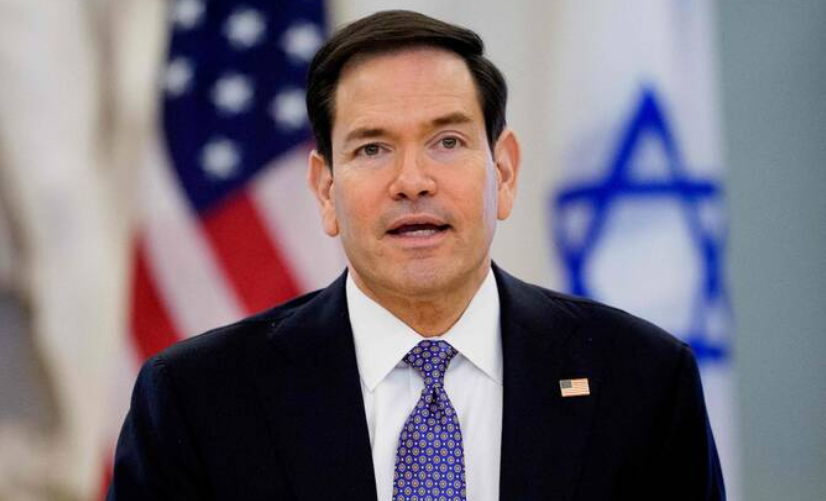
I strongly agree with Marco Rubio’s opening statement during this week’s historic negotiations between Lebanon and Israel: Hezbollah’s role in Lebanon and beyond must be brought to an end. The Lebanese people are victims of Hezbollah and Iranian aggression.
The Israel-Lebanon negotiations in Washington are still at an early stage and the goal should be to achieve a long-term security arrangement and peace, rather than a short-term ceasefire that brings us back to the same point in a few months or years. This means, for the benefit of the Lebanese before anyone else, disarming Hezbollah.
These first direct diplomatic engagements between the two sides in decades remain fragile and highly contested, even in Lebanon. While the Lebanese delegation is understandably looking to halt hostilities immediately and then deal with Hezbollah in order to avoid any more destabilization, the US is clearly looking to achieve a long-term agreement. And this is the right process.
While I am still optimistic about the process, I cannot help but think about multiple instances of negotiations, especially between Israel and the Palestinian Authority, where all the points were discussed and agreed upon, only to hear the Palestinian leadership state that this solution would not be accepted by the people and hence it was dropped. This has not worked to the advantage of the Palestinians. The infighting has increased and weakened them even more, reaching the catastrophic levels we witness today.
This is why a referendum on these negotiations is a necessity. Despite my strong belief that Hezbollah should surrender its arsenal and that a stable peace should be achieved with Israel, is it fair to ask if most Lebanese feel the same? Do they really want peace and do they trust their government to achieve it? Hence, to avoid the mistakes of the Palestinians, this should be put to the people.
A clear referendum on peace with Israel should be presented. Despite the war, Lebanon is today in a better situation than the Palestinians and can still conduct this vote. One may ask: why now? Simply because a mandate from the people prior to any agreement would solidify the Lebanese stance. The main risk being that if an agreement were to be reached, we would have an unrepresentative group like Hezbollah and its allies trying to torpedo it.
Even if at this stage the process of the negotiations are still exploratory, the objective should be to reach a concrete agreement and to resolve all major political and military disagreements. There cannot be a half-baked solution that only temporarily stops the fighting.
I am confident that the Lebanese would overwhelmingly vote for peace and stability, as this is the only way to move toward a better phase for the country. A negative vote would mean that Lebanon was stuck and would probably not be able to disarm Hezbollah anytime soon. In this scenario, the Lebanese should be ready to become a part of the dying Iranian axis.
So, this would be, in fact, a choice between life and prosperity versus evil and destruction. Some would argue that this vote was a question of demographics and perhaps they are right, but we can no longer live with this hypocrisy and the people need to take responsibility.
This is not something new. The EU was built with the use of such votes. In France, the referendum on the Maastricht Treaty in 1992 aimed to legitimize deeper European integration, including the creation of the EU and the path toward a single currency, by transferring significant national sovereignty to supranational institutions. The country’s 2005 referendum on the European Constitution, which sought to simplify and consolidate EU treaties into a single constitutional text to improve clarity and institutional efficiency, saw a victory for the “no” campaign, slowing the integration process.
Similarly, the 1992 Swiss referendum on the European Economic Area aimed at deciding whether Switzerland should more closely integrate with the EU single market. It was narrowly rejected, meaning the country ultimately chose a more independent, bilateral approach.
Votes can go either way, as we witnessed during the UK’s Brexit referendum of 2016, which resulted in a historic decision to leave the EU, fundamentally reshaping the country’s political and economic relationship with Europe. The same process has been used for constitutional referendums as well as independence votes. Lebanon probably needs both this referendum on an agreement with Israel and a constitutional one, but the latter is another story.
Another reason I would like to see this vote take place is that it would let the Lebanese decide whether they agree with what Rubio said — that the country is a victim of an Iranian occupation, which followed the Syrian one, and that Hezbollah is an integral part of this evil force.
If they voted no to peace, it would mean that they disagreed and this would be an unfortunate scenario, as there is little doubt it would give Hezbollah and its allies a green light for a full takeover of the country. As the regime in Tehran is disintegrating, this would not only be morally wrong but also the worst possible decision for peace and the stability of future generations.
It is high time to take responsibility and give a strong mandate so that the state, not an organization, benefits from unity during what are clearly going to be difficult but imperative negotiations.
Khaled Abou Zahr is the founder of SpaceQuest Ventures, a space-focused investment platform. He is CEO of EurabiaMedia and editor of Al-Watan Al-Arabi.