Out of the 2024-25 budget of Tk 7,97,000 crore, only 0.48 per cent has been proposed to be allocated to persons with disabilities. Which is far from 1 percent, not even half a percent. Additionally, the number of disability allowance beneficiaries under social security has decreased.
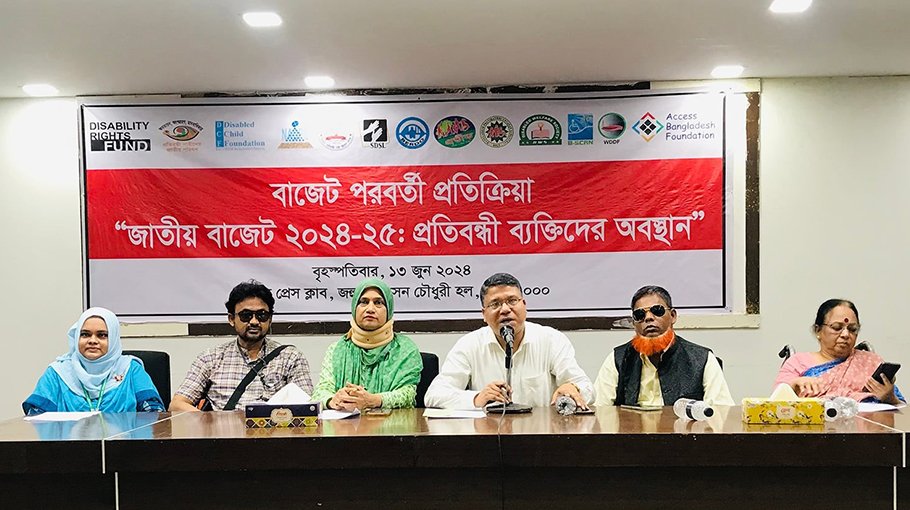
Speakers made these remakes at a post-budget reaction meeting titled “National Budget 2024-25: Status of People with Disabilities” organized by Access Bangladesh Foundation with the support of Disability Rights Fund and representatives from 13 organizations for people with disabilities at the National Press Club on Thursday.
The organizations include the National Council of Disabled Women (NCDW), Disabled Child Foundation (DCF), NADPO, Joyita Disabled Women Development Organization, Society of the Deaf and Sign Language Users, BERDO, Protik Mohila O Sheshu Sangstha, BPUS, Disabled Welfare Society, B-Scan, and WDDF.
Access Bangladesh Foundation Chairperson Mohua Paul presided over the meeting, and its Executive Director Albert Mollah presented an analysis on the budget allocation for people with disabilities.
Albert Mollah thanked the Prime Minister, the Finance Minister, and the Bangladesh government for increasing the number of disability allowance beneficiaries from 2.9 million to 3.34 million, raising the monthly education stipend for students with disabilities from BDT 950 to BDT 1,050 at the higher secondary level, and allocating BDT 1.5 billion for the National Academy for Autism and Neurodevelopmental Disabilities project, up from BDT 975.8 million in the 2024-25 fiscal year budget.
However, he expressed concern that the allocation for disability sectors constitutes only 2.80 per cent of the social safety net programs (down from 2.94% in 2023-24) and 0.48 per cent of the total budget (down from 0.49 per cent in 2023-24). He pointed out that this year’s allocation is insufficient compared to the needs of people with disabilities. The monthly allowance for people with disabilities remains unchanged at BDT 850, which is very minimal considering the rising cost of living and inflation. The number of disability stipends for students has remained at 100,000 for the past five years. He emphasized the need for ministry-wise budget allocations for inclusive development, skill development, and self-employment initiatives for people with disabilities, which are currently lacking. He also noted the absence of provisions to implement UN Convention on the Rights of Persons with Disabilities, the Rights and Protection of Persons with Disabilities Act of 2013, the Neurodevelopmental Disability Protection Trust Act of 2013, policies, and action plans.
Albert Mollah also highlighted that despite clear mentions in the Eighth Five-Year Plan for implementing the 2013 law, making the national coordination committee effective, strengthening monitoring, and providing a monthly benefit of BDT 3,000 to people with disabilities, there is no reflection of these in the final year budget of the Eighth Five-Year Plan. It is necessary to consider whether the budget allocation prioritizes the needs of people with disabilities, whether government spending on people with disabilities is sufficient to establish their rights, whether all ministries' expenditures contribute to the inclusion of people with disabilities, whether the budget allocation increases progressively every year, whether existing infrastructure and services are accessible to people with disabilities, and whether people with disabilities and their organizations are involved in the budget allocation and financial management process. The national budget analysis reveals the absence of these considerations.
During the reaction meeting, Sharmin Akter Dolon, Program Coordinator of WDDF, presented 11 demands to the government for reconsideration. Key demands included determining the monthly allowance for people with disabilities according to the National Social Security Strategy and the Eighth Five-Year Plan, introducing a caregiver allowance for severely disabled persons, initiating projects for self-employment of people with disabilities, allocating for skill development training and ensuring employment post-training, taking effective steps to implement the quota in government jobs, providing tax benefits in phases to encourage private employers, ensuring quality assistive devices and duty-free import based on disability type and need, and providing them free to poor disabled persons, and abolishing all types of VAT-tax and surcharges on savings instruments like savings certificates, FDRs, and DPS for people with disabilities. Additionally, ensuring that 100% of students with disabilities receive educational stipends to prevent dropout, introducing separate stipends for disabled students in technical institutions, ensuring physical and informational accessibility in educational and technical institutions, making educational support materials suitable for people with disabilities, incorporating sign language and Braille in teacher training curricula for inclusive education, allocating budget to make the teaching and assessment process suitable for disabled students, and establishing a Bengali Sign Language Institute for the development of hearing-impaired individuals. Furthermore, ensuring infrastructural and informational accessibility for people with disabilities in all public and private sectors, importing and manufacturing buses with power or manual ramps suitable for disabled people, creating accessible shelters and housing for the homeless, using signage, and making rail stations, bus terminals, and launch terminals accessible.
Including people with disabilities in the framework of Smart Bangladesh by allocating budget for infrastructural and informational accessibility of all websites, government e-services, and union information centers, making general health services suitable and accessible for disabled people, providing specialized health services for them, allocating ministry-based budgets for the inclusive development of people with disabilities, increasing participation in education and employment, undertaking extensive awareness programs at the grassroots level to reduce violence and abuse, allocating budget for the organizations of disabled people, and ensuring that a portion of the allocated budget for efficiency development, entrepreneur development, and employment activities is spent on the employment of people with disabilities.
Nazrana Yeasmin Hira, Program Coordinator of Manusher Jonno Foundation, highlighted the need for ministry-wise budget allocation.
Badiul Alam, President of NADPO, mentioned that the BDT 850 allowance for people with disabilities is insufficient for a person's livelihood.
Representatives of NGOs, journalists, people with disabilities, civil society, and organizations of persons with disabilities attended the discussion. The meeting concluded with a vote of thanks from Mohua Paul.