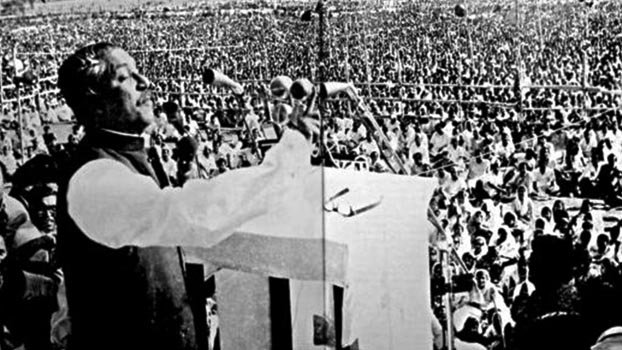
On this day, 49 years ago, Bangabandhu Sheikh Mujibur Rahman’s historic speech rallied up millions of Bangalis to prepare for a war of independence amid widespread reports of armed mobilisation by West Pakistan. Delivered at the Ramna Race Course, the rousing speech gave voice to the aspirations of a nation that was out to prove its right to sovereignty.
The 7th March Speech delivered by Father of the Nation Bangabandhu Sheikh Mujibur Rahman is a blazing and revolt poetry which had sowed the kernel of freedom amidst the people of Bangladesh. Thus it gave the birth of a new nation in exchange for a sea of blood. While standing in front of a sea of people Bangabandhu, the poet of politics roared “Joy Bangla” with the liability of the whole nation on his shoulder, it had an instant electrifying effect on them towards achieving a common purpose, freedom.
The significance of the historic 7th March speech has had transcended the boundary of borders and the circle of time through its historical consequences and rhetoric appeals like the historical speech of Winston William Churchill or The Gettysburg Address by Abraham Lincoln or like Martin Luther King’s “I have a dream.” Significantly the recent recognition of the historic 7th March speech as a world documentary heritage by UNESCO has added a new layer of global significance to it.
Being a former student of Media and Communication, in one of my academic courses I was supposed to learn and study the rhetoric analysis of the historic 7thMarch speech. While doing this, I was exploring why whenever or wherever I watch it or listen to it, it gives me a feeling of being the son of the Father of the Nation Bangabandhu Sheikh Mujibur Rahman. Also while doing this, I found this speech to be one of the masterpieces of persuasive public speaking in the world’s history.
Clad in a white panjabi and pyjama with the characteristic black overcoat, Father of the Nation Bangabandhu Sheikh Mujibur Rahman stepped up to the dais at around 3:15pm. The confluence of people welcomed him with the "Joy Bangla" slogan.
Each carefully thought out word was used to sketch Mujib's guidelines for his people to follow in the developing confrontation with the civil-military-political combine of West Pakistan. At the erstwhile Race Course Maidan (currently Suhrawardy Udyan), the history begun like this:
“My brothers,
I have come before you today with a heart laden with sadness. You are aware of everything and know all. We have tried with our lives. And yet the sadness remains that today, in Dhaka, Chittagong, Khulna, Rajshahi and Rangpur the streets are soaked in the blood of my brothers. Today the people of Bengal desire emancipation, the people of Bengal wish to live, the people of Bengal demand that their rights be acknowledged”
Standing in front of a sea of people Bangabandhu thundered:
“In every village, every neighborhood, set up Sangram Parishad under the leadership of the Awami League. And be prepared with whatever you have. Remember: Having mastered the lesson of sacrifice, we shall give more blood. God willing, we shall free the people of this land”.
In his own imitable and iconic oration, Mujib told a tale of exploitation as million-strong crowd hung on every word.
Bangabandhu goes into the core principle of democracy when he says, “despite our majority, we would still listen to any sound ideas from the minority, even if it is a lone voice, I support anything to bolster the restoration of a constitutional government.” Perhaps, the weightiest dictum he utters in the speech is: “the struggle this time is a struggle for freedom, the struggle this time is a struggle for independence.” Bangabandhu uses the word “independence” as a leitmotif of “emancipation”. He is precise and clear when he says,“what I want is justice, the rights of the people of this land.”
It was a symphony of a struggle and Bangabandhu was the conductor.
At the mammoth rally at the Race Course ground on March 7, 1971, Mujib called on the freedom-loving Bangalees to fight back against the oppressive Pakistani regime.
And so was signalled the twilight of the struggle for national self-expression and eventual liberation from colonial rule.
In this historic speech, Bangabandhu mentioned the four conditions under which he and the Awami League would attend the National Assembly meeting to be held on March 25 -- the immediate lifting of martial law, the immediate withdrawal of all military personnel to their barracks, the immediate transfer of power to elected representatives of the people, and a proper inquiry into the loss of life during the conflict.
He also gave several directives for a civil disobedience movement -- people should not pay taxes; government servants should take orders only from him; the secretariat, government and semi-government offices and courts in East Pakistan should observe strikes; with necessary exemptions announced from time to time, only local and inter-district telephone lines should function; railways and ports could continue to function, but their workers should not co-operate if they were used to repress the people of East Pakistan.
At the end of his speech, Bangabandhu Sheikh Mujibur Rahman declared, ‘Ebarer Sangram Amader Muktir Sangram, Ebarer Sangram Swadhinatar Sangram’ (The struggle this time is the struggle for our emancipation; the struggle this time is the struggle for independence).
The historic 7th March speech was so powerful that it had bolstered the Bengalis to start their nine-month long bloody journey for freedom. It created such a strong sense of mass-agitation amongst deceived people of Bangladesh which had compelled them to break the chain of oppression. Moreover, yet this speech has been an epitome of valor and courage even after forty six years of our liberation. Also it has been transcending to every aspect of our lives since the independence of the country.
The heartfelt demand of the mass people of Bangladesh was resounded by this epoch-making speech of Father of the Nation. The killings, oppression, and torture of the Pakistani occupation forces on the Bengalees were pictured through this Speech, and the main goal of this Speech was the necessity and desire of the emergence of an independent State."
In his speech Father of the Nation Bangabandhu asked the Bengalis to remain prepared with whatever they had as he delivered it at the final stage of the independence struggle that united the entire nation against the colonial Pakistani forces and the Bengali Nation, and then started taking preparations for taking part in the armed War of Liberation being imbued with his inspirational speech”.
The 7 March speech dealt with almost all issues alive then. But the most important was the directives given by Bangabandhu for running the civil government ignoring the government of Pakistan. In fact from 3rd of March to 26th, the people of Bangladesh listened to the orders of Sheikh Mujib and not the autocratic ruler of Pakistan. There was no flag of Pakistan anywhere in Bangladesh excepting the cantonment where the occupation armies had been staying. A Pakistani leader Aga Khan who visited Bangladesh at that time said that none could save Pakistan other than Sheikh Mujib. The situation was so grave then. In reality it was in that speech Sheikh Mujib told his people how to conduct a guerilla war against the occupation army and ordered to lay seize of the occupation army. He spoke of such a seizure that the supply of food and water cuts off. He ordered disruption of road communications and what not. In fact he was de facto head of the government.
Bangabandhu will also always be remembered for his immense contribution towards the world recognizing Bangladesh as a country that had emerged from the ashes to become an important player among the international community of nations- within the United Nations, the Commonwealth, the Non-Aligned Group and the Organization of the Islamic Conference. One can only remember with gratitude the great contribution made by Bangabandhu.
The presentation of the 7th March speech produced such rhetorical appeals which persuaded people of all ages and all classes and also people from every walks of life. The birth of Bangladesh is the burning example of the fruitfulness of the historic 7th March speech. Sheikh Mujib’s idiosyncratic appeal with his arduous voice and examples from the history built his credibility and gained the trust of the mass-people. Despite all the conflicts between erstwhile East and West Pakistan, Bangabandhu addressed the West Pakistanis as “brothers.” Those who sacrificed their lives became his “children.” Through such words he touched the core of heart of the people. The words from March 7 should never be forgotten. It is time once again to gratefully remember and pay homage to the great patriarch.
Bangabandhu was gifted with extraordinary organisational acumen and had the inkling of the brutality of the Pakistani military junta. Accordingly, he exhorted the people for an imminent armed struggle. His historic 7th March speech bears an eloquent testimony to that.
Sayeed Hossain Shuvro is Editorial Assistant, Bangladesh Post