Mahfuzur Rahman
If there is one thing that the world needs to learn from the US, I will pick its pragmatism and flexibility. The most recent example will be the way it deals with the Talibans’ rise. The 16 August speech of US president Joe Biden is a testament of this pragmatism. This speech will remain as a textbook reference in the discussions of US foreign relations, as well as in the history of the United States.
The pragmatism has been demonstrated when the US president says, I quote from the speech, ‘We focus on the threats we face today in 2021 – not yesterday’s threats.’ Many compares US exit from Afghanistan to its retreat from Vietnam. Many in US, both the Republicans and the Democrats, particularly the veterans of Obama administration, are criticizing the US government for the withdrawal from Afghanistan, for failing to predict Talibans’ speed, for failing to protect, support or repatriate the Afghans, and most importantly for not ensuring safe exit of the Americans from Afghan soil well before the doomsday.
When people are free to play with many ifs and buts, the president’s speech has covered all possible issues and questions. One may not be satisfied with the answers or with the explanations. Many may have supplementary questions, but the speech clearly touches the issues that the American people are having in their mind.
Not many have appreciated what Joe Biden says. If I pick words, not out of context, from his speech, ‘I will not repeat the mistakes we’ve made in the past’, I will insist that this is the beauty of pragmatism of US leadership.
My impression is that the Talibans will not interfere in the safe
exit of the US citizens who are stranded in Kabul, and also the
Afghans specially who are under the Special Immigrants Visa
(SIV) and Operation Allies Refuge (OAR) programme
It is known to all that during the liberation war of Bangladesh in 1971, the US administration remained hostile towards our cause of independence. Many of us even know that the then US Consul in Dhaka Archer Blood used to send telegrams to the US State Department criticizing the US position on our War of Liberation. Only a few of us may know that later on the State Department introduced Archer Blood medal for its officials who rightly challenges the decision of the State Department. And we all know, despite its negative role in 1971, the US government did not hesitate to recognize the independent Bangladesh on 4th April 1972 as the 38th country to do so.
If I can refer to the brilliant remarks of Bill Clinton that he made in Dhaka during his visit of 2000 –‘Twenty-nine years ago this month, against extraordinary obstacles, Bangladesh began a lonely fight for existence that did not receive the support it deserved from many countries around the world.’ Who will believe that these words will come from a president of the US, a country that was on a different side during our War of Independence – a clear sign of pragmatism?
Twenty years ago, when the US forces put its steps in Afghanistan, it was the Talibans that need to be ousted. Since then, the US was at continuous loggerheads with the Talibans. However, this did not prevent the US to open negotiations, both covert and open, when it felt appropriate for the sake of its exit. I am sure, during all these negotiations, the US, raised all the issues pertinent to a safe exit, and wanted to secure its interest most.
It is a fact that the US State Department never recognized the Talibans as the legitimate representatives of the people of Afghanistan, or the state. Though the text of the February 2020 agreement with the Talibans, mentioned as many as sixteen times, the nomenclature, ‘the Islamic Emirate of Afghanistan’, but that was always preceded by the words, ‘. . . which is not recognized by the United States as a state...’ This is the demonstration of flexibility of the US foreign policy.
I need to recall again the situation during our War of Independence, when the US Department of Justice received representatives of the independent Bangladesh Government in exile, Justice Abu Sayeed Chowdhury and A. H. Mahmood Ali, later on our Foreign Minister, to name a few, and carried on discussions on the question of independence of Bangladesh and the War. I see this flexibility a beauty of US foreign policy.
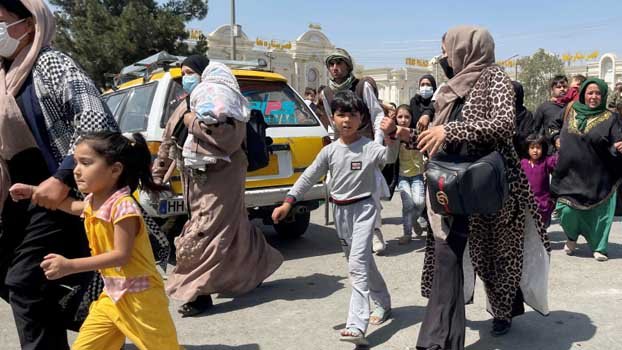
My impression is that the Talibans will not interfere in the safe exit of the US citizens who are stranded in Kabul, and also the Afghans specially who are under the Special Immigrants Visa (SIV) and Operation Allies Refuge (OAR) programme. The major challenge for the Afghans will be to avoid the Taliban’s check posts and reach the airport in safe condition and in time. No matter, what the other governments including the allies opine, if this exit strategy works well, I do not think the US will fudge much even to recognize the next possible functional government of Afghanistan – one that will be formed by the Talibans.
It took twenty years for the US to recognize the government of Hanoi, I do not think this time it will take such a period.
The word pragmatism will be tested by the strategy to bring the Talibans or its ‘Emirate’ to the fold of the club of the nations. Again, if I take words from Joe Boden’s mouth, it was clear that he did not want to pass on any rubbish for the next president. We can surely expect another pragmatic from the US presidency.
He, who admits and learns from the mistakes, makes fewer mistakes in future. US President Joe Biden uttered, ‘Our mission in Afghanistan has taken many missteps.’ Therefore, we now expect further wisdom for correcting the ‘missteps.’ And this expects to ensure what the twenty-year presence could not ensure - a stable Afghanistan.
- Mahfuzur Rahman is a former ambassador of Bangladesh. An alumnus of BUET, Monash University, Harvard University, Maryland University, and Hawaii Asia Pacific Centre for Security Studies. He can be reached at mahfuz1961@gmail.com.