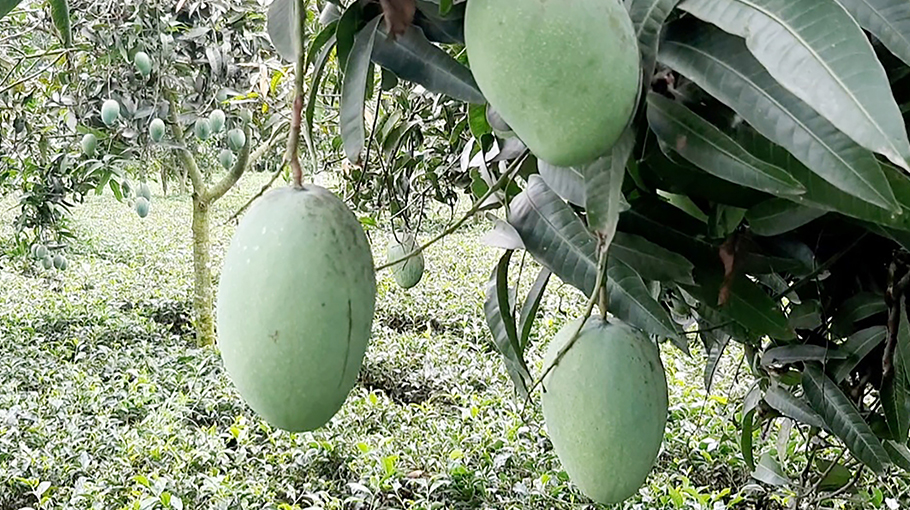
Tea farmers in Panchagarh are now cultivating different fruits inside their plain land tea gardens to recover losses as they have their backs against the wall for not getting fair price of raw tea leaves.
Sources said the tea growers are not doing well in Panchagarh as they are trapped in the syndicate of the tea factories. Farmers are obliged to give raw tea leaves at the desired price of the tea factories. If tea leaves are not picked within the stipulated time, they are not suitable for the factory. There is no other option but to throw away the discarded leaves.
Many tea farmers have uprooted tea trees of their gardens due to losses and those who still have gardens are trying to make up for the loss by cultivating alternatives besides tea. In the tea gardens, mango, lotkon (Burmese grape), betel nut, malta and other species of trees have been planted. In the meantime, many trees have yielded well. Now, though the price of tea leaves is low, they are dreaming of recouping their losses by selling the fruits of other trees.
However, tea board officials said planting other fruit trees in tea gardens increases the attacks of pests in gardens. But the agriculture department said the farmers are being trained to focus on organic production by bringing the farmers under the project.
The bordering district of Panchagarh has long been known as the tea kingdom of the plains. As the soil of the plains is suitable for tea, the number of tea plantations increased rapidly. However, to overcome the emergency crisis, the farmers of this district have developed mixed fruit gardens in the tea gardens of the plains. The tea gardens are now adorned with beautiful rows of large and small mango, lotkon, malta and betel nut plantations. Most orchards have different species of mango trees. Different varieties of mangoes, including Haribhanga, Amrupali and Banana Mango, are being produced organically. Organic pesticides are being used on these plants. This increases the demand of organic mangoes among the consumers and the price of mangoes is also very good in the market. Tea farmers are seeing profit by getting multiple crops in one land. When the mangoes begin to ripen, they are packaged and sent to the customer level through various wholesalers of the district and the country or through couriers.
Kazi Anisur Rahman, a farmer of Bara Billa (Magura) area in Tentulia Upazila, said he first started cultivating mangoes as a companion crop in the tea garden on a large scale. Many tea growers in Tentulia are now cultivating mangoes in their tea gardens after seeing an unexpected yield in the next year. Buyers come from different districts to buy these tea garden mangoes.
Abu Bakkar Siddique, a tea farmer of Dangapara village under Kamat Kajaldighi Union in Panchagarh Sadar Upazila, said the thrill of agriculture is nowhere else in the world. A good farmer can do much for himself and the country, if he is mindful.
Abu Bakkar, the father of six children, educated his children highly. Although he is alone in the world of life, this art of agriculture keeps him busy. At present, he has done well by planting vegetables and fruits, including mango, lotkon, betel nut and lemon, on about 20 bighas of land. He said that he got Tk 2 lakh by selling the lotkons of 50 trees this season and Tk one lakh by selling mangoes. He is earning regularly by selling vegetables throughout the year.
Abdul Matin, deputy director of Panchagarh District Agricultural Extension Department, said farmers are being trained to produce poison-free organic mangoes under the project. Various fruits, including mangoes and lotkons, are being sent to different parts of the country after meeting the demand of the district. However, the farmers are benefiting financially along with creating a business based on organic mangoes.