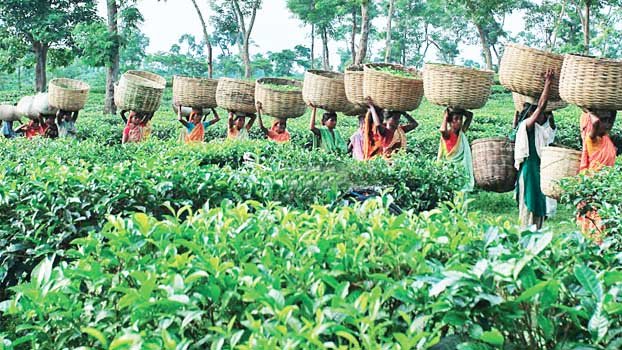
Lured by lucrative market price of tea seems inspiring the growers to expand its cultivation in the country’s hill and the Barind tracts.
Besides tea production in the hilly areas of Sylhet, Chittagong and other hill districts, tea is also being produced in flat paddy lands in the northern part of the country like all other crops.
An undeclared revolution in tea production has taken place in the northern part of the country. Tetulia, the northernmost upazila, has changed people's perception of tea production.
The cultivation of tea in paddy lands has changed the lifestyle of the farmers of Panchagarh.
Emerging tea sector is playing an effective role in improving the living standards of thousands of people in the Karatoa Valley ecological zone, comprising five northern districts of Bangladesh- Panchagarh, Thakurgaon, Dinajpur, Nilphamari and Lalmonirhat districts.
When asked Kul Prodip Chakma, Secretary of Bangladesh Tea Board, about the development and current status of the tea industry, he told the Bangladesh Post that, “Tea cultivation has already been expanded in Panchagarh, Lalmonirhat and Bandarban in the Chittagong Hill Tracts, which will be increased more in the coming days.”
Kul Prodip Chakma said, “Being directed by the then Prime Minister Sheikh Hasina during her visit to Panchagarhin 1996, thensome tea saplingswere planted there locally in Panchagarh on experimental basis.”
Following better results, BTB scientists conducted feasibility study in Panchagarhand Thakurgaon in 1999 and found 16,000 hectares of land suitable for tea cultivation on commercial basis.
Kul Prodip Chakma said, “Following the continuous success, local farmers started commercial-basis tea cultivation on the `small-scale gardening-basis’ in the valley ushering in a new horizon in the agriculture economy.”
“Apart from that, tea cultivation is gradually increasing in several areas of Sherpur and Mymensingh districts. The Tea Board is providing all kinds of assistance to small farmers in those areas,” he added.
Tea farmers in Tetulia said that tea cultivation will increase if there is ‘assurance of sale’. It will be possible to earn a huge amount of foreign currency by meeting the demand of the country and exporting tea abroad.
Nasir Uddin Ahmed Mithu, owner of theSabiha Tea Company in Tetulia, told the Bangladesh Post that, “Tea cultivation on `small-scale gardening-basis’ has ushered in a new perspective to change fortune of local farmers of North Bengal which is enriching the country's economy. If the big packaging companies buy the tea leaves of Panchagarh from auction, then the tea production in North Bengal will increase more.”
However, tea production in Bangladesh is mainly concentrated in Surma Valley of Sylhet Division, Halda Valley of Greater Chittagong and Karatoa Valley of Panchagarh. Most of the tea production in the country is in Moulvibazar area.
In particular, the quality of green tea produced at the Bangladesh Tea Research Institute (BTRI) is very good. When the owner of Chapata.net was asked about the green tea produced by BTRI, he said that the factory where the green tea is produced is very fresh and the quality of this tea is very good.
According to the Tea Board's Panchagarh regional office, 16,000 acres of land in the district have been made suitable for tea cultivation and tea is being cultivated on 2,255.55 acres of land.
Talking to this correspondent, the Senior Scientific Officer at Bangladesh Tea Research Institute, also Project Director of the Northern Bangladesh Project of BTB at its regional office, Dr Mohammad Shameem Al Mamun told the Bangladesh Post that, “With continuous expansion of tea cultivation on `small-scale gardening-basis’, production of green tea leaves is boosting every year creating jobs for thousands of tea workers, mostly women, in the valley.”
Meanwhile, tea is being cultivated in 167 gardens in the country,which is not enough compared to the domestic demand of the country. There is no alternative to increasing tea production to deal with this situation.