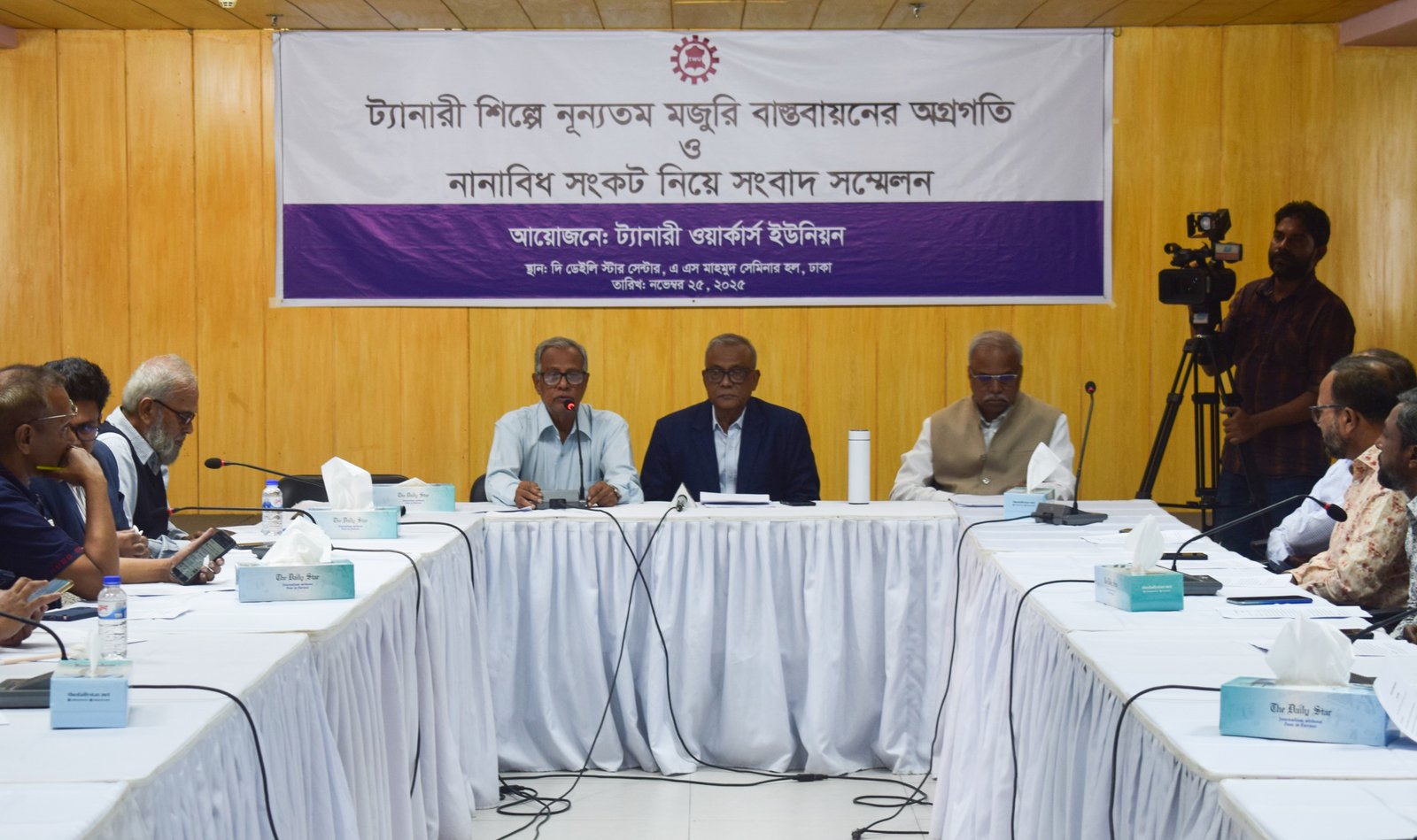
The Tannery Workers’ Union has warned that the country’s tannery industry is plunging into a severe crisis due to the owners’ prolonged delay in implementing the government-declared minimum wage, large-scale layoffs, the spread of illegal contractor systems and an initiative to bring the sector under the Bangladesh Export Processing Zones Authority (BEPZA).
At a press conference held at The Daily Star Centre in Dhaka on Tuesday, the union alleged that the industry is now in a state of “extreme uncertainty”, despite a gazette notification issued on November 21, 2024 and the Ministry’s subsequent revision of the minimum wage.
Union President Abul Kalam Azad and General Secretary Abdul Malek said discussions, tripartite meetings and the Ministry’s final decisions have continued for almost two years, yet tannery owners have taken “no effective measures” to implement the revised wage.
They accused factory managements of deliberately classifying long-serving employees as “temporary” to deny them their lawful wages, calling it a clear breach of labour law. They further noted that while bipartite agreements were required to be renewed after the wage board’s decision, owners were “intentionally delaying” the process, putting other worker benefits at risk.
The union also expressed alarm that the interim government’s move to place the tannery sector under BEPZA was taken without any consultation with workers’ representatives.
Leaders alleged that skilled workers and machine operators were being laid off in a “planned manner” and replaced with contractor-supplied labour. Many dismissed workers were not receiving their legal dues, they said, warning that a formal, regulated sector was being pushed towards informal labour arrangements.
Advocate AKM Nasim, Country Programme Director of Solidarity Center Bangladesh and member of the Labour Reform Commission, said the owners’ reluctance to enforce the gazetted wage and the inaction of government agencies were “deeply worrying”. He added that disparities were particularly visible among temporary labourers in Dhaka and female workers in Chattogram.
He cautioned that moving the industry under the EPZ framework could significantly restrict workers’ freedom of association, noting that the newly amended Labour Act limits the number of unions within an establishment cluster to five.
Labour Reform Commission Chairman Syed Sultan Uddin Ahmed said the sector remained risky despite its importance to the economy. Prolonged temporary employment, delays in wage enforcement and renewed uncertainty over wage review were “weakening the foundation of trust”, affecting both the industry and national economy, he added.
He urged the media to highlight the issue with national importance, saying such coverage would help protect workers and maintain stable industrial relations.
AU/BP