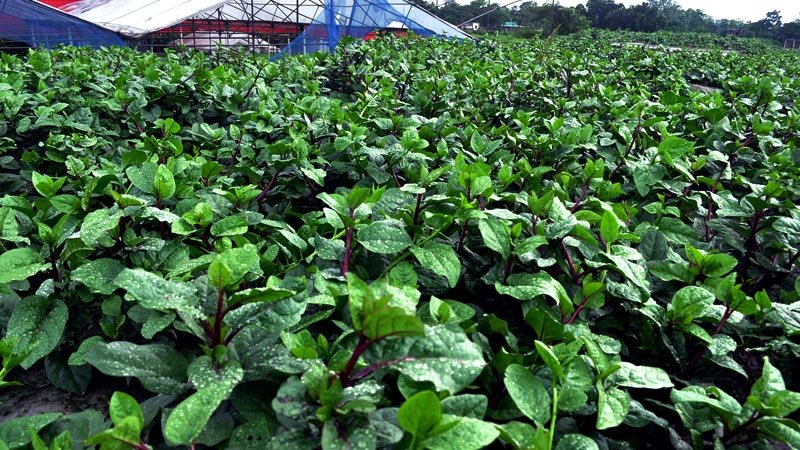
Basella spinach, a very popular spinach in Bangladesh, was planted on soil abandoned near a brick-making kiln in Aminbazar. The soil would have been used to make bricks was found to be highly fertile when the spinach started growing there. The brick field in low lying areas of Gabtoli remained submerged forcing the owner of the factory to suspend production and allow such crop to grow on the stacked soil. Such spinach grows without much care while it is cheap and highly nutritious preferred by lower middle class people of the society. Basella is very low in calories and fats (100 grams of raw leaves provide just 19 calories). Nonetheless, it holds an incredibly good amount of vitamins, minerals, and antioxidants.
Fresh leaves, particularly of basella rubra, are rich sources of several vital carotenoid pigment anti-oxidants such as ß-carotene, lutein, zeaxanthin. Together, these compounds help act as protective scavengers against oxygen-derived free radicals and reactive oxygen species (ROS) that play a healing role in aging and various disease processes.
In addition to natural fiber (roughage) that are found in the stem and leaves, its fleshy leaves facilitate in smooth digestion. Fiber diet brings a reduction in cholesterol absorption, and help prevent bowel problems. The spinach leaves and stem are incredibly rich sources of vitamin A. about 100 grams of fresh leaves provide 8000 IU or 267 pc of recommended daily allowance (RDA) of this vitamin. Consumption of natural vegetables and fruits rich in vitamin-A and flavonoids has been thought to offer protection from the lung and oral cavity cancers.
Likewise in spinach, basella too is an excellent source of iron. About 100 g fresh leaves contain about 1.20 mg or 15pc of daily intake of iron. Iron is an essential trace element required by the human body for red blood cell (RBC's) production. It also contains good amounts of many B-complex vitamins such as folate, vitamin-B6 (pyridoxine), and riboflavin. About 100 grams fresh leaves provide 140 µg or 35% of folates. This vitamin is one of the essential compounds for DNA production and growth. Folate deficiency in during very early stages of pregnancy might results in the neural tube defects in the newborn baby.
Further, basella leaves are good sources of minerals like potassium (11% of RDA/100 g), manganese (32% of RDA/100 g), calcium, magnesium, and copper. Potassium is an important component of cell and body fluids that helps controlling heart rate and blood pressure. Manganese and copper used by the human body as a co-factor for the antioxidant enzyme, superoxide dismutase.