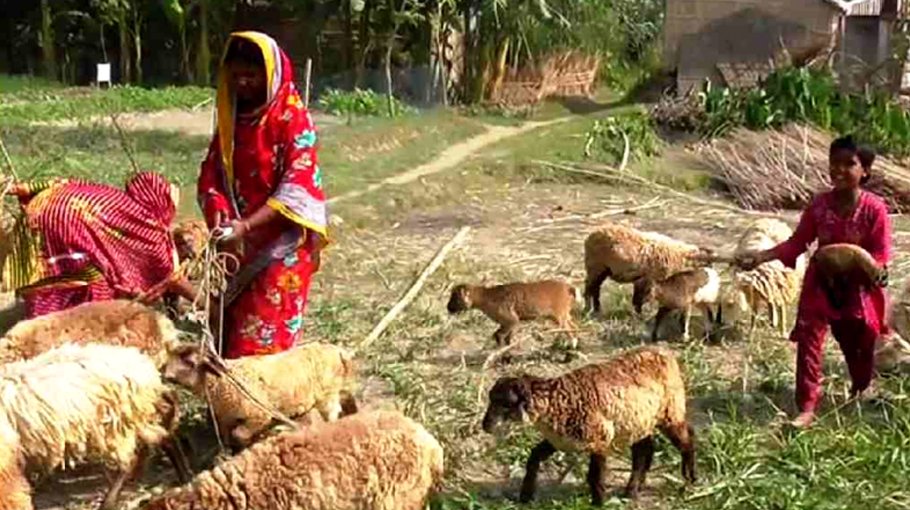
Anandi Saren, 17, has become almost self-reliant through her household-based sheep farming besides contributing to her family and the society as a whole.
After getting one sheep as donation on a voluntary basis in 2017, she enhanced the number to 11 at present by dint of her much attentiveness and
devotion to the sheep rearing venture. An Intermediate class student of Kakonhat Degree College, she had filled up her form for SSC Examination last year with the money she earned after selling two sheep.
Anandi Saren, daughter of Mikhail Saren in Sundarpur village of Godagari Upazila in the district, has elaborated her success attained through efficiency in the micro-level venture, while talking to BSS on Wednesday. She said the single lamb was her lifeline for taking the poverty-prone family to a stable position. But her initial stage was not happy as many of
her neighbors criticized the sheep farming initiative. Anandi said the sheep farming has eradicated her poverty and enhanced
her dignity in the society. She gets money, meat and milk from it regularly. Mita Mormu, 15, a student of class nine in Kakonhat Girls High School,
has found the path of generating income through sheep farming.
She said sheep farming has a vital role towards women empowerment and poverty reduction at the grassroots level. Many of the students have attained success through sheep farming, she added.
A class six student of Nobai Bottola Mission High School in Godagari Upazila, Shefali Saren is seen very much devoted to the rearing since she was
given two sheep in 2020.
Like them, 125 ethnic minority female students were given 127 sheep in Godagari, Tanore and Chapainawabganj Sadar Upazilas since 2017 with the main thrust of facilitating them to continue their respective institutional learning through the sheep rearing income.
Jahangir Alam Khan, Coordinator of Integrated Water Resource Management Project, said the incidence of child marriage among the ethnic minority girls is comparatively high because of their dropout from school due to financial constraint.
He said they have given sheep among the students so that they can improve their living and livelihood conditions through rearing. Motivating and inspiring the landless, small and low-income people to attain their self-reliance through sheep farming is another motto of the initiative.
Professor Jalal Uddin Sarder of the Department of Veterinary and Animal Sciences in Rajshahi University said there is no protein-value difference
between the meat of sheep and goat or cattle.
Even sheep meat is enriched with more protein in comparison to goat and cattle.
He said sheep are more resistant to disease than other domestic animals, adding the household-based sheep farming, after using modern methods and technologies, can be a vital means of meeting up the nutritional demand in the region.
The issue of improvement and conservation of native sheep in society- based farms should be given priority for the greater interest of poverty
reduction and self-employment through the best use of enormous opportunities in the sector.