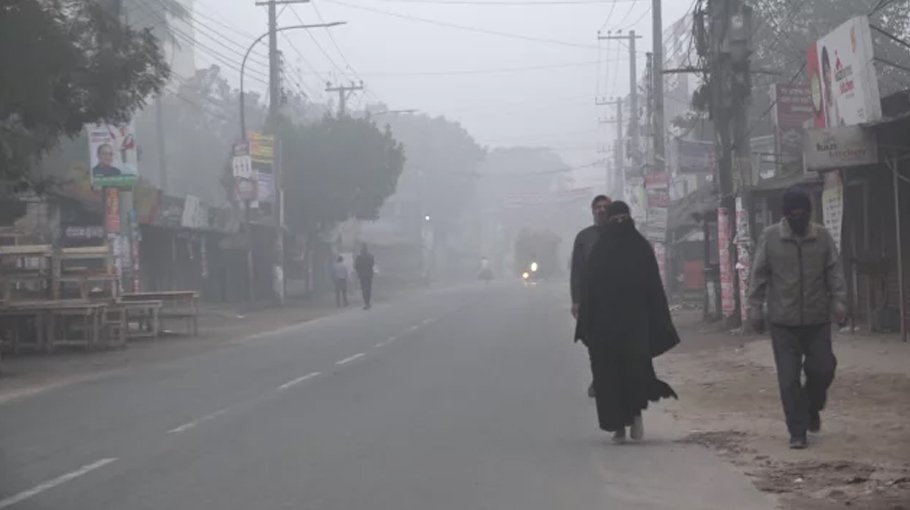
With the advent of the Bengali month of Poush, the first month of the Winter in Bangladesh, the country, especially the northers districts, has started experiencing chilly wether. The month of Paush begins tomorrow (Saturday).
The mild cold wave was sweeping some places of the northern region of the country while people across the country are also experiencing the bite of chilly weather.
However, the season’s first cold wave is likely to fully sweep parts of north-eastern and western districts from today (Friday). A dense fog might also descend on the regions with chances of the cold wave continuing through December 18, said Bangladesh Meteorological Department (BMD).
According to the BMD, the mid cold may continue for the next one or two days. Dinajpur, Chaudanga, Panchagarh, Kurigram and some other districts will experience the cold wave, said Bazlur Rashid, a meteorologist at the BMD.
The cold wave is expected to affect some other districts in Rajshahi, Rangpur, and Khulna divisions, as well as Sreemangal in Sylhet division, and Sitakunda, Hatia, and Rangamati districts in Chattogram likely to experience a significant drop in temperature. The entire nation may also witness an intensified sense of winter.
A cold wave is announced when a temperature is recorded below 10 degrees Celsius, he said, adding that the country’s lowest temperature was recorded at 10.3 degrees Celsius on Thursday.
Weather may remain mainly dry with temporary partly cloudy sky over the country. Moderate to thick fog may occur over the country from midnight to dawn. Night temperature may fall slightly and day temperature may remain nearly unchanged throughout the country.
The lowest temperature in the country this year was recorded in Panchagarh’s Tetulia at 10.3 degrees Celsius over 24 hours till 6:00 am on Thursday. On the other hand, the highest temperature was recorded in Cox’s Bazar’s Teknaf at 30.7 degrees Celsius during the same period.
Northern districts, which are known as the area of most impoverished population segments in the country, bear the brunt of the winter as the chilling northern wind first arrives there.
Daily wage earners and farmers working outdoors suffer much as they have inadequate warm clothes to withstand the chilling cold.
Health experts said that the government should provide free vaccinations for children and the elderly against rotavirus and flu to tackle the possible increase in winter diarrhoeal and flu patients among these age groups.
Winter officially begins in December, but it sets in pockets of northern region earlier than the rest of the country.
However, the changing face of winter in Bangladesh has become increasingly evident in recent years, marked by fluctuations in temperature, precipitation, and weather patterns.
These variations carry profound implications for agriculture, livelihood and the overall environment with factors such as climate change, urbanisation, and deforestation playing significant roles in shaping these shifts.
Bangladesh, traditionally characterised by a humid, warm climate influenced by pre-monsoon, monsoon, and post-monsoon circulations, frequently grapples with heavy precipitation and tropical cyclones.
The historical climate has typically seen average temperatures around 26⁰C, with fluctuations between 15⁰C and 34⁰C throughout the year.