Although the slogan ‘good yield with good seed’ has been added to modern agriculture, seed preservation or seedling preparation is a long standing tradition of the farmer.
Farmers prepare seedlings in the seedbed one or one and half months before the specified time of transplanting Aman or Boro rice seedlings.
There was no shortage of seedlings in the previous days as seedbed was planted in more land than required. Nowadays, due to scarcity of land and high price of seeds, farmers produce seedlings according to their needs.
Even then, if there is a crisis of seedlings due to any reason including natural calamity, the farmer’s used to deal the shortage by buying the seedbed from another farmer.
But the present story is a little different. The busy farmer does not have time to find out who has seedlings in the seedbed, what kind of seedlings or how old the seedlings are.
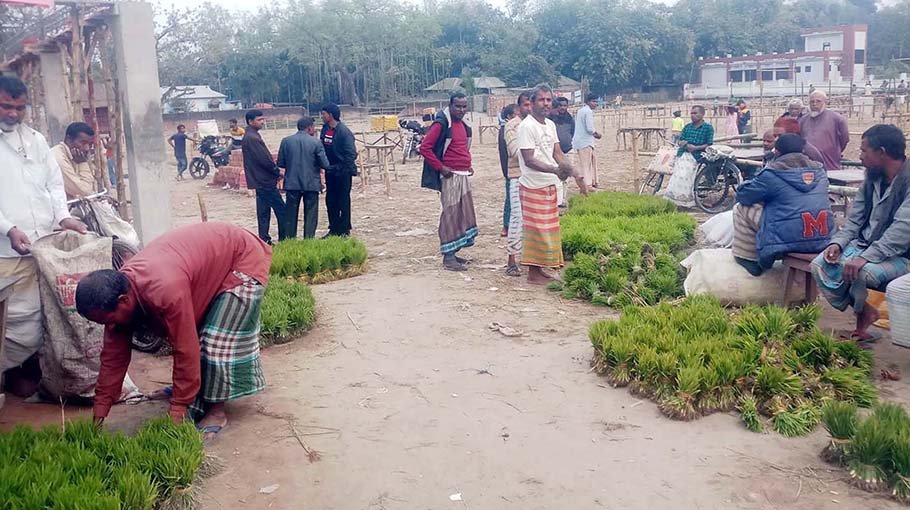
That is why rice seedlings have been being bought and sold in the northern markets for a number of years, especially during the Aman and Boro seasons.
Sharecroppers, including marginal and small farmers are relying on the saplings bought in the market to avoid the hassle.
By capitalizing on this opportunity, the traders have made the seed market.
This year Boro paddy seedlings have come up from the seedbed to the tea shop at Gangachara in Rangpur. Each fourth (four handfuls) of saplings is being sold at Tk 20. Boro rice seedlings are slightly damaged due to cold wave and dense fog every year. Rice seedlings are stolen from the seedbed every night due to the seedling crisis during the Boro planting season.
Although one or two farmers managed to save the seedlings with great difficulty, the price is skyrocketing.
Due to this, marginal and small farmers became apprehensive about Boro cultivation at the last moment.
Visiting to Baraibari Haat in Gangachara, it is known that Boro rice saplings are being sold in tea shops. It was found that the farmers were buying saplings from different tea stall as per their need.
Belal Hossain, a farmer from Mandalrhat area, who came to buy saplings, said that the saplings were not found anywhere. Here every each fourth sapling is being sold at Tk 20. In other words, each sampling price is Tk 5.
Ibrahim Ali, a farmer in the Paikan area, said that about 60 handfuls of saplings are required to plant saplings per bigha (33 per cent) of land.
The price is Tk 3300. Shopkeeper Abdul Jalil said that he was in trouble as the saplings were stolen from the seedbed. So he is bringing it to the tea shop and selling it.
Visiting the Lalbagh market in Rangpur city, it was found that the farmers are not able to make the right decision as the price is high even though the seedlings are for sale. Here too, every fourth sapling does not available below Tk 20. Osman Ali, a farmer from the adjoining Barbari area, who came to buy saplings, said he had planted seedbeds for planting in the land. But those got damaged in the fog. So he is being forced to buy saplings.
According to the Agriculture Department, the target for boro cultivation has been set at 503550 hectares of land in five districts of Rangpur region this season.
Of these, Rangpur has 130950 hectares, Gaibandha has 127845 hectares, Kurigram has 115555 hectares, Lalmonirhat has 47650 hectares and Nilphamari has 81550 hectares.
In order to achieve the target of boro cultivation, seedbed has been planted in 23,090 hectares of land in these five districts.
It is possible to plant 20 hectares of land with one hectare seedbed seedlings.
Mentioning that the borough has till March 15, the rate at which the saplings are being planted will exceed the target at that time. Compared to other years, there is no shortage of seedlings this time.
In the last phase of potato harvesting, two or four farmers who are cultivating boro without any plan are facing shortage of seedlings but they are collecting it from different places.