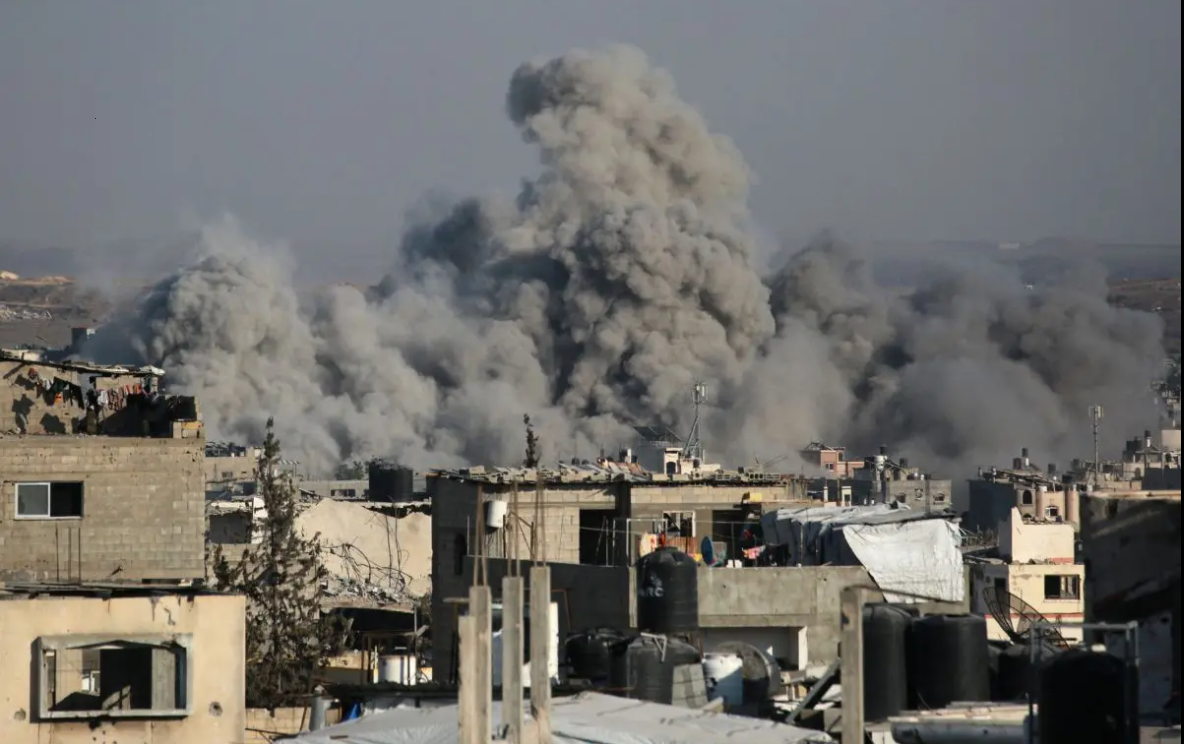
At least 81 Palestinians have been killed and more than 400 injured in Israeli strikes across Gaza in the 24 hours until midday on Saturday, the Hamas-run health ministry said.
In one incident, at least 11 people, including children, were killed after a strike near a stadium in Gaza City, Al-Shifa hospital staff and witnesses told news agencies. The stadium was being used to house displaced people, living in tents.
Footage verified by the BBC shows people digging through the sand with their bare hands and spades to find bodies.
The Israeli military said it was "unaware of injuries as a result of the strike" aside from "a suspicious individual who posed a threat" to its forces.
Meanwhile, US President Donald Trump said he was hopeful a ceasefire could be agreed in the next week.
Qatari mediators said they hoped US pressure could achieve a deal, following a truce between Israel and Iran that ended the 12-day conflict between the countries.
In March, a two-month ceasefire collapsed when Israel launched fresh strikes on Gaza. The ceasefire deal - which started on 19 January - was set up to have three stages, but did not make it past the first stage.
Stage two included establishing a permanent ceasefire, the return of remaining living hostages in Gaza in exchange for Palestinians imprisoned in Israel, and the complete withdrawal of Israeli forces from Gaza.
On Thursday, a senior Hamas official told the BBC mediators have intensified their efforts to broker a new ceasefire and hostage release deal in Gaza, but that negotiations with Israel remain stalled.
A rally was organised on Saturday evening in Tel Aviv calling for a deal to free the remaining Israeli hostages held by Hamas in Gaza. Organisers said "the time has come to end the fighting and bring everyone home in one phase".
Meanwhile, Israeli attacks in Gaza continue. Friday evening's strike near the Palestine Stadium in Gaza City killed at least 11 people, hospital staff and witnesses said.
One witness said they were sitting when they "suddenly heard a huge explosion" after a road was hit.
"This area was packed with tents - now the tents are under the sand. We spent hours digging with our bare hands," Ahmed Qishawi told the Reuters news agency.
He said there are "no wanted people here, nor any terrorists as they [Israelis] claim... [there are] only civilian residents, children, who were targeted with no mercy," he said.
The BBC has verified footage showing civilians and emergency services digging through the sandy ground with their hands and spades to find bodies.
Fourteen more people were reported killed, some of them children, in strikes on an apartment block and a tent in the al-Mawasi area.
The strike in al-Mawasi killed three children and their parents, who died while they were asleep, relatives told the Associated Press.
"What did these children do to them? What is their fault?" the children's grandmother, Suad Abu Teima, told the news agency.
More people were reported killed on Saturday afternoon after an air strike on the Tuffah neighbourhood near Jaffa School, where hundreds of displaced Gazans were sheltering.
The strike killed at least eight people, including five children, the Palestinian health ministry said.
One witness Mohammed Haboub told Reuters that his nephews, father and the children of his neighbours were killed in the strike.
"We didn't do anything to them, why do they harm us? Did we harm them? We are civilians," he told the news agency.
The health ministry said ambulance and civil defence crews were facing difficulties in reaching a number of victims trapped under the rubble and on the roads, due to the impossibility of movement in some of the affected areas.
Asked about the strike on the Tuffah neighbourhood, the Israel Defense Forces (IDF) told the BBC that it "struck a suspicious individual who posed a threat to IDF troops operating in the northern Gaza Strip".
"Prior to the strike, numerous steps were taken to mitigate the risk of harming civilians", it said, adding that it was "unaware of injuries as a result of the strike, besides the individual struck".
Reuters Three cars and multiple tents and people's belongings buried in the sand following a strikeReuters
Tents and people were buried after an Israeli strike on Friday
The IDF released a statement on Saturday evening saying it had killed Hakham Muhammad Issa al-Issa, a senior figure in Hamas's military wing, in the area of Sabra in Gaza City on Friday.
The IDF said he was one of the founding members of Hamas's military wing, a member of Hamas's general security council, and played a "significant role in the planning and execution" of Hamas's 7 October 2023 attack on Israel.
The Israeli military launched its bombardment of Gaza in response to the attack, in which about 1,200 people were killed and 251 others were taken hostage.
More than 56,000 people have been killed in Gaza since then, according to the territory's Hamas-run health ministry.
Possible Ceasefire Within a Week
U.S. President Donald Trump suggested Friday that a ceasefire deal could be reached within the next week. “We’re working on Gaza and trying to get it taken care of,” he told reporters.
An official familiar with the situation said Israeli Strategic Affairs Minister Ron Dermer is expected to travel to Washington next week for discussions covering Gaza, Iran, and related topics. Talks between Israel and Hamas have resumed intermittently since the previous ceasefire collapsed in March, reigniting Israel’s military operations and worsening Gaza’s humanitarian crisis.
Roughly 50 hostages remain in Gaza from the initial 251 abducted during Hamas’ attack on Israel on October 7, 2023. Fewer than half are believed to be alive.
Yotam Cohen, whose brother Nimrod is among the hostages, expressed frustration Saturday: “What more is there to destroy in Gaza? Who is left to eliminate?” His comments came during renewed rallies by hostage families following a recent truce between Israel and Iran.
Over 6,000 Dead Since Ceasefire Broke
According to Gaza’s Health Ministry, over 56,000 Palestinians have died during the war, including 6,089 since the last ceasefire ended. The ministry says more than half of those killed have been women and children, although it does not separate civilians from militants in its reports.
Israel insists its military targets only Hamas fighters and holds the group responsible for civilian casualties, accusing it of operating from densely populated areas.
Families of hostages are hopeful that Trump’s role in brokering a truce with Iran could influence negotiations in Gaza. Israeli Prime Minister Benjamin Netanyahu, buoyed by public approval for the Iran operation, may now have more room to push for a ceasefire—though members of his far-right coalition remain opposed.
Hamas maintains it is ready to release all hostages if the war ends, while Netanyahu has vowed to continue the conflict until Hamas is fully disarmed and removed from Gaza, a demand the group refuses.
Food Crisis and Deadly Aid Access
As the humanitarian situation worsens, desperate Palestinians are struggling to obtain food. Israel restricted all food deliveries for over two months and has only allowed limited aid since mid-May.
According to Gaza’s Health Ministry, more than 500 people have died and many more injured while trying to access food over the past month. The Gaza Humanitarian Foundation, newly established to distribute aid, has faced deadly chaos as civilians are reportedly shot at while approaching distribution points.
Palestinian witnesses claim Israeli troops fired on crowds, while the Israeli military says only warning shots were used and that investigations are underway.
People often walk long distances through military zones to reach aid locations. Efforts by the United Nations have been hindered by looting and overwhelming crowds.
Among Saturday’s fatalities were two Palestinians killed by Israeli gunfire while waiting for food near the Netzarim corridor, a road dividing northern and southern Gaza. Their bodies were taken to Al-Shifa and Al-Awda hospitals.
The Israeli military has not issued an official statement on the latest incidents.