Hassan Al-Mustafa
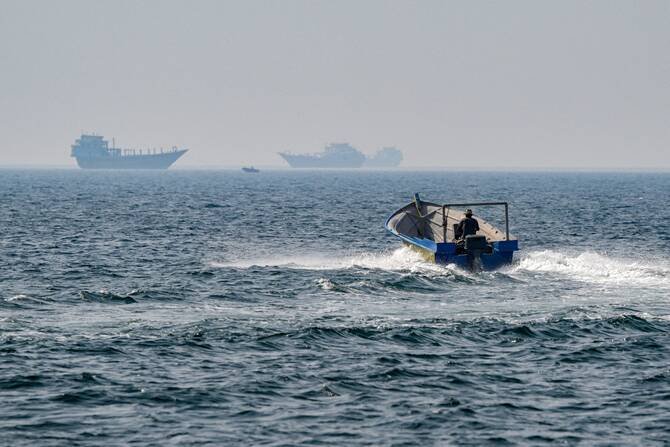
Saudi Arabia’s Ministry of Foreign Affairs broke its silence on May 5 with a pointed call for de-escalation, restraint and an end to provocation across the Arabian Gulf. In the same statement, Riyadh threw its weight behind Pakistan’s mediation effort and the wider diplomatic drive for a political settlement — warning that the region could ill afford to drift any further toward instability. The Kingdom also pressed for the full restoration of maritime traffic through the Strait of Hormuz, insisting that ships be allowed to pass freely and safely, without conditions.
This message tracked closely with the line Riyadh has held since the regional crisis ignited on Feb. 28. Saudi Arabia was never a combatant in the war that pitted Israel and the US against Iran, yet it absorbed the blows all the same. Iranian ballistic missiles and drones struck Saudi territory during the fighting and Iraqi militias loyal to the Islamic Revolutionary Guard Corps hit critical infrastructure inside the Kingdom, briefly knocking out segments of the energy supply. Saudi engineers restored operations within days — a response that quietly underscored just how prepared the state had become for precisely this kind of pressure.
Riyadh’s posture throughout the war has been one of strategic patience. It declined to enter the fight offensively, leaned on its air defenses to absorb Iranian salvos and rerouted oil flows from the Eastern Province through the East-West pipeline to Red Sea terminals. Other ports along the western coast kept goods, food and essential supplies moving into Gulf states whose trade had been choked off by Iran’s closure of the Strait of Hormuz.
Behind the scenes, Foreign Minister Prince Faisal bin Farhan worked the phones. He kept lines open to Gulf, Arab and Western capitals, stitching together what amounted to a regional safety net — one designed to keep the war from metastasizing. At its peak, the conflict threatened to drag in Turkiye and Azerbaijan, an escalation that would have meant a wider, bloodier regional war and the kind of chaos in which extremist groups, sectarian militias and extremist movements traditionally thrive — a landscape in which states erode and sectarian conflict fills the vacuum.
Even under Iranian fire, Riyadh refused to slam the diplomatic door. Iran’s ambassador to the Kingdom, Alireza Enayati, remained in his post throughout the war. Once a Pakistani-brokered ceasefire took hold, Prince Faisal and his Iranian counterpart, Abbas Araghchi, spoke by phone on multiple occasions in publicly disclosed calls. Saudi airports continued to receive Iranian pilgrims arriving for the Hajj without incident — a deliberate signal that Riyadh treats religious obligation as a duty distinct from political grievance.
Pakistan’s role was central and Saudi Arabia made sure it was supported. Prime Minister Shehbaz Sharif flew to Jeddah to meet Crown Prince Mohammed bin Salman, while the two countries’ foreign and defense ministers maintained tight coordination. Those efforts paid off in the truce President Donald Trump announced for both the Gulf theater and Lebanon, alongside the temporary halt to “Operation Freedom” inside the Strait of Hormuz; a pause engineered, in part, to give diplomacy room to breathe.
On May 6, Sharif posted publicly on X to acknowledge the efforts of Saudi Arabia and the crown prince, which “will go a long way toward advancing regional peace, stability and reconciliation during this sensitive period.” A phone call between Prince Faisal and Araghchi followed while the Iranian foreign minister was on a visit to Beijing.
What Saudi Arabia is now pursuing is narrower in name but ambitious in scope: lower the temperature across the Middle East, from the Gulf to Lebanon; reopen the Strait of Hormuz to safe navigation; clear the sea mines; and shut down any attempt by Tehran to dictate unlawful terms over the waterway.
Riyadh wants a permanent ceasefire locked in place and a framework agreement that closes off any military path for Iran’s nuclear program. In exchange, Tehran would see sanctions, the embargo and its frozen assets eased in stages — confidence built one verified step at a time, paired with binding guarantees against future Iranian aggression against Saudi Arabia or its Gulf neighbors. The same framework would force a reckoning with the armed militia question: weapons surrendered to national armies, fighters brought under the rule of law and threats to Arab neighbors taken off the table.
The endgame Riyadh is working toward is not complicated. Saudi Arabia wants peace in the Gulf to get on with the rest of its agenda — Vision 2030, economic diversification, the hardening of its borders and critical infrastructure, and the steady build-out of its military. What it is asking of Iran is straightforward: respect international law, stop the strikes, stop arming proxies and stop nurturing the violent actors that destabilize the neighborhood.
Stability would serve the people on both sides of the Gulf, provided Tehran is bound to commitments that actually hold. If that threshold can be cleared, Iran may find, in time, that development — its own and the region’s — is the better bet.
Hassan Al-Mustafa is a Saudi writer and researcher specializing in Islamist movements, the evolution of religious discourse, and relations between the Gulf states and Iran. X: @Halmustafa