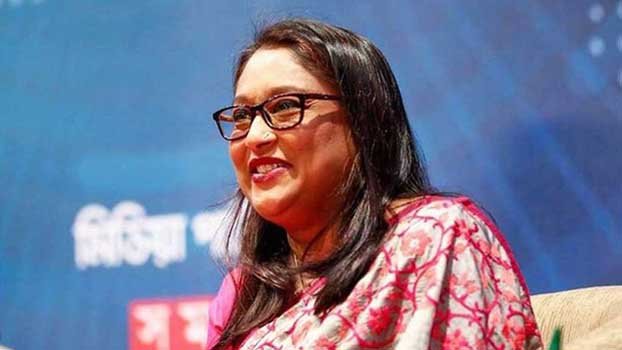
The stories of women facing harassment in ferries, buses, and other public places are the stories of most women in the country and Saima Wazed Hossain, the daughter of Prime Minister Sheikh Hasina, has the same experience to share.
She recounts through a webinar of ‘Women’s Safety in Public Places (WSPP)’.
Referring to the kind of experiences women come across in public places, CRI Trustee and Co-chairman and Climate Vulnerable Forum (CVF) Thematic Ambassador Saima Wazed said, “These are not fairytale stories. These are real and I can relate to my life experiences as well.”
“When I was a college student, I had to travel by train. Once we, three friends, were going somewhere by train and there was a compartment for ladies. In that compartment, we sat on our baggage placed on the floor because we knew that we would be harassed if we got into a general compartment. We would be safe and secure in the ladies’ compartment.”
“Why do we women have to live like this? Why would you feel uncomfortable? Why should we live in apprehension? Why should we get dressed in a certain way and otherwise be blamed? Why is the fear instilled in our minds since our childhood? Why won’t we be able to move with courage?”
“Well. We need to learn self-protection skills. Of course. But, why do we have to stay like that? Why can’t we expect that they will respect us? Why do we have to live with gender identity? Why should we move extra carefully just because we are women? Why can’t we live the life of our choice? If we do a job, we have to be concerned about whether it would require us to stay late in the night.”
Reflecting on the gamut of issues facing women and demanding a change, she said, “We have to work equally like boys. In many cases, our families are depending on us. When we earn the penny for my family, why should we still be treated differently? Why should we be given extra rules? When you see the prime minister is a woman, we have to take that into account. We have to ensure that women must move anywhere with dignity.”
Stressing the need for educating children on gender equality at home, Saima Wazed said: “I want everyone in our country to be taught the way I teach my four children that women and men are no different. We are all equal. Let us pay the deserved respect to women in the home, outside the home, on streets, in schools, and the workplace.”
Launching a campaign titled 'Women's Safety in Public Places (WSPP)’ through a webinar, Saima came up with the observations that came hot on the heels of a streak of incidents of violence against women across the country.
The campaign was launched by Young Bangla – the youth wing of the ruling Awami League’s research wing Centre for Research and Information (CRI) in collaboration with UNDP and the National Human Rights Commission (NHRC).
“If a girl is harassed somewhere and no one comes to protest, what can she do alone? Anyone witnessing that incident must stand beside that girl,” she added.
“Our boys have to be educated on gender equality from home so that that education reflects on their behavior when they grow up and play a role in the family. So, it all starts with the home,” she further said.
With a strict stance against the stereotypes surrounding women in our society, she said, “If my strong voice is discouraged in my home, if I am hushed up, if I am reminded now and then – ‘Stay calm, cool, and don’t protest’ – that is something not supported by the history of Bengali nation. You see that women were at the forefront of the movements launched by Bengalis. When our history inspires us, we must protest before anyone else does. Why should we keep silent?”
“A woman of any age must walk with dignity and safety anywhere in the country. Everyone – not just women – is required to ensure that,” she went on saying.
Referring to a documentary played during the webinar depicting how women fall prey to sexual harassment, she said that any form of violence against women – not just rape – must be properly addressed.
“Sometimes a girl is told that she must do something. Else her professional development will be cut short or she may even lose her job. Unless we address all these issues, the problem will persist,” she further said.
UNDP Country Director Sudipto Mukherjee, State Minister for Women and Children Affairs Fazilatun Nessa Indira, State Minister for Information and Communication Technology (ICT) Zunaid Ahmed Palak, Chief Coordinator for Sustainable Development Goals (SDGs) Zuena Aziz, and Inspector General of Police (IGP) Benazir Ahmed joined a panel discussion as part of the online launching.
Earlier, in March, the Young Bangla and Human Rights Programme of UNDP signed a memorandum of understanding (MoU) to promote the 'Women's Safety in Public Places' campaign.
To this end, the youth organization has already set some stepping stones towards women's safety and empowerment, and the latest campaign is set as one of those.
Young Bangla has, since its inception, been carrying out, along with its partner organizations, a series of activities such as workshops, seminars, and other events to boost awareness about women's empowerment, the youth organisation said, adding that this campaign will springboard that effort.