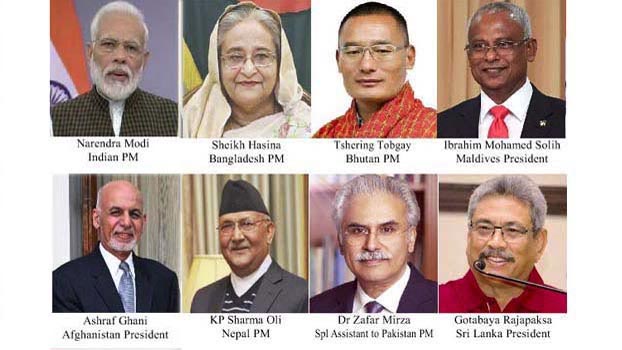
Leaders of South Asian countries in an unprecedented move united on Sunday through a videoconference keeping their differences aside to fight off their novel enemy – coronavirus pandemic – giving the SAARC a new life.
Afghan President Ashraf Ghani, Bangladesh Prime Minister Sheikh Hasina, Nepalese Prime Minister KP Sharma Oli, Bhutanese Prime Minister Lotay Tshering, Sri Lankan President Gotabaya Rajapaksa, and Maldivian President Ibrahim Mohamed Solih joined the conference led by Indian Prime Minister Nadrendra Modi.
He convened the meeting to chalk out a common strategy. Pakistan, however, was represented by its state minister for health Dr Zafar Mirza.
All agreed that they are facing a serious challenge in tackling the coronavirus outbreak since nobody knows what shape the pandemic will take in the coming days.
They agreed to have a common strategy for handling such challenges. They also agreed to find cooperative solutions such as sharing of knowledge, best practices, capacities and possible resources.
The South Asia which is the home of world’s one-fifth population still remained a low prevalent region of the new coronavirus. The eight member states of SAARC so far confirmed less than 150 cases.
But the leaders agreed that they must work together since nothing can be predicted.
“We cannot predict the situation which is why it is most valuable to share each other's perspective,” Modi said in his inaugural speech.
He made a number of proposals and offered India’s support for the SAARC member states.
Hasina also called for a strong collaboration among the eight member states in devising a collective strategy and mobilising resources in combating coronavirus.
About 40 years old SAARC is often criticised for not delivering anything for the people of the region. Only 18 summits have taken place so far. The 19th meet was postponed in November 2016 when India boycotted the summit citing Pakistan’s support for terrorist groups as the reason.
Pakistan’s minister termed the videoconference ‘constructive and insightful’ and said: “I think we can keep up the momentum”.
“We give public health a chance to bring us together,” he said. He, however, raised the contentious political issue of Jammu and Kashmir over which India and Pakistan fought battles.
Modi said it is clear that all have to work together on coronavirus. “We can respond best by coming together, not growing apart, collaboration not confusion, preparation, not panic,” Modi said.
In this spirit of collaboration, he shared ideas of India. That include creation of a COVID-19 Emergency Fund and based on voluntary contributions. India pledged $10 million as a start. The aim is to help any of the nations meet the cost of emergent actions to combat this pandemic. The Foreign Secretaries will finalise concept and operational rules.
He also proposed Indian Rapid Response Teams of doctors, specialists and testing equipment, who are already on standby.
Online training capsules for emergency response staff, for all SAARC countries, using the model India used to raise capacity of emergency staff across India.
A review video conference of doctors and medical professionals, in one week to ten days, to consider specific measures and best practices in SAARC States.
A review video conference of trade officials to consider the impact of travel restrictions on intra-regional trade within SAARC, recognizing the high level of inter-dependence of several of our economies. Help prepare a website with informational material in all SAARC languages, sharing software in India’s own Integrated Health Information Platform for Disease Surveillance, and training to use this MIS system, for all SAARC partners.
Modi also proposed to use of the SAARC Disaster Management Centre, to identify and popularize best practices in fighting Covid-19.
For the future, he proposed creating a Research Platform for all SAARC States to share ideas and proposals for diagnostic and therapeutic interventions for diseases and epidemics. Indian Council of Medical Research will help coordinate this.
“We have to fight the battle together. We have to win it together,” he said, adding that: “Let me assure that we will do our best for our neighbours”.
“Our neighbourhood collaborations should be a model for the world,” he said.
Prime Minister Hasina, however, stressed on forging collaboration among the SAARC countries through collective expertise and resources to fight the coronavirus pandemic.
She also proposed that an institution be established to prevent and fight any public health threat in the South Asian region in future.
“We believe it’s extremely important to establish an institution to prevent and fight against any public health threat in the South Asian region in future…. Bangladesh will be happy to host such institution if you all kindly agree,” she said.
She said all the SAARC countries need to cooperate and collaborate closely to fight this COVID-19 pandemic.
“We need to forge collaboration through our collective capacity, expertise and resources,” she said.
She said Bangladesh is ready to share its capacity and expertise as well as the best practices with the SAARC countries, including logistic support, if required.
“To continue this dialogue at the technical level, our (SAARC) health ministers, health secretaries and relevant health experts can also have this kind of videoconferences to discuss specific areas of cooperation,” she proposed, saying WHO South-East Asia Regional Director may be invited to these videoconferences.
“We need to devise a strong SAARC-wise strategy to fight this public health threat and protect our citizens,” she said, highlighting the steps taken by Bangladesh to prevent the spread of coronavirus.
Sharing his ideas, Nepal PM KP Sharma Oli said that the collective efforts will help devise a sound and robust strategy for SAARC region to fight coronavirus.
“I would like to thank PM Modi ji for taking this important and timely initiative. Our collective wisdom and efforts will help us devise a sound and robust strategy for the SAARC region as we fight COVID19,” he said.
The Sri Lankan President said that the economy of his country has taken serious blow. He also urged the member countries to formulate mechanism to assist his country’s economy.
“Our economy has taken serious blow, particularly tourism sector which was just recovering after last years’ terrorist attack. I strongly recommend SAARC leaders to formulate a mechanism to assist our economies to tide over a difficult period,” Rajapaksa said.
He also thanked PM Modi for taking the initiative to share ideas and to understand the challenges and discuss measures to tackle coronavirus.
Afghan President Ashraf Ghani said that all the member countries should create a common framework for tele-medicine to combat the coronavirus.
“We should create a common framework for tele-medicine to combat coronavirus. The closing of borders will result in a significant problem of availability of food, medicines and basic goods,” he said.
Maldives President Ibrahim Mohamed Solih said that his country is fortunate to have received general assistance from India and he thanked PM Modi and people of India for the help.
He also said that his country is facing the economic problems due to the sharp decline of tourists over coronavirus scare.