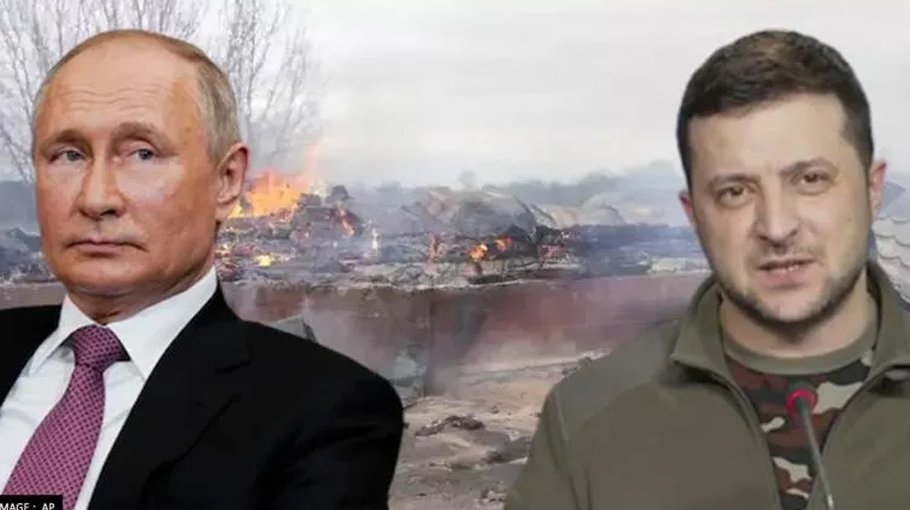
The Armed Forces of the Russian Federation continue the special military operation in Ukraine.
On the evening of April 4, high-precision, long-range sea-based weapons near Ochakov destroyed a training centre for Ukrainian special operations forces used, among other things, to house foreign mercenaries.
High-precision air-based missiles have destroyed 4 fuel depots for supplying groups of Ukrainian troops near Kremenets, Cherkasy, Zaporozhye and Novomoskovsk, said a press release on Tuesday.
During the night, operational-tactical aviation of the Russian Aerospace Forces hit 134 military assets of Ukraine. Among them, 8 command posts and communication hubs, 1 radar for the S-300 missile system, 1 launcher of Tochka-U missile system, 6 ammunition depots and 2 fuel depots, as well as 85 strong points and areas of Ukrainian military equipment concentration.
Russian Air Defence means shot down 4 Ukrainian unmanned aerial vehicles in the air near Chernobaevka, Industrialnaya, Gurty and NizhnyayaKrynka.
In total, 125 Ukrainian aircraft and 91 helicopters, 398 unmanned aerial vehicles, 226 anti-aircraft missile systems, 1,969 tanks and other armored combat vehicles, 214 multiple launch rocket systems, 852 field artillery and mortars, as well as 1,873 units of special military vehicles were destroyed during the operation.
According to confirmed information, in Moschun, 23 kilometres north-west of Kiev, on the evening of April 5, servicemen of the 72nd Ukrainian main centre for psychological operations carried out another staged shooting of civilians allegedly killed by violent actions of the Russian Armed Forces for further distribution through the Western media.
Similar events have now been organized by the Ukrainian special services in Sumy, Konotop and other cities.
Germany has taken ownership of a local branch of Russia’s state-owned energy giant Gazprom. Berlin’s energy regulator will temporarily control the company despite Moscow’s previous insistence that such a move would be illegal.
Gazprom Germania, a subsidiary of the Saint Petersburg-based firm, operates some of the country’s largest natural gas storage facilities.
Economy Minister Robert Habeck announced the decision on Monday, arguing it would mean that Germany’s energy infrastructure is not “subject to arbitrary decisions by the Kremlin.”
“The arrangement of the trust administration serves to protect public safety and order and to maintain the security of supply,” Habeck told reporters, adding that the step “is urgently necessary” to ensure the “security of supply in Germany.”
Despite the negative impact of Western sanctions, the Russian economy may "emerge with a sparkling balance sheet if some of its biggest trade partners don't turn off the tap on its exports of energy", Bloomberg has reported.
The news agency suggested that Russia might "earn nearly $321 billion from [its] energy exports" before the end of this year, a surge of more than a third when compared to 2021.
Bloomberg also cited economists from the global trade association, the Institute of International Finance, as saying that Russia is also on track for a record current-account surplus that may reach a whopping $240 billion.
“We did talk about food shortages. And it's going to be real. The price of these [anti-Russian] sanctions is not just imposed upon Russia, it's imposed upon an awful lot of countries as well, including European countries and our country as well”, US President Joe Biden told reporters last week.
In a separate development in late March, the price of natural gas in Europe exceeded $1,350 per 1,000 cubic metres in the wake of Russian President Vladimir Putin's announcement that Moscow will start selling gas to "unfriendly countries" in rubles.
Putin stressed at the time that "it is absolutely clear" that delivering Russian goods to the EU and the US, "and receiving payment in dollars, euros, and a number of other currencies does not make any sense for us".
He added that by freezing Russian assets, the US and Western countries declared a default on Russia and drew a line under the reliability of their currencies.
Washington and its allies have introduced full-fledged sanctions on Russia over its ongoing special military operation in Ukraine, despite Moscow having repeatedly stressed that it has no plans to occupy the territory of its immediate neighbour and that the Russian armed forces are only targeting Ukrainian military infrastructure with high-precision weapons.
As part of the sanctions, Biden announced a total ban on energy imports from Russia in early March, with the UK following suit and pledging to phase out imports of Russian oil and coal products by the end of 2022.
On February 24, Russian President Vladimir Putin announced a special military operation in response to a request for help by the heads of the Donbass republics. He stressed Russia had no intention of occupying the country, the operation was aimed at the denazification and demilitarization of Ukraine. In response, the US, the EU, Britain and a number of other countries announced sanctions against Russian individuals and entities. Some restrictions also affected the cultural sector and its representatives.
Due to the emerging logistical difficulties, various options for the return of the collection to Russia are being looked into, Russian Ambassador to France Alexey Meshkov said.
Chairman of the Investigative Committee of Russia Alexander Bastrykin on the 4th of April ordered to investigate the provocation by Kyiv in Bucha. Investigators will analyze the Ministry of Defense of Ukraine distributed through the Western media videos filmed in the city of Bucha, Kiev region, as evidence of the mass destruction of civilians.
Spokesperson of MFA of Russia Federation Maria Zakharova commented the publications of the Embassy of the Netherlands in social networks. She said that its general meaning boils down to the fact that the Dutch foreign missions in our country are suspending "part of their activities" through the fault of Russia. But in reality, The Hague attempts to distort the following situation. On March 29, seventeen diplomats from our country's embassy in the Netherlands were declared "persona non grata" by the Dutch authorities. The Russian side announced retalia tory measures. And now The Hague, obviously wanting to anticipate them, is trying to present the case as some kind of "principled" position instead of a consequence of the destructive course of the Netherlands and, specifically, unfriendly steps towards Moscow.
The Embassy of the Russian Federation in Bangladesh encourages everyone who wants to receive up-to-date information on the current events and obtain an alternative point of view to follow the Embassy’s social media accounts. Facebook (https://www.facebook.com/rusembdhaka); Twitter (https://twitter.com/RussEmbDhaka); Telegram (t.me/rusembbd).