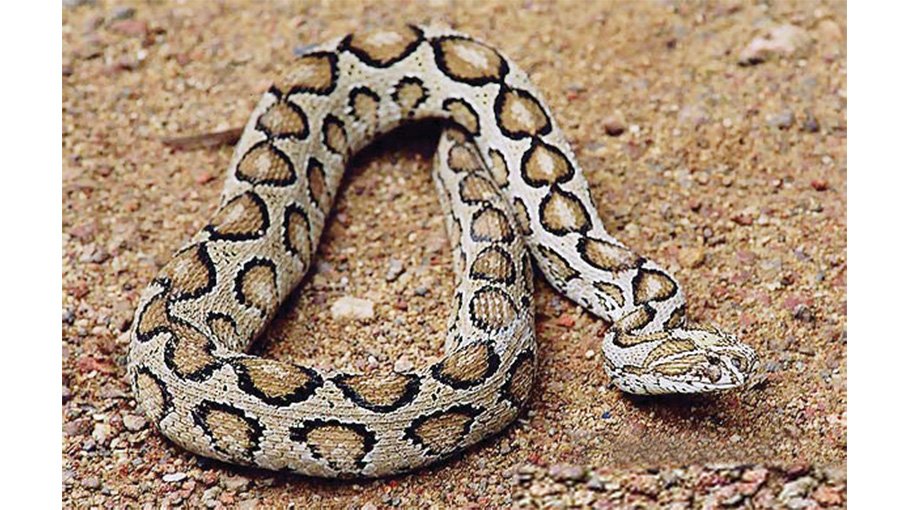
Raising alarm across Bangladesh, the highly venomous snake Russell’s Viper, which is notorious for its lethal bites, has reportedly extended to at least 28 districts.
Rescuers claim that not all of the information about the snake that is circulating in the media is true; some of it is false, and there is a cure.
There have been reports of Russell’s Viper bites, deaths, and casualties in 28 different districts like Naogaon, Chapainawabganj, Rajshahi, Natore, Pabna, Dinajpur, Kushtia, Meherpur, Chuadanga, Jhenaidah, Jashore, Khulna, Satkhira, Rajbari, Faridpur, Madaripur, Shariatpur, Manikganj, Dhaka, Munshiganj, Barisal, Bhola, Patuakhali, Jhalkathi, Chandpur, Laxmipur, Noakhali, and Chattogram.
The snake’s deadly presence has left communities on edge, prompting urgent calls for action and heightened public awareness.
This snake, dubbed the ‘Killing Machine’, has caused severe concern in areas such as Harirampur Upazila in Manikganj. Saiful Islam, a local resident of the area, reported increased sightings of the viper in residential areas, escalating fear among locals.
Over the past three months, five people have succumbed to viper bites, including a one-and-a-half-year-old child in Kalai village.
The viper, once prevalent in Rajshahi and Chapainawabganj, now inhabits regions along the Padma River and coastal districts like Patuakhali.
In the last two weeks alone, several deaths from viper bites have been reported, underscoring the snake’s rapid spread.
Researchers at the Venom Research Centre attribute this proliferation to favourable weather conditions, including increased humidity and heat due to climate change.
The Bangladesh Post was informed by Prof. Dr. Md. Kamrul Hasan, a professor of zoology at Jahangirnagar University and an expert on snakes and reptiles, that the snake in question is primarily based in Rajshahi. There is a reason why spreading is happening now. First of all, their eggs stay inside the body, where they develop into young. Their kids grow up easily as a result. Secondly, over the past ten years, the temperature has risen by 1-2 degrees, with Rajshahi experiencing a greater increase. The population is now skewed towards women; 80% of them are reported to be female. It has increased as a result. He claimed to be a good swimmer, descended from Padma, and to enjoy eating rats. There is undoubtedly a health risk. Furthermore, it is difficult to identify because of the colour of the soil. The media is also a source of rumours. It is necessary to raise awareness. At night, there should be torch lights available.
Anti-venom and treatment
Bangladesh faces a significant challenge in treating Russell’s Viper bites due to the lack of a specific anti-venom. Currently, Polyvalent Antivenom imported from India is used to treat these bites. While this antivenom is effective against various snake venoms, timely administration is crucial. Recovery rates can exceed 90% if treatment is received promptly, but delays often prove fatal.
Public and government responses
The resurgence of Russell’s Viper has sparked widespread panic, fueled by social media and local rumors. In response, the District Awami League President in Faridpur has offered a Tk 50,000 reward for killing the snake, highlighting the level of fear and urgency. The Health Department is actively researching anti-venom solutions, and experts recommend protective farming practices to reduce the risk of bites.
Efforts to combat this menace include the collection of 50 Russell’s Vipers by the Health Department and ongoing research into effective antivenoms. Currently, Bangladesh relies on antivenom produced in India, but there is hope for developing a locally produced solution.
Prof Dr Mohammad Robed Amin currently works as Line Director at the Department of Non-Communicable Disease Control Programme, Directorate General of Health Services, He told to the journalist that the importance of creating an indigenous antivenom to provide timely and effective treatment.
Challenges and recommendations
Addressing the threat posed by Russell’s Viper requires a multifaceted approach. Public awareness campaigns are essential to dispel myths and reduce panic. Accurate information about the snake and proper first-aid measures can save lives. Additionally, reliance on traditional healers (Ojha) should be discouraged in favour of prompt medical treatment. Conservation efforts are also crucial, as Russell’s Viper is critically endangered and an integral part of the ecological balance.
Historical and scientific context
Russell’s Viper, named after Scottish herpetologist Patrick Russell, has a long history in northern and southern Bengal. Once thought to have disappeared, the snake made a surprising comeback in 2009. Known locally as Chandrabora, this viper belongs to the Viparidae family and is equipped with significant venomous fangs capable of delivering deadly bites.
Snake Rescue Team, Bangladesh
Md Raju Ahmed, President of Snake Rescue Team Bangladesh, told the daily Bangladesh Post that 80% of information on snake bites circulating on Facebook is false, with local groups spreading rumours. He emphasised that polyvalent antivenom is available in district headquarters hospitals and should be administered within the first 100 minutes for effectiveness, urging people to seek medical help rather than relying on traditional healers.
Ahmed highlighted that 200 people died from Russell’s viper bites in the past year, found in 25–30 districts. He noted the snake’s presence within 1-2 km around the Padma river and recommended protective farming practices.
He criticised government negligence in anti-venom initiatives, stating that while antivenom is imported from India, there is no state initiative or organisation to address the issue adequately.
Origins and spread
The reappearance of Russell’s Viper in Bangladesh was traced in 2009, following the opening of dams in Farakka, India. This event is believed to have facilitated the snake’s entry into Bangladesh through river basins, particularly affecting areas like Chapainawabganj, Godagari, and the Barendra region. Despite this, experts denied that the snake travels from India to Bangladesh.
Initially, the viper was observed in these regions around 2009-2012, but its habitat has since expanded dramatically expecially in recent times.
Habitat and behaviour
Primarily found in Chandpur, Madaripur, Manikganj, and Dhaka within the Padma Basin, Russell’s Viper is unique among venomous snakes in that it gives birth to live young, producing 40 to 50 offspring per brood. This snake thrives in crop fields, feeding on mice, frogs, and insects, which makes agricultural areas particularly vulnerable.
Human impact and fatalities
The human toll of Russell’s Viper bites is devastating. In the last three months alone, at least five people have succumbed to its venom, including a one-and-a-half-year-old child. Rajshahi Medical College has reported 18 deaths from viper bites in the past year and a half. Nationwide, the snake has claimed 200 lives in the past year, underscoring the urgent need for effective medical response and public education.
Venom characteristics
Experts have noted that Russell’s Viper is notorious for its potent venom, which disrupts blood clotting and causes profuse bleeding, prolonged agony, and often death. The snake can strike with lightning speed, completing an attack and envenomation in just 1/16th of a second. Despite ranking fifth in venom potency globally, it is the most aggressive and fastest-striking venomous snake, making it a particularly dangerous predator.
Environmental factors
Climate change has created favourable conditions for the spread of Russell’s Viper. Excessive humidity, heat, and increasing water and saline areas contribute to the snake’s expanding habitat. These environmental factors, coupled with the snake’s migration through river basins, have facilitated its spread across new regions.
Ecological importance
Despite its deadly reputation, Russell’s Viper plays a vital role in controlling pest populations, such as mice and frogs. Its venom is also valuable in medical research, contributing to the development of treatments for heart attacks, strokes, and blood pressure.