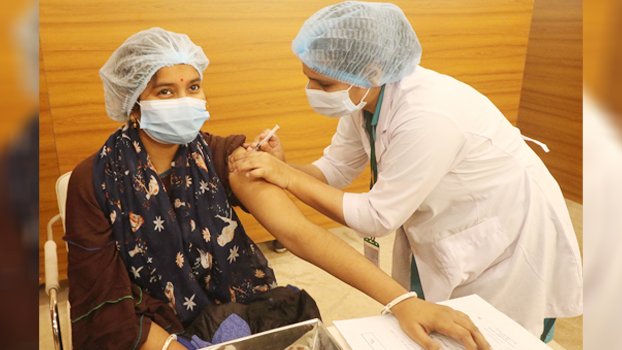
Ignoring all fears and rumors centring the corona vaccine and its so-called side-effects, mass of people are getting more and more interested to get vaccinated gradually.
The fear of the so-called side-effects is not influencing their mind any longer. As a result, the number of people interested to receive the jab is increasing day by day since the day after the launching of the vaccination programme on January 27.
Besides, various government initiatives and programmes are continuing to encourage vaccination. Being inspired with the government’s initiatives, people from all walks of life willing to receive vaccines are getting registered through online and apps.
Since the vaccination programme has been launched, a large number of people, including some of the ministers have received the vaccines.
A vested quarter and a section of fanatics are trying to circulate rumours and are engaged in anti-campaign centring the vaccines. But, there is not a single instance of side effects from the vaccine.
According to government official sources, in order to allay the fears of mass people , some 500 to 600 medical professionals of five hospitals--Kurmitola General Hospital (KGH), Kuwait-Bangladesh Friendship Hospital, Mugda Medical College Hospital, Dhaka Medical College Hospital (DMCH) and Bangabandhu Sheikh Mujib Medical University (BSMMU)--would get the vaccines ahead of launching the countrywide inoculation drive.
Officials familiar with the process also said the vaccine receivers would be kept under medical observation for seven days, a timeline which would be followed by the nationwide vaccination campaign on February 7, the health ministry said.Over10 crore people worldwide have so far been infected by the coronavirus and more than 21 lakh have died from the deadly virus.
In Bangladesh, around 5.5 lakh people were infected by the COVID-19, and more than 8,000 people died.
Earlier on January 27, Prime Minister Sheikh Hasina inaugurated the nationwide COVID-19 vaccination campaign at Kurmitola General Hospital (KGH) in the capital city of Dhaka through a virtual programme from her Gonobhaban official residence.
During the inaugural function, Sheikh Hasina said, “We want protection of all from the coronavirus. I want to say to you all to work with sincerity to make the Covid-19 vaccination programme a success. We want cooperation from all as everything will go well to this end.”
She said the vaccination programme was initiated strictly following World Health Organization (WHO) guidelines and protocols while Bangladesh appeared as one of the forerunner countries to launch the inoculation campaign.
The premier also unveiled the detailed vaccine roll-out plan in parliament saying “in the first phase of vaccine distribution, a total of 1.50 crore people (8.86pc of population) will get two doses of inoculation over a span of two weeks”.
She said Bangladesh would get 6.80 crore vaccines for 20 percent of its population or 3.40 crore people from the WHO, COVAX facility.
Sheikh Hasina said the vaccine recipient priority list was prepared in line with WHO’s Scientific Advisory Group of Experts (SAGE) guidelines taking into consideration the Bangladesh context.
The vaccine will be preserved in 64 district EPI stores and 483 EPI stores across the country.
It is known to all that Bangladesh received its first ever COVID-19 vaccine consignment on January 21 (Thursday) as India sent 20 lakh doses of vaccine developed by the University of Oxford and AstraZeneca as a gift.
The first consignment of COVID-19, 50 lakh Oxford-AstraZeneca vaccines purchased by the government, landed in Dhaka on January 25.
The total vaccine doses stand now at 70 lakh doses while a priority list of recipients was prepared by now with officials saying they included 452,027 government health workers and approved 600,000 private health workers who were directly engaged in the Covid-19 health services.
The other priority groups include 210,000 freedom fighters, 546,620 members of the frontline law enforcement agencies, 360,913 members from the military and civil defense forces, 50,000 officials and employees working in the offices which are indispensable for governing the state.
The others are 50,000 frontline media personnel, 178,298 elected representatives, 150,000 frontline employees of the city corporations and municipalities, 541,000 religious figures, 75,000 people engaged in funeral works, 400,000 staff engaged in emergency water, gas, sewerage, power, fire service and transport services.
Besides, 150,000 land, river and airport workers, 120,000 expatriate unskilled workers, 400,000 district and upazila level government employees engaged in emergency public services, 197,621 bank employees, 625,000 low immunity people suffering from tuberculosis, AIDS and cancer, 11,639,631 elderly people, 21,863 players and 170,000 people from buffer, emergency and outbreak groups were included in the list.