DS Sourav
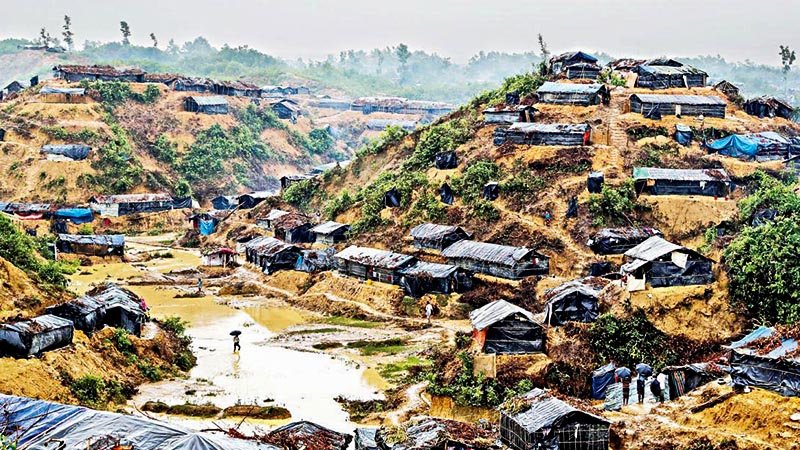
The Rohingyas staying in various Cox’s Bazar refugee camps, since 2017, have significantly damaged hills and forests ranging over 6200 acres of land, with estimated loss of Tk 1,865.56 crore in 2 years. Furthermore, cutting down of hills and trees have led to wide-scale destruction of the ecosystem and bio-diversity of the area, official sources said.
According to the report, the Rohingyas have cut down over tens of thousands of trees, both big and small to set up camps, make furniture and cook food.
They are now staying in 34 refugee camps at Cox’s Bazar Sadar, Kutubdia, Moheshkhali, Pekua, Ramu, Teknaf, Ukhia and Chakaria. In a report the Cox's Bazar Forest Department (South) informed the Wildlife Management and Nature Conservation Division, Chittagong, that as a result of mass deforestation the biodiversity across a large area has already been affected badly.
Of the 6200 acres of destroyed forest area, 2027 acres of land was where the Cox’s Bazar South Forest Department had planted trees while 4136 are natural forests. Bangladesh is now hosting over 1.1 million forcefully displaced Rohingyas in Cox’s Bazar district. Most of them arrived there since August 25, 2017 after a military crackdown by Myanmar termed as “textbook example of ethnic cleansing” by the UN.
It is to be noted that the government has constructed shelters in Bhashanchar with modern facilities, but they are reluctant to go there. Some vested interest groups reportedly are misguiding Rohingyas and sending them to different overseas countries through illegal channels. Moreover, some young Rohingyas are getting involved in crime and drug peddling.
This may be mentioned that various government agencies have built 2 lakh 12 thousand 607 houses, eight thousand 524 tube wells, 52 thousand 165 toilets, 13 thousand 708 bathrooms, 13 km power lines, 30 km roads, 20 temporary warehouses and 20 km canals for the better living of the Rohingyas. The number of such amenities is increasing day by day.
It has been reported by sources that even some government, private and international donor agencies are engaged in cutting hills to build permanent structures for offices and quarters, thereby further threatening local forests and environment. Funded by the World Bank and Asian Development Bank (ADB), 20 three-storied cyclone shelters, 60 deep tube wells with water reservoirs and water circulation lines, 20 fecal sludge management units, 20 septic tanks, six sub-stations, 50-kilometer-culverts and other infrastructure will be built soon.
The report raised concerns that the forests and environment of Ukhia-Teknaf will face severe and unrecoverable damage if these projects are implemented.
The report also says that last monsoon, due to heavy rainfall, the hills have suffered severe erosion. There is also the possibility of landslide in Ukhiya and Teknaf, as well as in other unplanned Rohingya settlements that have cut into hills and forests.
Humayun Kabir, Divisional Forest Officer (DFO) of Cox's Bazar South Forest Department said, a committee has been formed to assess the extent of damage done by the Rohingyas. The report is to measure the extent of damage done to manmade forests, natural forests and biodiversity. Cox's Bazar Refugee Relief and Repatriation Commissioner, Mohammad Abul Kalam said, “The damage to forests cannot be restored. The forest department has taken initiatives and hopefully the loss can be minimised.
Prime Minister Sheikh Hasina mentioned of such loss at the inauguration of World Environment Day on June 20, just before the report got published. The Rohingyas who fled from Myanmar, were given shelter on humanitarian ground, but they have done great damage to the forests. She said that, it is because of the Rohingya population that the natural environment of these areas are becoming very unsafe. So, as soon as they go back to their country, it will be better for Bangladesh.
Initiatives have been taken to plant seven and a half million trees of different species inside Rohingya camps to recover the damage. Saikat Biswas, a representative of the Inter-Sector Co-ordination Group (ISCG), said that the plantation programme will continue throughout the year, with the initiative of ‘Safe Plus’ programme being administered by three international organizations and some other non-governmental organizations.
Three UN agencies are implementing a three-year ‘Safe Plus’ programme to reduce the risk of hilly Rohingya camps; namely—International Organization of Migration (IOM), Food and Agricultural Organization (FAO) and World Food Programme (WFP). In addition to forestry, they are supplying LPG gas to over one million 45,000 Rohingya families as an alternative to fire wood to prevent them from cutting down more trees. The programme has been running since March 2018.
Besides the IOM, FAO and WFP, the UN refugee agency - UNHCR, British American Tobacco Bangladesh (BATB) and various foreign and non-government organizations have joined the forestry programme. Patrick Kerrigan, head of Safe Plus's IOM unit, at a programme in Cox's Bazar said, “So far the programme has been very successful, but there was not enough funding for the three-year project. WFP Emergency Co-ordinator (EC) Peter Guest on the occasion said that the forests were destroyed to make Rohingyas makeshift dwellings. We have taken the initiative to recover the forest loss.”
Madhi Abu Taher, the head of the camp-17 of Ukhia, Madhurchar, said, “When the Rohingyas came here, there were numerous trees, big and small. They cut them down for various reasons. Some have cut down trees to build houses, while some have cut down trees to use as fuel. The area is devoid of trees now for many reasons rooting back to the Rohingyas.”
Rohingya rights organization Arakan Rohingya Society for Peace and Human Rights chairman Muhib Ullah said, “To save the environment, awareness among the Rohingyas has to be raised.” With uncertainty looming large over the Rohingya repatriation, crimes -- from petty theft to drug peddling, abduction to murder -- have become common at the refugee camps in Cox’s Bazar.