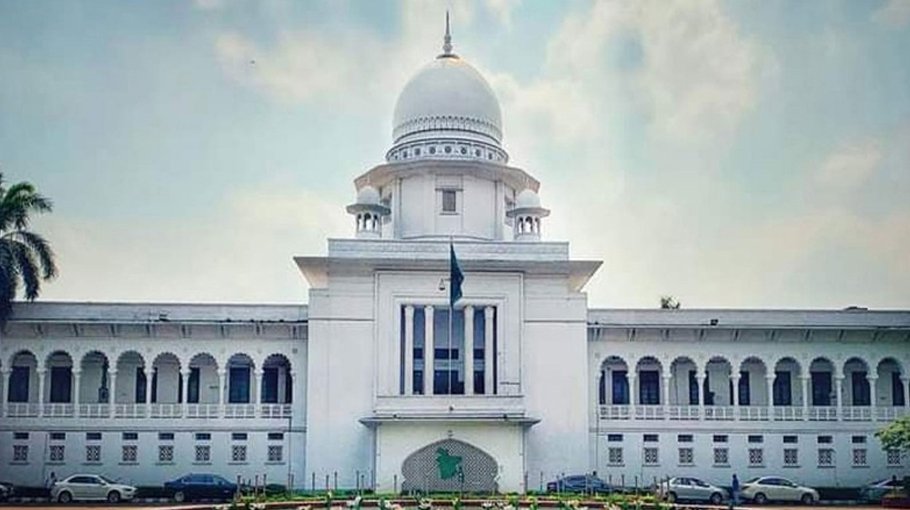
The High Court ordered the Bangladesh Telecommunication Regulatory Commission (BTRC) to remove the distorted re-composition of Kazi Nazrul Islam’s iconic song “Karar Oi Louho Kopat….” from all online platforms, including Facebook and YouTube.
The court also issued a ruling directing the BTRC to remove the song from the online platforms for six months.
After the hearing of a writ petition filed in this regard, the HC bench of Justice JBM Hassan and Justice Razik-Al-Jalil issued the order on Tuesday (January 9).
On December 6, the writ petition was filed to remove the Oscar-winning Indian music director AR Rahman’s rendition of Kazi Nazrul Islam’s famous song “Karar Oi Louho Kopat…” in the Bollywood film ‘Pippa’ from all online platforms.
AR Rahman recomposed the highly popular and historically significant song ‘Karar Oi Louho Kopat…’. He changed the tune of the song. Barrister Mohammad Humayun Kabir, a Supreme Court lawyer, on behalf of the Law and Live Foundation Trust and 10 lawyers of Bangladesh Supreme Court filed the writ petition.
The Supreme Court lawyers are Bayezid Hossain, Naim Sardar, Barrister Solaiman Tushar, Barrister Mahdi Zaman, Barrister Sheikh Moinul Karim, Barrister Ahmed Farzad, Shahidul Islam, Md Shahid Siddiqui, Md Anas Mia, and Md Bahauddin Al Imran.
Barrister Mohammad Humayun Kabir said that the writ petition was filed in the public interest to preserve the original tune of the national poet’s immortal song. “The song is a source of inspiration in our revolutionary struggles and movements. The song spoke out against all forms of injustice and impunity,” he said.
On November 19, a legal notice was sent for the removal of the song. The legal notice was sent to the Ministry of Information and Broadcasting, ICT Division, secretary of the Ministry of Cultural Affairs, Bangladesh Telecommunication Regulatory Commission (BTRC), and the Kabi Nazrul Institute as defendants.
Kazi Nazrul Islam composed ‘Karar Oi Louho Kopat…’ in protest of the arrest of Deshbandhu Chittaranjan Das by the British government.
The song was published in the book ‘Bhangar Gaan’ in 1924. Immediately after its publication, on November 11 in 1924, the British government banned ‘Bhangar Gaan’. Later, after India's independence, ‘Bhangar Gaan’ was republished.
In 1949, music director Kalipada Sen recorded the song for the film ‘Chattagram Astraghar Lunthan’ directed by Nirmal Chowdhury, with Girin Chakraborty and his co-artists. The song was also used in Zahir Raihan’s film ‘Jibon Theke Neya’ in 1969-70.