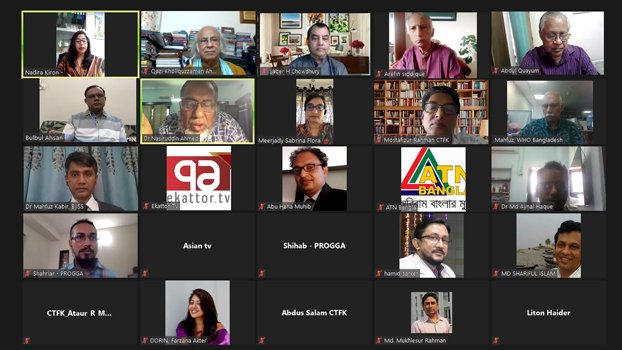
Speakers at a roundtable discussion on Monday recommended specific taxation for further increasing the prices of cigarette and other tobacco products in a bid to get a tobacco free nation.
“This will discourages the youth to start tobacco use as well as encourage the existing users, particularly those financially vulnerable, to quit” they opined. The virtual roundtable titled 'Tobacco Tax and Price Measures for a Tobacco-Free Bangladesh: Reality and the Way Forward' was jointly organized by PROGGA (Knowledge for Progress) and Anti-Tobacco Media Alliance (ATMA),
As PROGGA presented its budget proposals for FY 2021-22' during the event, its estimation says implementation of such proposal would encourage 1.1 million adult smokers to quit, prevent premature deaths of 390,000 existing smokers and 400,000 youths.
The proposals regarding supplementary duty, health development surcharge and VAT on cigarettes would also earn the government an additional BDT 3400 crore in revenues. During the roundtable, Saber Hossain Chowdhury, Chairman of the Parliamentary Committee on Environment, Forestry and Climate Change, said, “Each year before budget, we raise our demands to increase tobacco taxes. Unfortunately, the national budget never reflects our demands. Our constitution has declared that this republic belongs to its people.
The constitution has also bestowed the sacred responsibility of safeguarding public health on the State. So, our Honorable Prime Minister voiced her vision for a tobacco-free Bangladesh considering all such aspects. Those who are putting obstacles in the way need to be identified."
Eminent economist and the convener of the National Anti-Tobacco Platform, Dr. Qazi Kholiquzzaman Ahmad said, “It is quite frustrating for us to find NBR saying increase in tobacco taxes would harm the poor. The reality is quite the contrary. Increase in tobacco taxes benefits the poor the most.”
In addition to supporting the budget proposals, Kholiquzzaman also called for reinstatement of export duty on tobacco. Professor Dr. A A M S Arefin Siddique, Chairman of Bangladesh Sangbad Sangstha (BSS) and former Vice-Chancellor of Dhaka University, said, I hope those involved in formulation of national budget would incorporate at least some of these demands.
Additional Director-General of Directorate General of Health Services (DGHS) Prof. Dr. Meerjady Sebrina Flora opined that reducing the affordability and use of cigarettes through tax increases allows the people, particularly the poor, to spend more on nutrition and other necessities. Dr. Nasir Uddin Ahmed, former Chairman of National Board of Revenue (NBR), said, One of the major impediments in realizing such proposals in the national budget is the government's investment in British American Tobacco Bangladesh (BATB) as well as tobacco industry's influence on NBR.
Journalist Monjurul Ahsan Bulbul said, “Materializing a commitment made by the Honorable PM requires additional effort from those in policymaking level. Unfortunately, we cannot find any such effort in this case. We must be sincere in this regard.”
Abdul Quayum, Associate Editor of the Daily Prothom Alo, said, "Use of bidi and cigarettes causes diseases and thus increases medical expenses which, in turn, makes the poor even poorer. We need more campaigns to raise awareness regarding such devastating consequences."
Dr. Syed Mahfuzul Haque, National Professional Officer, World Health Organization (WHO) said, “We want to raise taxes on tobacco products so that it reduces the affordability of these products among the poor demographic and also discourages the youth to start its use.” The event was hosted by Nadira Kiron, Co-convener, ATMA. The budget proposals were presented by Md. Hasan Shahriar, Project Head, Tobacco Control, PROGGA. Among those present were also Mortuza Haider Liton, Convener, ATMA, ABM Zubair, Executive Director, PROGGA and representatives of anti-tobacco organizations and media outlets.