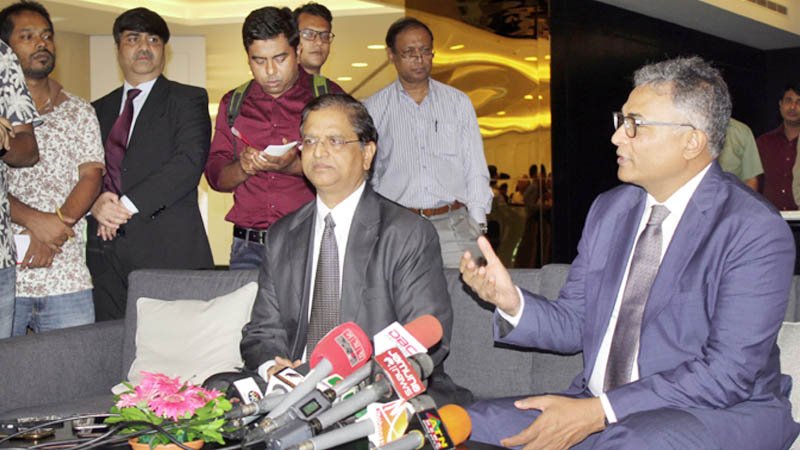
Bangladesh sees potential for exporting electricity to India in future as the level of power generation goes high in winter. This and other pertinent issues, such as, electricity import from India, expanding relationship and cooperation in both transmissions and generations of power sector of the two countries have been discussed in a high level meeting of Bangladesh-India Joint Steering Committee on power. The delegation expressed satisfaction over the progress of the Rampal power plant.
The meeting was held on Monday at Hotel Intercontinental in Dhaka. The Bangladesh delegation was led by the Senior Secretary of Power Division Dr Ahmed Kaykaus while India's delegation was led by Power Secretary Subhash Chandra Garg.
After the meeting, the delegations met with the press, where they vowed to work jointly to develop further the bilateral relations. Dr Ahmed Kaikaus told reporters Bangladesh and India are on the same page as issues have been sorted out. A few sites have been identified to the benefit of both countries.
He said, “Subhash Chandra Garg has a very special place for Bangladesh in his heart. Our friendship with India is growing day by day and one of the remarkable achievements we have done is in the power sector.” He added, ‘‘we are trying to explore mutually beneficial areas in the future, instead of exploring certain projects. We are trying to identify areas in the future through which the people of Bangladesh and India can both be rewarded.”
He also said “We also discussed other issues as well. There is nothing disputable between Bangladesh and India. We have resolved everything.” “Indian government is kind enough to open up windows for everyone and it is upon us, how we can take advantage of that policy,” said Ahmed. Kaikaus also said Bangladesh was not going to buy the proposed 340 MW electricity from Tripura of India, due to the huge capital required to build a sub-station for the purpose. Beside it was not profitable.
He said the proposed import of 340 MW is in addition to the existing supply and Bangladesh finds the proposed 340 MW import technically and financially unviable as the transmission system from Tripura is “weak”. He also said Bangladesh now has available electricity in Cumilla region which is being generated from gas-fired plants at a lower cost. “So, we’ll prefer the proposed 340 MW to be imported for regions like Rangpur, Dinajpur and Thakurgaon where there is power shortage and liquid fuel is used to generate electricity at higher cost,” he continued. The government deems investment into building the sub-station needed to import power as unnecessary, according to people familiar with the matter. The meeting was told that it would cost $300 million to build a Back-to-Back High Voltage Sub-station to bring power from Tripura. As Bangladesh was able to produce surplus power at present, the sub-station building was not found to be cost-effective or necessary. The country would continue to import the 160 megawatts of power it has been importing from the north‑eastern Indian state and no more additional import from Tripura. The meeting was also told that if the need arose, a gas-fired power plant could be set up using the availability of gas in Cumilla. Dr Kaikaus said Bangladesh also wants to export electricity during its off-peak season of winter to Indian market if it finds any suitable buyer as there is no bar on export or import of electricity to or from India as Indian regulatory authority allows such trade.
He also said Bangladesh-India’s joint venture Rampal power project has so far made 42 percent progress and its construction will be completed within a few months to reach the targeted time frame. “However, we have identified some sectors that both the countries will benefit from working together,” he said.
India’s power ministry’s secretary Subhash Chandra Garg said, “Bangladesh is developing in the power sector gradually. India and Bangladesh maintain good relations in the power sector, which will only continue to grow. We are trying to get into the total picture, how both can be beneficial.” Subhash also said, “We have excellent cooperation in transmission of electricity, 1000 MW from one side and 140 MW from the other side of India. The electricity, flowing from India to Bangladesh is a major way to meet the power deficit in Bangladesh.” He also said ‘‘we have discussed how in the future, we should expand our relationship and cooperation in both transmissions and generations.’’ He added “The meeting was great and I think it will be great for both the countries to move forward in this cooperation.” India has long been seeking to transport power to its other parts by transmission lines through Bangladesh. It was decided at the meeting that joint surveys would be undertaken to do detail assessments in this regard. The meeting also decided to conduct surveys to connect Bangladesh with India through Saidpur’s East Saidpur instead of Parbatipur. The two countries plan on setting up a proposed Katihar-Parbatipur-Borannagar 765-kilovolt line and a technical survey would be conducted to assess the feasibility of importing power to other parts of Bangladesh from India, added the sources.
The meeting discussed the progress of ongoing power projects and proposals and decided to do a review on exporting power from Bangladesh to India.Alongside these, the countries discussed the state of the guidelines and regulations on power export followed by India. When the Bangladeshi side raised the matter of tax exemption on power imports from India, the Indian side stated that the matter lay under the jurisdiction of the Indian Revenue Department, which would be duly notified.
“The meeting discussed prospect of exporting electricity to India and also on relieving Bangladesh of import duties in case of any complication arising from political reasons or amendments to laws in India,” said a press release of Bangladesh Power development Board undersigned by its Director (public Relations) Saiful Hasan Chowdhury. Bangladesh currently has generation capacity 18,961 megawatt of electricity against demand for 8,500 to 12,500 megawatts, therefore, there is a scope to export, according to sources at the power ministry.
Bangladesh also urged India to waive duties, such as certificate of deposit and value-added tax, on its power imports at the meeting.The meeting also discussed possibilities of setting up a joint power plant in India, reviewed the proposal of setting up a power transmission line aiming to import electricity from Nepal and Bhutan through India, as well as about joint investment in Bhutan’s hydropower plant.