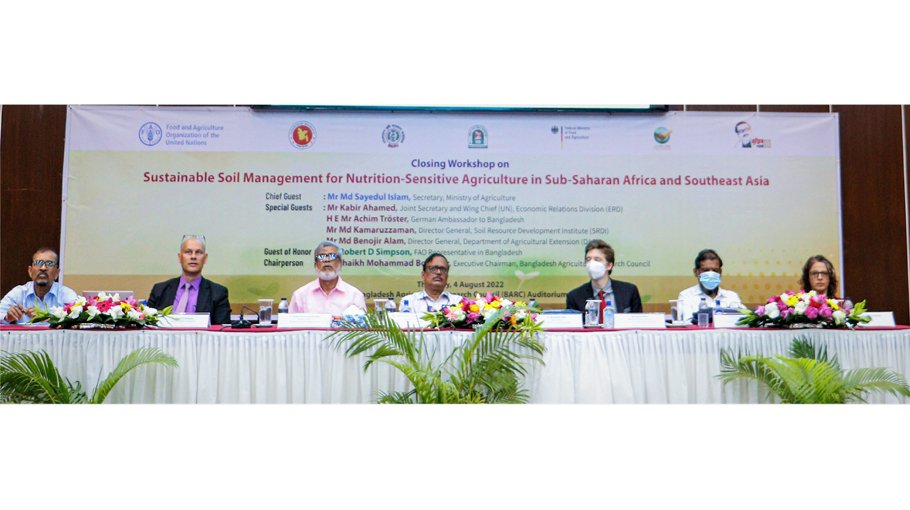
Experts at a workshop on Thursday said global soil degradation is estimated at 33 percent, and policymakers around the world are looking for solutions to implement the Sustainable Development Goals (SDGs) to combat this challenge.”
Food and Agriculture Organization of the United Nations (FAO) organized the workshop on the close of the project “Sustainable Soil Management for Nutrition-sensitive Agriculture in Sub-Saharan Africa and Southeast Asia.”
In order to improve the nutritional value of foods grown locally, the Government of Bangladesh and the Global Soil Partnership (GSP) initiative of the Food and Agriculture Organization of the United Nations (FAO) launched the project in September 2019 with funding from the German Government.
Its goal is to promote and support the use of Sustainable Soil Management (SSM) for nutrition-sensitive agriculture. The Bangladesh Agricultural Research Council (BARC) and the Soil Resource Development Institute (SRDI) of the Ministry of Agriculture implemented the project.
In addition to Bangladesh, FAO has executed the initiative in Malawi and Burkina Faso. The goal of the "Sustainable Soil Management for Nutrition-sensitive Agriculture in Sub-Saharan Africa and Southeast Asia" project was to develop recommendations for SSM policy guidelines based on existing knowledge and a multidisciplinary approach to show the role of soil in human health.
The project activities included field demonstrations in three Upazilas in Bangladesh, as well as a baseline survey of 600 farmers, 45 field demonstrations, awareness development training for 180 stakeholders, and soil doctor training for 450 farmers. The majority of the world's food is derived from soil, which is a critical resource and an important part of the natural ecosystem. Increases in population, increased food demand, and competing land uses are all putting stress on soils. More than half of the people in Bangladesh are malnourished, and 450 000 children have severe acute malnutrition. Consumption of nutrient-deficient staple crops cultivated on nutrient-depleted soils is a potential contributor of nutritional deficits.
Robert D. Simpson, FAO Representative in Bangladesh, said “Global soil degradation is estimated at 33 percent, and policymakers around the world are looking for solutions to implement the Sustainable Development Goals (SDGs) to combat this challenge.”
The closing workshop included Md. Sayedul Islam, Secretary, Ministry of Agriculture as the chief guest.
Florian Höllen, Head of Development Cooperation, Embassy of the Federal Republic of Germany, Md. Kamaruzzaman, Director General, Soil Resource Development Institute (SRDI) and Kabir Ahamed, Joint Secretary and Wing Chief (UN), Economic Relations Division (ERD) were among the special guest of the event.
Robert D. Simpson, FAO Representative in Bangladesh was present as the guest of honor. Carolina Olivera Sanchez from FAO HQ, Italy overviewed the project and Dr. Shaikh Mohammad Bokhtiar, Executive Chairman, BARC was the chair of the event.