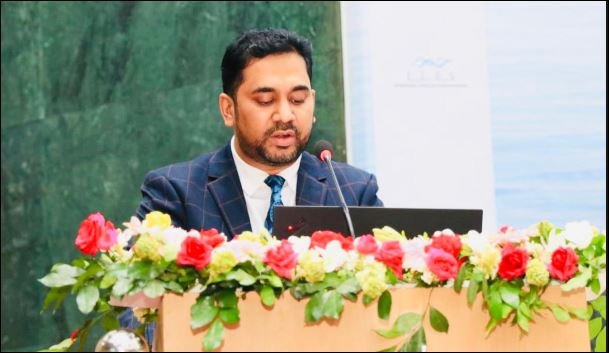
By Rafiqul A. Khan
As Bangladesh stands at the threshold of unlocking its vast marine potential, the role of dedicated marine scientists becomes increasingly crucial in developing the nation's blue economy.
Professor Dr. Md. Jobaer Alam of the Department of Oceanography, University of Dhaka, represents a paradigmatic example of how academic excellence, research innovation, and practical expertise can converge to drive sustainable maritime development.
His comprehensive expertise in mariculture specially seaweed culture and cage culture, and oceanographic sciences positions him as a pivotal figure in Bangladesh's journey toward becoming a middle-income country through strategic utilization of its marine resources.
Professor Alam's academic journey reflects a profound commitment to marine science education and research. His educational foundation began with a Bachelor's degree in Fisheries from the University of Dhaka in 2003, followed by a Master's degree in the same field in 2005. This solid foundation in fisheries science provided him with fundamental knowledge of aquatic ecosystems and marine resource management. His international exposure came through a Post Graduate Diploma in Aquaculture Technology from Vancouver Island University, Canada, in 2008, where he gained cutting-edge knowledge in modern aquaculture techniques and sustainable marine farming practices.
Demonstrating his versatility and commitment to continuous learning, Professor Alam pursued an MBA from Keller Graduate School of Management in the United States in 2011, equipping himself with essential business acumen crucial for translating scientific research into economically viable ventures. His academic journey culminated with a Ph.D. in Environmental Science from the University of Dhaka in 2023, solidifying his expertise in environmental sustainability and marine ecosystem dynamics.
This diverse academic background uniquely positions Professor Alam to bridge the gap between scientific research and commercial application, a critical requirement for developing Bangladesh's blue economy. His international education, particularly his Canadian experience in aquaculture technology, has exposed him to advanced mariculture techniques and sustainable practices that can be adapted to Bangladesh's coastal conditions.
Professor Alam's career trajectory at the University of Dhaka demonstrates exceptional leadership and academic progression. Beginning as a Teaching Assistant at North South University in 2006, he joined the University of Dhaka as a Lecturer in the Department of Fisheries in 2009. His transition to the Department of Oceanography in 2012 marked the beginning of his specialization in marine sciences. Rising through the academic ranks, he served as Assistant Professor from 2013 to 2018, then as Chairman and Associate Professor of the Department of Oceanography from 2018 to 2022, later he promoted as a Professor in 2024.
As Chairman of the Department of Oceanography for two consecutive terms, Professor Alam has been instrumental in shaping the next generation of marine scientists in Bangladesh. His leadership has been characterized by a focus on practical research applications and industry-relevant education. Under his guidance, the department has enhanced its research capabilities and strengthened its connections with national and international marine research institutions.
Professor Alam's research portfolio spans the entire spectrum of oceanographic sciences, including biological, geological, and physical oceanography. His research interests encompass blue economy development, phytoplankton and zooplankton diversity, marine fish biology, and crustacean studies. This comprehensive approach to marine science research has resulted in over 20 peer-reviewed publications in national and international journals, covering topics from marine biodiversity to sustainable aquaculture practices.
His supervisory role has been particularly impactful, having guided more than 20 Master's degree students in their thesis research. These research projects cover diverse areas crucial to Bangladesh's blue economy development, including seaweed cultivation feasibility studies, cage culture assessment, marine plankton diversity analysis, and coastal water quality monitoring. Notable among these supervised research projects are studies on the commercial potential of seaweed culture at Saint Martin's Island, feasibility assessments of cage culture systems, and comprehensive analyses of marine biodiversity in Bangladesh's coastal waters.
The breadth of research topics under his supervision demonstrates his commitment to addressing real-world challenges facing Bangladesh's marine sector. Projects examining fishers' livelihoods, sustainable tourism development, and marine resource marketing have direct implications for blue economy development policies and practices.
Professor Alam's expertise in seaweed culture represents one of his most significant contributions to Bangladesh's blue economy potential. His research on commercially important seaweed species, particularly his work on Padina gymnospora cultivation in the coastal waters of Saint Martin's Island, has laid the groundwork for developing Bangladesh's seaweed industry. This research, published in the Journal of Biodiversity Conservation and Bioresource Management in 2024, provides crucial insights into the seasonal and locational variations in physicochemical properties that affect seaweed cultivation success.
His comprehensive study titled "Exploration of the Possibility of Commercially important Seaweed Culture in the adjacent Seawater of the Saint Martin's Island, Bangladesh," funded by the Ministry of Science and Technology, represents pioneering work in establishing the scientific foundation for seaweed aquaculture in Bangladesh. This research has identified optimal conditions for seaweed cultivation and assessed the commercial viability of different seaweed species in Bangladeshi coastal waters.
In the realm of cage culture, Professor Alam has conducted extensive feasibility studies examining the potential for implementing cage culture systems to improve local livelihoods, particularly at Saint Martin's Island. His research has demonstrated the technical feasibility and economic potential of cage culture operations, while also addressing environmental sustainability concerns and community engagement requirements.
Research Impact on Blue Economy Development
Professor Alam's research directly addresses several key pillars of Bangladesh's blue economy strategy. His work on marine spatial planning, evidenced by his GIS-based zoning plan for Saint Martin Island using spatial and multi-criteria evaluation techniques, provides crucial tools for sustainable marine resource management. This research, funded by the Ministry of Science and Technology, offers practical solutions for balancing conservation needs with economic development opportunities.
His studies on nutrient dynamics and water quality in coastal areas, particularly around Saint Martin's Island, provide essential baseline data for sustainable aquaculture development. The 2023 publication in Heliyon on "Nutrient and heavy metal dynamics in the coastal waters of St. Martin's island in the Bay of Bengal" offers critical insights into water quality parameters that determine the success of marine aquaculture operations.
Furthermore, his research on chlorophyll-a variability and its relationship with changing physical conditions in the northeastern Bay of Bengal contributes to understanding marine productivity patterns, essential for fisheries management and aquaculture site selection.
Professor Alam's professional recognition extends beyond academic circles, reflecting his significant contributions to marine science and blue economy development. His membership in the Oceanographic Society of Bangladesh as an Executive Member since 2021 positions him at the forefront of the country's oceanographic research community. Similarly, his role as an Executive Member of the International Centre for Ocean Governance since 2018 connects him with global ocean governance initiatives and best practices.
These professional networks and recognitions enhance Professor Alam's ability to access international expertise, funding opportunities, and collaborative research partnerships that can accelerate Bangladesh's blue economy development efforts.
Professor Alam's expertise positions him uniquely to contribute to several critical areas of Bangladesh's blue economy development. His research foundation in seaweed culture can be expanded to establish pilot commercial seaweed farming operations, potentially creating new livelihood opportunities for coastal communities while contributing to export earnings. The development of integrated multi-trophic aquaculture systems, combining fish cage culture with seaweed cultivation, represents a particularly promising avenue for sustainable marine farming.
His comprehensive understanding of marine spatial planning can inform national policies for marine protected area designation, sustainable fishing zone demarcation, and aquaculture site selection. The integration of his research findings into national blue economy planning processes could significantly enhance the effectiveness of maritime resource utilization strategies.
Furthermore, his established network of trained graduate students represents a valuable human resource pool for implementing blue economy initiatives across Bangladesh. These research-trained professionals can serve as technical experts in government agencies, private sector marine enterprises, and non-governmental organizations focused on sustainable marine development.
Professor Md. Jobaer Alam embodies the intersection of academic excellence, practical expertise, and visionary leadership essential for developing Bangladesh's blue economy. His comprehensive research portfolio, extensive experience in marine science education, and proven track record in translating scientific knowledge into practical applications make him an invaluable asset for the nation's maritime development aspirations. As Bangladesh seeks to harness its vast marine potential sustainably, leaders like Professor Alam will play crucial roles in ensuring that scientific rigor guides policy decisions and that research innovations drive economic growth while preserving marine ecosystems for future generations.
The integration of his expertise in seaweed culture, mariculture, and comprehensive oceanographic sciences into national development planning represents an opportunity for Bangladesh to accelerate its blue economy transformation. His continued leadership in marine science education and research will undoubtedly contribute to building the human resource capacity essential for sustaining long-term blue economy success.