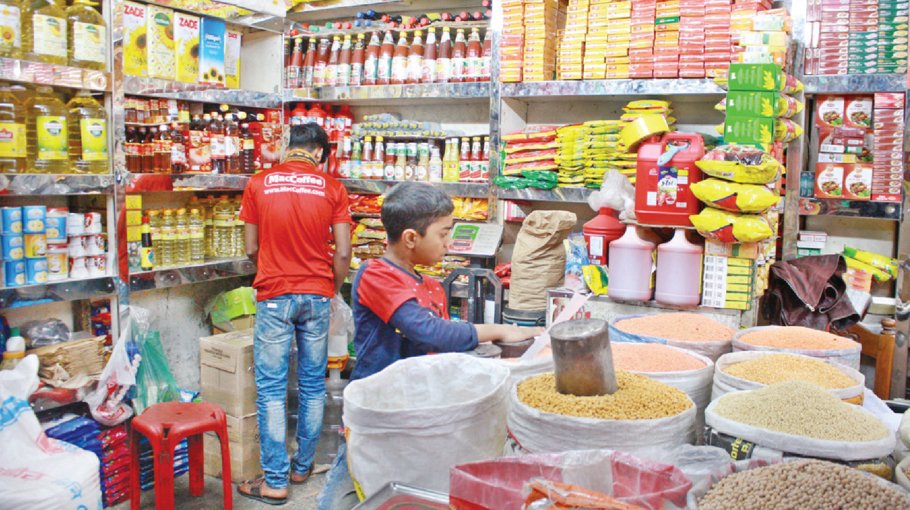
Prices of daily essential commodities, including rice, have not come under control despite various initiatives taken by different ministries and agencies of the government.
Repeated drives against syndicates and unscrupulous traders have not been able to enforce fair prices in the markets.
It has become a ‘perpetual culture’ to increase the price of some daily commodity every week, manipulated by unscrupulous syndicates.
In such a situation, there is extreme dissatisfaction among consumers with the abnormal prices of daily commodities.
For this, they blame the irresponsibility of the concerned ministries of the government and the lack of regular market monitoring. From broiler chicken to all types of vegetables, ginger-garlic, fish-meat, sugar and edible oil, prices are increasing, and the consumer is being held hostage.
Targeting the upcoming Ramadan, the prices of six products have started increasing since last December.
Market analysts said soaring food inflation rates in the country have been attributed to poor market management and the profit-seeking behaviours of certain businessmen in syndicates.
According to them, even though this situation has been going on for years, several organisations of the government are not able to play an effective role. They have limited their activities only to speech. And using this opportunity, the identified syndicate members are cutting the pockets of the consumers several times a year.
Several market surveillance agencies of the government are working to protect the consumer from these situations. Among them, the supervision cell of the Ministry of Commerce, Directorate of National Consumer Rights Protection under the Ministry of Commerce, Department of Agricultural Marketing under the Ministry of Agriculture, BSTI, Bangladesh Food Safety Authority under the Ministry of Food, City Corporation, District Administration, RAB and other law and order forces of the government are working.
Consumers said that even though the relevant ministries have held a meeting and said to take strict measures, there is no reflection in the market. Apart from this, no positive results are coming despite the strict warnings of several ministers.
Meanwhile, the Awami League formed the government for the fourth consecutive term after winning the national elections held in January. This year’s election manifesto from the party has also emphasised on the control of commodity prices.
After the formation of the government, Awami League President and Prime Minister Sheikh Hasina directed all relevant ministries to control the market of daily commodities.
Awami League (AL) General Secretary Obaidul Quader on Friday said the government is worried about the price hike of essential commodities.
“There is volatility in commodity prices worldwide. We are also concerned about the price hike of commodities. We have been working to check the price hike of goods,” he said at a press conference at AL President's Dhanmondi political office in the capital.
Besides, several ministries including the Ministry of Commerce, Ministry of Agriculture, Ministry of Food and Ministry of Finance are working together to control product prices.
Several concerned ministers are also warned to take strict measures against dishonest people in the market to reduce the price of products. But there is no effect on the market.
Visits to multiple retail markets in the capital revealed that sugar was sold at Tk 135 per kg in November last year, but sugar was sold at the price of Tk 145-150 in January this year. Besides, good quality lentils were sold for Tk 130 per kg in November. And in January 140 Tk.
Chickpeas were sold at Tk 85 per kg in November and now sold at Tk 100-115 per kg. Among edible oils, open soybean oil was sold at Tk 150 per litre in November, and the price rose to Tk 160 per litre in January. Bottled soybean oil was sold at Tk 168 per litre in November and Tk 172-173 per litre in January. Palm Super was sold at Tk 135 per litre in November, and at Tk 142 per litre in January.
Onion was sold at Tk 130 per kg in November, but it was sold at Tk 135 in December. However, due to the arrival of local varieties in the market, the price has decreased slightly till Sunday and was sold at Tk 90-100, but on Wednesday it was sold at a maximum of Tk 120.
Consumers Association of Bangladesh (CAB) President Gulam Rahman said that the market regulation should not only be verbalized. Effective steps should be taken for this.
He said people are suffering a lot due to the increase in the prices of daily commodities. Therefore, the market management should be pushed to make the product prices bearable.
Beef was sold at Tk 750 per kg in the capital’s retail market on Wednesday. It was sold for Tk 600-650 two weeks ago. Besides, broiler chicken is being sold at Tk 190-200 per kg. Layer chicken is being sold at Tk 280 per kg. Sonali chicken is being sold at Tk 320 with an increase of Tk 20 per kg during the week.
Dr Nasrin Sultana, Assistant Director of the Department of Agricultural Marketing, told Bangladesh Post “The rational price of the product is fixed by the department. A raid is being conducted in the market with a team including a magistrate to see if the products are being sold at that price.”
“Also, if there is any kind of chaos in the product marketing system, it is being prevented. In case of irregularities, action is being taken under the Agricultural Marketing Act” she added.
Recently, State Minister for Commerce Ahsanul Islam Titu said that the prices of all daily commodities will be brought under control before the upcoming month of Ramadan. Sufficient food stock is available for the occasion of Ramadan. India had stopped exporting for a long time. Already talked to the Commerce Minister of India. India will export sugar and onion to Bangladesh before Ramadan.
Earlier the duty was high but now it will be reduced. Apart from this, various daily products including sugar will be imported from Brazil and other countries. Food products will be distributed throughout the country during fasting through TCB, said the minister.
Md Abdul Jabbar Mondol, Assistant Director of the Directorate of National Consumer Rights Protection (DNCRP), said that the Directorate is conducting surveillance operations in the market as per its capacity. The director general of the department is holding regular meetings with the traders. Giving guidance to traders. Strict action is being taken immediately if any irregularity is found.